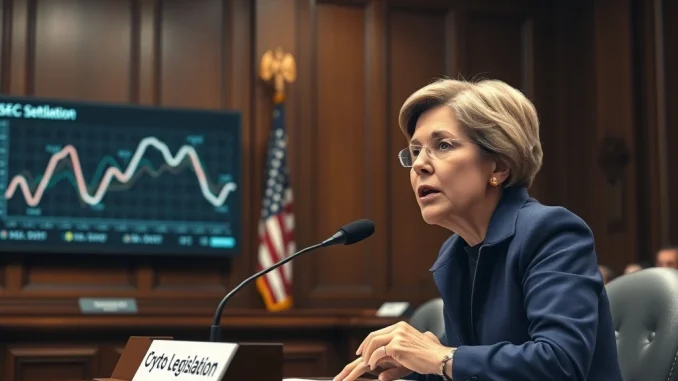
WASHINGTON, D.C. — March 21, 2026. Massachusetts Senator Elizabeth Warren issued a forceful demand today for explicit anti-corruption provisions in all cryptocurrency legislation moving through Congress. Her statement came hours after the U.S. Securities and Exchange Commission finalized a controversial $10 million settlement with Tron founder Justin Sun. Warren directly connected Sun’s $90 million in political crypto investments to what she called “the President’s crypto corruption,” injecting high-voltage politics into ongoing debates over the landmark digital asset market structure bill. This development threatens to derail bipartisan negotiations that have progressed for months, placing new scrutiny on the relationship between regulatory enforcement and political financing in the digital age.
Warren Condemns SEC Settlement as “Free Pass” for Crypto Corruption
Senator Warren, the ranking Democrat on the Senate Banking Committee, released a blistering statement on Thursday morning. She accused the SEC of effectively giving billionaire Justin Sun a “free pass” after his companies agreed to pay $10 million to settle charges unrelated to his political activities. “Justin Sun poured $90 million into Trump’s crypto ventures, and today the SEC agreed to drop its case against him,” Warren stated. Her office provided documentation showing Sun’s investments through token purchases in World Liberty Financial, a platform linked to the Trump family. The SEC’s settlement resolved allegations of market manipulation and unregistered securities offerings against Sun and his companies, including the Tron Foundation and BitTorrent Foundation. Crucially, the settlement did not require Sun to admit or deny the SEC’s findings, a point Warren emphasized as evidence of preferential treatment.
The timing of Warren’s intervention is particularly significant. The Senate Banking Committee, which she helps lead, is currently considering the digital asset market structure bill that passed the House as the CLARITY Act. This legislation represents the most comprehensive attempt to date to establish clear regulatory frameworks for cryptocurrencies, covering everything from token classification to exchange operations. Warren did not name the specific bill in her statement, but congressional aides confirmed her remarks were directed at this pending legislation. The bill advanced from the Senate Agriculture Committee in January after extensive negotiations between crypto industry representatives, traditional finance stakeholders, and multiple federal agencies.
Three Immediate Impacts on Pending Crypto Legislation
Warren’s corruption allegations create immediate complications for the market structure bill’s path forward. First, they introduce a highly partisan element into what had been largely technical, bipartisan discussions. Second, they force lawmakers to consider adding entirely new ethical and transparency requirements that weren’t in previous drafts. Third, they potentially delay the bill’s markup indefinitely as committees reassess its provisions against these new concerns. The Senate Banking Committee already postponed a markup in January after Coinbase CEO Brian Armstrong expressed reservations about the legislation “as written.” As of Friday, the committee had not rescheduled this critical procedural step.
- Partisan Polarization: The direct reference to presidential corruption transforms the debate from technical regulation to political accountability, making compromise more difficult.
- New Regulatory Hurdles: Any anti-corruption provisions would need to define prohibited behaviors, establish disclosure requirements, and create enforcement mechanisms—adding complexity to an already dense bill.
- Timeline Disruption: With elections approaching, legislative windows are closing fast. Delays now could push final passage into 2027 or later.
Expert Analysis: Legal and Regulatory Implications
Dr. Sarah Chen, a former SEC enforcement attorney now at Georgetown University Law Center, provided context about settlement practices. “The SEC frequently uses neither-admit-nor-deny settlements to resolve cases efficiently,” Chen explained. “However, when those settlements involve figures who are also major political donors, it inevitably raises questions about regulatory independence.” Chen noted that the SEC’s settlement with Sun addressed specific securities law violations, not his investment activities. Meanwhile, Professor David Lin of Stanford’s Blockchain Research Lab highlighted the legislative challenge. “Inserting anti-corruption measures into market structure legislation is conceptually sound but technically difficult,” Lin stated. “You’re trying to prevent financial crimes within a bill designed to categorize assets and define trading venues. The mechanisms are different.” Both experts agreed that Warren’s intervention would slow the legislative process, potentially for months.
Broader Context: Crypto, Politics, and Regulatory Capture
This controversy emerges against a backdrop of increasing entanglement between cryptocurrency wealth and political financing. Federal Election Commission records show cryptocurrency industry political donations have increased approximately 400% since 2022, with significant amounts flowing through opaque mechanisms like token-based contributions. The White House has hosted three meetings between administration officials and crypto industry representatives in recent months, though the substance of those discussions remains confidential. Meanwhile, banking organizations have raised concerns that certain provisions in the market structure bill—particularly those involving stablecoin rewards—could incentivize risky behaviors. The American Bankers Association warned in a January memo that such provisions “could undermine credit stability and lead to deposit flight risk.”
| Key Legislation | Current Status | Primary Controversy |
|---|---|---|
| Digital Asset Market Structure Bill (CLARITY Act) | Pending in Senate Banking Committee | Token classification, exchange regulations, now anti-corruption measures |
| Stablecoin Transparency Act | Incorporated into larger bill | Reserve requirements and reward mechanisms |
| Blockchain Innovation Act | Passed House, awaiting Senate | Research funding and regulatory sandboxes |
What Happens Next: Legislative Pathways and Political Calculus
The Senate Banking Committee faces immediate procedural decisions. Chairman Sherrod Brown must determine whether to proceed with markup on the existing bill, delay further to incorporate anti-corruption provisions, or split the legislation into separate components. Committee staff are reportedly reviewing existing anti-corruption statutes to identify potential models, including the Foreign Corrupt Practices Act and the Bank Secrecy Act. Simultaneously, the White House is evaluating whether to issue a formal statement on the matter, balancing its stated goal of “responsible innovation” with growing political pressures. The administration’s position could prove decisive, as presidential support or opposition often determines a bill’s fate in closely divided Congress.
Industry and Political Reactions
Reactions from the cryptocurrency industry have been mixed but measured. The Blockchain Association issued a statement supporting “strong ethical standards” while cautioning against “overly broad provisions that could stifle legitimate innovation.” Notably, some pro-crypto lawmakers have acknowledged the legitimacy of Warren’s concerns while disagreeing with her solutions. Representative Patrick McHenry, a key architect of the House version, stated that “addressing bad actors is important, but we shouldn’t punish an entire industry for the actions of a few.” On social media, both Donald Trump and his son Eric criticized traditional banks this week for their positions on the market structure bill, though neither addressed Warren’s specific corruption allegations. This political cross-pressure—between progressive demands for accountability and conservative advocacy for innovation—creates the complex landscape the legislation must now navigate.
Conclusion
Senator Elizabeth Warren’s demand for anti-corruption provisions in cryptocurrency legislation represents a significant escalation in Washington’s crypto wars. By directly linking the SEC’s settlement with Justin Sun to broader concerns about political influence, she has transformed a technical regulatory debate into a high-stakes political confrontation. The immediate effect will be further delay for the already complex market structure bill, as lawmakers grapple with how to prevent financial crimes within legislation primarily designed to categorize assets and define trading venues. Ultimately, this development underscores the growing tension between cryptocurrency’s disruptive potential and traditional political accountability mechanisms. As the 2026 legislative calendar advances, all stakeholders will be watching whether Congress can craft rules that both foster innovation and prevent corruption—or whether these competing imperatives will derail comprehensive regulation entirely.
Frequently Asked Questions
Q1: What specifically is Senator Warren proposing for crypto legislation?
Warren is demanding that any cryptocurrency legislation moving through Congress include explicit anti-corruption provisions. While she hasn’t released specific language, such provisions would likely require transparency for political contributions made via cryptocurrency, restrictions on donations from entities under regulatory investigation, and possibly enhanced disclosure requirements for crypto investments by public officials and their families.
Q2: How does the SEC’s $10 million settlement with Justin Sun relate to crypto legislation?
Warren contends that the settlement—which resolved SEC charges against Sun without requiring him to admit wrongdoing—creates the appearance of preferential treatment for a major political donor. She argues this demonstrates why legislation needs built-in anti-corruption safeguards, rather than relying solely on after-the-fact enforcement actions that can be settled quietly.
Q3: What is the current status of the main crypto bill in Congress?
The digital asset market structure bill (formerly the CLARITY Act) passed the House of Representatives and advanced from the Senate Agriculture Committee in January 2026. It is now pending before the Senate Banking Committee, where Senator Warren serves as ranking Democrat. The committee indefinitely postponed a markup in January and has not yet rescheduled it.
Q4: Could adding anti-corruption provisions actually delay or kill the crypto bill?
Yes, potentially. Adding complex new requirements would require additional committee review, possible hearings, and revised text. With limited legislative days remaining before elections, significant delays could push final passage into 2027 or beyond. There’s also risk that added provisions could alienate either progressive or conservative support needed for passage.
Q5: How are cryptocurrency industry groups responding to these developments?
Major industry organizations like the Blockchain Association have expressed general support for ethical standards while cautioning against overly broad measures. They emphasize the need for clear rules that don’t inadvertently restrict legitimate activities or place US companies at a competitive disadvantage globally.
Q6: What should ordinary cryptocurrency investors watch for next?
Investors should monitor announcements from the Senate Banking Committee regarding markup scheduling, any draft language of proposed anti-corruption provisions, and statements from key committee members. The White House’s position will also be crucial, as presidential support or opposition often determines whether major legislation advances in an election year.