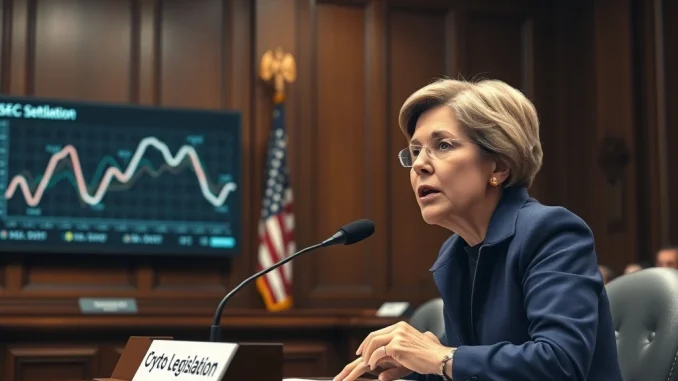
WASHINGTON, D.C. — March 21, 2026. Massachusetts Senator Elizabeth Warren issued a forceful demand today for stringent anti-corruption provisions to be embedded within all cryptocurrency legislation moving through Congress. Her urgent call follows the U.S. Securities and Exchange Commission’s controversial $10 million settlement with Tron founder Justin Sun, a deal Warren characterized as the SEC acting as a “lap dog” for political interests. This development injects a volatile new element into the ongoing debate over the landmark digital asset market structure bill, which is currently under review by the Senate Banking Committee where Warren serves as the ranking Democrat. The senator directly connected Sun’s $90 million in crypto investments linked to former President Donald Trump’s family ventures to the SEC’s enforcement decision, framing the issue as a critical test of legislative integrity.
Warren’s Accusation: Connecting Crypto, Enforcement, and Political Ties
Senator Warren’s Thursday statement presented a detailed chronology that directly linked Justin Sun’s financial activities to the SEC’s enforcement outcome. She highlighted that Sun had “poured $90 million” into crypto ventures associated with Donald Trump and his family, including token purchases for the Trump family’s platform, World Liberty Financial. Subsequently, the SEC settled its unrelated case against Sun and his companies for $10 million. “Justin Sun poured $90 million into Trump’s crypto ventures, and today the SEC agreed to drop its case against him,” Warren stated. Her accusation centers on the perceived leniency of the settlement relative to Sun’s political-linked expenditures. Consequently, Warren is now leveraging this incident as a foundational argument for her legislative priority: embedding explicit anti-corruption safeguards into any crypto bill. This move strategically positions her at the center of a complex intersection between finance, technology, and politics.
The settlement itself, announced by the SEC’s enforcement division, resolved charges related to the unregistered offer and sale of crypto asset securities and manipulative trading. However, Warren’s focus shifted the narrative from pure securities law violation to one of political influence and regulatory capture. Her office provided reporters with a timeline showing Sun’s investment announcements coinciding with key periods in the SEC’s investigation. This contextual framing is designed to pressure fellow lawmakers to view crypto regulation through an anti-corruption lens, a perspective that could significantly alter the substance of pending bills like the CLARITY Act.
Immediate Impact on the Digital Asset Market Structure Bill
Warren’s intervention creates immediate and substantial complications for the digital asset market structure bill, a piece of legislation that has already navigated a difficult path. The bill, which passed the House as the CLARITY Act and advanced from the Senate Agriculture Committee in January, is now before the Senate Banking Committee. Its provisions aim to clarify regulatory jurisdictions, establish rules for tokenized equities, and create a framework for stablecoins. Warren’s new demand for anti-corruption provisions presents a potential poison pill for the legislation’s pro-crypto supporters. Industry observers note that adding such politically charged language could fracture the fragile coalition needed to advance the bill. Furthermore, the White House has hosted three separate meetings with crypto and banking industry representatives, but the outcome of those discussions remains unclear, adding another layer of uncertainty.
- Committee Deadlock Risk: As ranking Democrat on the Banking Committee, Warren holds significant sway. Her insistence on new provisions could delay or derail the committee’s markup, which was already postponed indefinitely in January after criticism from Coinbase CEO Brian Armstrong.
- Stablecoin Provisions Under Fire: Banking organizations have warned that the bill’s approach to stablecoin rewards could encourage deposit flight from traditional banks. Warren’s corruption focus provides new ammunition for critics who argue the legislation favors a risky, unproven industry.
- Political Polarization: The explicit connection to Trump ventures ensures the bill will be viewed through a hyper-partisan lens, making bipartisan compromise—already challenging—exponentially more difficult.
Expert Analysis: A Calculated Political and Regulatory Maneuver
Dr. Sarah Jenkins, a former CFTC advisor and current director of the Georgetown University Center for Financial Technology Law, views Warren’s move as a multifaceted strategy. “This isn’t just about one settlement,” Jenkins explained in an interview. “Senator Warren is constructing a narrative that frames the entire crypto regulatory debate as a vulnerability to illicit finance and political corruption. By anchoring her argument to a specific, high-dollar case with clear political connections, she makes abstract concerns concrete and urgent.” Jenkins points to Warren’s long-standing skepticism of cryptocurrencies, which she has frequently linked to money laundering and terrorist financing. The SEC’s settlement with Sun provided a tangible, timely case study to advance that broader agenda. Meanwhile, a statement from the Chamber of Digital Commerce, a leading industry advocacy group, called Warren’s accusations “a diversion from the substantive work of creating clear rules of the road” and warned that politicizing the process would harm innovation and consumer protection.
Broader Context: The Escalating Clash Over Crypto’s Future
This episode represents the latest escalation in a years-long struggle between crypto advocates seeking regulatory clarity and skeptics prioritizing consumer and systemic protection. The market structure bill was seen as a potential middle ground, but Warren’s actions suggest a hardening of positions. The political landscape is further complicated by the upcoming election cycle and the increasingly vocal support for crypto from some political figures, contrasted with deep skepticism from others. The table below outlines the key stakeholders and their stated positions on the core issue of linking crypto legislation to anti-corruption measures.
| Stakeholder Group | Position on Anti-Corruption Provisions | Primary Concern |
|---|---|---|
| Senator Warren & Allies | Strongly Support | Preventing illicit finance and political influence in digital asset markets |
| Pro-Crypto Legislators | Generally Oppose | Adding complex, subjective rules that stifle innovation and delay needed clarity |
| Banking Industry | Mixed / Leaning Support | Leveling the playing field and addressing risks from stablecoins |
| Crypto Industry Groups | Strongly Oppose | Politicizing technical regulation and creating compliance uncertainty |
| White House | Unclear / Evaluating | Balancing innovation leadership with financial integrity and national security |
What Happens Next: Legislative Pathways and Sticking Points
The immediate next step rests with the Senate Banking Committee. Chairman Sherrod Brown must decide whether to schedule a markup session for the market structure bill and, if so, whether to entertain amendments incorporating Warren’s anti-corruption demands. Committee staff confirmed on Friday that no new markup date has been set, and the body is in a “period of review.” The White House’s position will be critical; if the administration publicly backs Warren’s call, it would significantly increase pressure on Democratic committee members. Conversely, if the White House urges a narrower, more technical bill, it could isolate Warren. Meanwhile, the SEC has not publicly responded to Warren’s criticism of the Sun settlement, but its future enforcement actions will be scrutinized for any perceived patterns. Industry lobbyists are preparing for a protracted battle, with some exploring whether a smaller, standalone stablecoin bill might emerge as a more viable alternative if the comprehensive market structure legislation collapses.
Stakeholder Reactions and Market Response
Reaction from the crypto community has been swift and critical. Many developers and entrepreneurs argue that conflating a single enforcement action with the need for broad, industry-wide anti-corruption rules is misguided and punitive. “This is about applying existing laws, not creating new, vague standards that will be impossible to comply with,” said Marta Hernandez, a crypto legal consultant. On social media, pro-crypto voices aligned with Trump and his son Eric have amplified their criticism of traditional banks and the SEC. Market analysts noted increased volatility in tokens associated with the Tron ecosystem following the news, though broader crypto markets remained relatively stable, suggesting traders see this primarily as a political rather than a fundamental economic event.
Conclusion
Senator Elizabeth Warren has successfully shifted the terrain of the crypto regulation debate. By directly connecting the SEC’s settlement with Justin Sun to political contributions and demanding explicit anti-corruption provisions, she has introduced a potent new variable into the legislative calculus. The path forward for the digital asset market structure bill is now fraught with greater political risk and complexity. Its proponents must either find a way to address corruption concerns without derailing the bill’s core objectives or face the likelihood of further delays and potential failure. The ultimate impact will extend beyond a single piece of legislation, setting a precedent for how Congress weighs innovation against integrity in the digital age. Observers should watch for signals from the White House and the Senate Banking Committee’s schedule as the clearest indicators of whether Warren’s demands will reshape the law or remain a pivotal moment in a stalled process.
Frequently Asked Questions
Q1: What exactly is Senator Elizabeth Warren demanding in new crypto bills?
Senator Warren is demanding that any cryptocurrency legislation moving through Congress, including the major market structure bill, include specific provisions designed to prevent corruption and illicit political influence. She points to the SEC’s settlement with Tron founder Justin Sun after his investments in Trump-linked ventures as evidence of the need for such rules.
Q2: How does the SEC’s settlement with Justin Sun relate to crypto legislation?
Warren connects the two by arguing that the $10 million settlement appears lenient given Sun’s $90 million in politically connected crypto investments. She uses this case to assert that the crypto industry is vulnerable to corruption, thus justifying new legislative safeguards as a condition for any regulatory framework.
Q3: What is the current status of the main crypto market structure bill in Congress?
The bill, known as the CLARITY Act in the House, passed the Senate Agriculture Committee in January 2026. It is now awaiting a markup session in the Senate Banking Committee, which has not been scheduled. The indefinite postponement in January and Warren’s new demands create significant uncertainty about its timeline.
Q4: Why are some lawmakers and industry groups opposed to adding anti-corruption provisions?
Opponents argue that existing anti-money laundering and securities laws already address corruption. They fear that new, vaguely defined provisions would create legal uncertainty, stifle innovation, and further delay the clear regulatory rules that the crypto industry has sought for years.
Q5: How does this conflict fit into the bigger picture of US crypto regulation?
This represents a central tension in the debate: one side prioritizes establishing clear rules to foster innovation and market stability, while the other prioritizes preventing financial crime and systemic risk. Warren’s move intensifies this clash by adding a layer of political corruption to the existing concerns about consumer protection and financial stability.
Q6: How could this affect everyday cryptocurrency users and investors?
In the short term, it likely means continued regulatory uncertainty, which can contribute to market volatility. In the long term, if anti-corruption rules are enacted, they could mean more stringent identity checks, reporting requirements for transactions, and potentially limited access to certain crypto services or assets, similar to traditional finance regulations.