Global, May 2025: In a move that could fundamentally reshape how users interact with blockchains, Ethereum co-founder Vitalik Buterin has proposed a paradigm shift in crypto security. Moving beyond code audits and formal verification, Buterin’s latest concept centers on transaction simulations—a system designed to close the critical gap between what a user intends to do and what actually happens on-chain. This proposal, detailed in a recent social media post, reframes security not as a property of the protocol alone, but as a function of user understanding and predictable outcomes.
Vitalik Buterin’s Vision: From Code-Centric to Intent-Centric Security
For years, blockchain security has focused predominantly on the integrity of the underlying code. Billions have been spent on smart contract audits, bug bounties, and formal verification to ensure protocols behave as programmed. However, a persistent vulnerability remains: the user’s understanding of that behavior. Buterin argues that the root cause of many costly exploits and unexpected losses isn’t a bug in the code, but a mismatch between user intent and the transaction’s actual execution path. A user might approve a token spend thinking they are completing a simple swap, unaware that the smart contract holds sweeping permissions that could drain their wallet. Transaction simulations aim to make this execution path transparent and predictable before a user ever signs a transaction.
How Would Transaction Simulations Work in Practice?
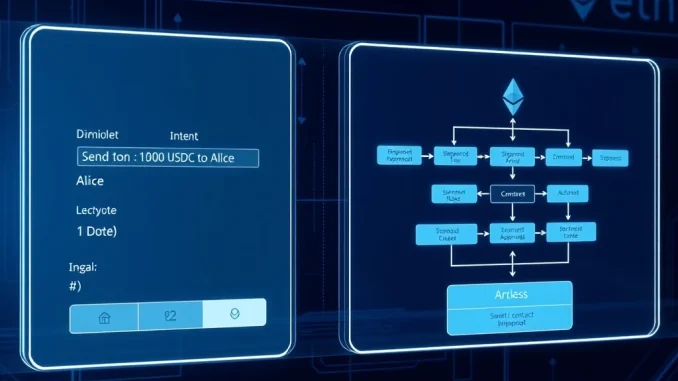
The core idea involves wallets or user interfaces running a local, sandboxed simulation of a transaction before broadcasting it to the network. This simulation would not just check for basic errors, but would map out the complete journey of the transaction, identifying every contract it interacts with, every state change it triggers, and every potential financial outcome. The system would then present this information in a clear, human-readable format. Key components of such a system would likely include:
- Local Execution Environment: A secure, isolated module within a wallet that can mimic the Ethereum Virtual Machine (EVM) state.
- Intent Parsing: Translating a user’s high-level goal (e.g., “get the best price for 1 ETH”) into a concrete transaction sequence.
- Path Exploration: Analyzing all possible branches the transaction could take based on variable states like liquidity or oracle prices.
- Clear Risk Reporting: Highlighting actions like token approvals, potential for slippage, or interactions with newly deployed or risky contracts.
This proactive approach contrasts sharply with the current reactive model, where users often only discover problematic outcomes after a transaction is irrevocably confirmed.
The Historical Context: A Response to an Evolving Threat Landscape
Buterin’s proposal did not emerge in a vacuum. It is a direct response to the evolving sophistication of crypto scams and the inherent complexity of decentralized finance (DeFi). The infamous “infinite approval” exploit, where users grant a protocol unlimited access to a token, has led to hundreds of millions in losses. Similarly, phishing attacks that trick users into signing malicious transactions rely on this opacity. By simulating a transaction, a wallet could flag an “infinite approval” request with a stark warning, or identify that a signature request is destined for an unknown, potentially malicious contract. This concept builds upon earlier ideas like “meta-transactions” and “account abstraction,” which sought to improve user experience, but focuses squarely on pre-execution clarity and security.
Technical Hurdles and Implementation Challenges
While the vision is compelling, implementing robust transaction simulation at scale presents significant technical challenges. Simulating a transaction requires an accurate, up-to-date mirror of the blockchain’s state, which is data-intensive. Furthermore, complex transactions involving multiple DeFi protocols (a “money Lego” cascade) can have a near-infinite number of potential outcomes based on minute, real-time market changes. A simulation must be fast enough to be useful—taking several minutes to run defeats the purpose for time-sensitive trades. Developers would also need to establish standards for how contracts expose their functionality to simulators, potentially requiring new protocol-level conventions. Overcoming these hurdles will require collaboration across wallet developers, infrastructure providers, and the broader Ethereum community.
Potential Impact on Wallets, Users, and the Broader Ecosystem
The widespread adoption of transaction simulations would represent a sea change for the crypto ecosystem. For wallet providers like MetaMask, Rabby, or Rainbow, it would become a critical competitive feature, shifting the security battleground. Users, particularly newcomers, would gain an invaluable tool for navigating the complex DeFi landscape with greater confidence. The technology could also:
- Reduce the incidence of “fat-finger” errors and mistaken transactions.
- Provide an educational layer, helping users learn about contract interactions safely.
- Create a new metric for “simulation-tested” protocols, adding a layer of trust.
- Ultimately reduce the burden on insurance protocols and the frequency of community-funded “reimbursement” efforts after major hacks.
However, it also raises questions about liability. If a simulation fails to predict a negative outcome, who is responsible? The onus would remain on developers to ensure their simulation engines are comprehensive and accurate.
Conclusion: A Foundational Step Towards Mainstream Adoption
Vitalik Buterin’s push for transaction simulations is more than a technical feature request; it is a philosophical realignment of blockchain security priorities. By placing user intent and comprehension at the center, the proposal addresses one of the most significant barriers to mainstream adoption: trust and predictability. If successfully implemented, this technology could dramatically reduce user-facing risks, making decentralized applications safer and more accessible for millions. It represents a maturation of the ecosystem, moving from merely securing the protocol to securing the human experience on top of it. The journey from concept to standard practice will be complex, but its potential to reshape crypto security from the ground up is undeniable.
FAQs
Q1: What are transaction simulations in crypto?
Transaction simulations are a proposed security feature where a wallet or interface runs a test version of a blockchain transaction locally before it is officially submitted. This simulation predicts the exact outcome, including all smart contract interactions, token movements, and potential risks, giving the user a clear preview of what will happen.
Q2: How is this different from a regular transaction preview?
Current previews often show only basic details like the recipient and amount. A full simulation executes the transaction logic in a sandboxed environment, revealing complex outcomes like changing token balances, fee structures, interactions with multiple contracts, and the specific conditions required for success or failure.
Q3: Would transaction simulations prevent all crypto hacks?
No. They are designed to prevent a major category of hacks that rely on user misunderstanding, such as malicious signature requests or unlimited token approvals. They would not prevent exploits of a smart contract’s own logic if the code itself contains a bug, though they could make the effects of that bug visible to the user beforehand.
Q4: When might we see this technology in popular wallets?
Basic forms of simulation for simple transactions already exist in some advanced wallets. A comprehensive, standardized system as envisioned by Buterin is a longer-term project. Prototypes and incremental features may roll out over the next 12-24 months, with full integration dependent on ecosystem-wide development efforts.
Q5: Do transaction simulations cost gas or slow down trading?
The simulation runs locally on the user’s device or via a dedicated service provider, so it does not cost gas (network fees). There may be a slight delay—perhaps a second or two—as the simulation runs, but the goal is for this process to be fast enough not to disrupt the user experience for time-sensitive actions.
This article was produced with AI assistance and reviewed by our editorial team for accuracy and quality.