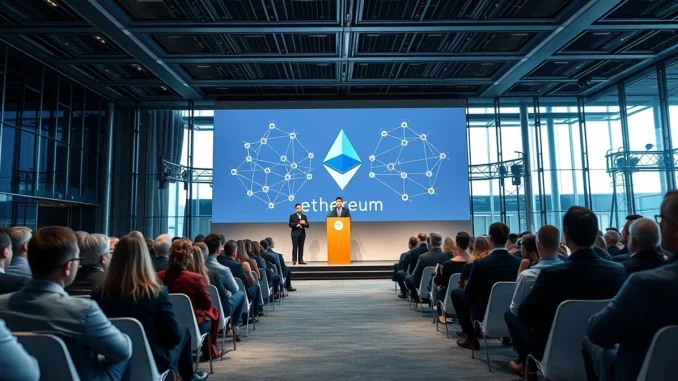
March 15, 2026 — Ethereum co-founder Vitalik Buterin has issued a public call for the blockchain network to pursue a broader mission that extends far beyond its current dominance in decentralized finance (DeFi). In a detailed blog post and subsequent industry commentary, Buterin argued that Ethereum’s long-term success depends on cultivating impactful applications in social coordination, identity, and decentralized governance.
Shifting Focus from Financialization
Buterin’s commentary arrives as Ethereum’s DeFi ecosystem shows signs of maturation. Total value locked (TVL) in Ethereum-based DeFi protocols has stabilized above $90 billion, according to data from DeFi Llama. This represents significant growth from early 2024 levels but indicates a plateau in explosive, sector-defining expansion.
The Ethereum creator expressed concern about over-reliance on financial applications. “While DeFi has proven Ethereum’s capability for robust, trustless systems, its ultimate value may be defined by how it improves human coordination,” Buterin wrote. He pointed to high transaction fees during network congestion as a persistent barrier for non-financial, high-volume use cases.
The “Ethereum Beyond Finance” Vision
Buterin outlined several key areas for development. Decentralized social media platforms resistant to censorship and data exploitation top the list. He referenced existing experiments like Farcaster as early proofs of concept. Decentralized identity solutions, often called “soulbound tokens,” represent another pillar. These non-transferable tokens could verify credentials, affiliations, and reputation without centralized authorities.
Furthermore, Buterin emphasized decentralized autonomous organizations (DAOs) for community governance and funding public goods. “The tools for collective decision-making and resource allocation are still primitive,” he noted. “Ethereum can host the next generation of these tools.”
Technical Roadmap and Challenges
This strategic pivot aligns with Ethereum’s ongoing technical evolution. The completion of “The Surge”—a series of scaling upgrades centered on rollup technology—has increased network throughput. Lower transaction costs are considered essential for social and identity applications that require frequent, low-value interactions.
Industry analysts note that developer activity has already begun diversifying. A recent report from Electric Capital showed a 15% year-over-year increase in monthly active developers working on non-financial Ethereum applications through late 2025. However, user adoption for these nascent applications remains a fraction of DeFi’s user base.
DeFi’s Continued Evolution
Buterin’s vision does not dismiss DeFi’s importance. Instead, he frames it as a foundational layer. “DeFi is the economic engine,” he stated. “But an engine needs a vehicle. We must build the rest of the car—and the roads and cities it drives in.”
The DeFi sector itself continues to innovate within Ethereum. New protocols are focusing on real-world asset (RWA) tokenization and institutional-grade liquidity pools. This maturation suggests DeFi is transitioning from a speculative frontier to a component of global financial infrastructure.
What Comes Next for Ethereum
The call to action presents both an opportunity and a challenge for the Ethereum community. Resources and developer mindshare remain finite. Prioritizing new verticals could divert attention from refining core financial infrastructure. Conversely, successful expansion could drive the next wave of mainstream adoption and insulate Ethereum from competitive blockchains specializing in niche use cases.
Buterin concluded by urging developers and investors to support ambitious projects that tackle complex social problems. “The hardest problems are often the most worth solving,” he wrote. “Ethereum’s unique properties position it to attempt solutions others cannot.” The network’s journey beyond finance is now a central part of its public narrative.
This article was produced with AI assistance and reviewed by our editorial team for accuracy and quality.