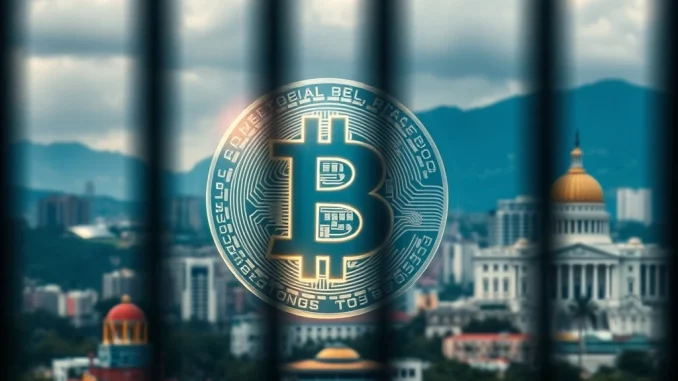
WASHINGTON, D.C. – April 2025 – A former top U.S. securities regulator has delivered a strikingly noncommittal response to one of cryptocurrency’s most pressing geopolitical questions: whether the United States might attempt to seize Venezuela’s alleged multibillion-dollar Bitcoin reserves. Former Securities and Exchange Commission (SEC) Commissioner Paul Atkins carefully addressed the explosive speculation during a recent Fox Business interview, highlighting the complex legal and diplomatic challenges surrounding Venezuela’s rumored cryptocurrency holdings. His comments arrive amid intensifying scrutiny of how nations use digital assets to navigate international sanctions, creating a potential flashpoint in U.S.-Venezuela relations.
Venezuela Bitcoin Reserves: The $60 Billion Question
Speculation about Venezuela’s cryptocurrency reserves reached fever pitch following the 2024 U.S. indictment of President Nicolás Maduro on narcoterrorism charges. Subsequently, multiple intelligence reports and blockchain analysts suggested the South American nation had accumulated substantial Bitcoin and Tether (USDT) holdings in a “secret vault” designed to circumvent crushing international sanctions. While some estimates placed these reserves as high as $60 billion, blockchain forensic analysis reveals a significant discrepancy. Venezuela’s officially confirmed, publicly verifiable on-chain Bitcoin holdings amount to approximately 240 BTC, valued around $15 million at current prices. This massive gap between rumored and verified holdings forms the core of the current diplomatic and financial mystery. International sanctions experts note that Venezuela, like several other sanctioned nations including Iran and North Korea, has increasingly explored cryptocurrency as a tool for international trade. The country launched its own oil-backed Petro cryptocurrency in 2018, although the project largely failed to achieve its stated goals. Consequently, analysts believe the government shifted toward established, liquid assets like Bitcoin and stablecoins.
Former SEC Commissioner’s Cautious Commentary
Paul Atkins, who served as an SEC Commissioner from 2002 to 2008, approached the question with characteristic regulatory caution. “While I cannot confirm the authenticity of these reports,” Atkins stated during his television appearance, “it remains to be seen what action the U.S. would take if an opportunity for seizure arose.” His noncommittal stance reflects the unprecedented legal territory surrounding state-held cryptocurrency assets. Unlike traditional foreign bank accounts or physical gold reserves, Bitcoin exists on a decentralized ledger without a clear geographic location for seizure. Legal experts point to several formidable obstacles for any potential seizure attempt. First, authorities must definitively prove the existence and control of the assets. Second, they must navigate the technical challenge of accessing private keys, which Venezuela would undoubtedly secure through sophisticated means. Finally, any action would require complex international legal coordination, potentially involving multiple jurisdictions where the assets or their custodians might be located. Atkins’ background provides crucial context for his measured response. As a commissioner, he developed a reputation for careful, market-focused regulation rather than aggressive enforcement actions. His post-SEC career includes advising financial institutions on regulatory compliance, giving him particular insight into the intersection of finance and law.
The Technical and Legal Hurdles of Crypto Seizure
Seizing state-controlled cryptocurrency presents unique challenges distinct from traditional asset freezes. The U.S. Department of Justice has successfully seized cryptocurrency from criminal enterprises, but a nation-state adversary represents a different scale of complexity. Technical experts explain that without access to Venezuela’s private keys—the cryptographic passwords controlling the Bitcoin—seizure becomes nearly impossible. The government could employ multisignature wallets requiring multiple approvals, hardware wallets stored in secure locations, or utilize privacy-enhancing techniques to obscure transaction trails. From a legal perspective, the U.S. would need to establish clear jurisdiction over assets that exist on a global, decentralized network. Previous cases involving sanctioned entities have relied on targeting intermediaries like exchanges or custodians. However, if Venezuela controls its keys without third-party involvement, this pathway closes. Furthermore, any seizure attempt would likely trigger significant debate about the precedent it sets for digital sovereignty and the treatment of cryptocurrency as state property under international law.
Historical Context of Sanctions and Cryptocurrency
The current speculation exists within a broader historical pattern of nations using alternative financial systems under sanctions. During the 20th century, countries like South Africa and Iraq developed elaborate schemes to bypass economic restrictions. In the digital age, cryptocurrency offers a new, technologically advanced method for this age-old practice. A comparative analysis reveals telling patterns:
| Country | Sanctions Context | Reported Crypto Use | Confirmed Actions |
|---|---|---|---|
| Venezuela | U.S. sanctions since 2015, intensified 2019 | Alleged $60B BTC/USDT reserves | Petro cryptocurrency launch, 240 BTC on-chain |
| Iran | Comprehensive U.S. sanctions | Bitcoin mining for export revenue | Licensed mining operations, $1B+ estimated revenue |
| North Korea | UN and U.S. sanctions | Cybertheft and ransomware attacks | $1.7B+ in crypto stolen per UN reports |
| Russia | Sanctions after Ukraine invasion | Exploring crypto for trade settlements | Legal framework development, mining expansion |
This pattern demonstrates cryptocurrency’s growing role in geopolitical finance. However, Venezuela’s situation remains distinctive due to the extraordinary scale of the alleged holdings and their potential connection to state oil revenues. Energy analysts note that before sanctions crippled its traditional oil exports, Venezuela produced over 2 million barrels daily. Even a small percentage of this revenue converted to cryptocurrency over several years could theoretically approach the rumored figures.
Market and Diplomatic Implications
The potential existence of such large state-held Bitcoin reserves carries significant implications for both cryptocurrency markets and international diplomacy. From a market perspective, $60 billion represents approximately 3% of Bitcoin’s total current market capitalization. The sudden seizure or liquidation of such a position could create substantial volatility, although experts debate whether Venezuela would ever attempt to move such a large amount through exchanges. More likely, the reserves would serve as long-term strategic holdings or collateral for international agreements. Diplomatically, the situation creates a delicate balancing act for the U.S. government. Aggressive seizure attempts could:
- Escalate tensions with Venezuela and its allies
- Set controversial precedents for digital asset seizure
- Drive other nations toward more privacy-focused cryptocurrencies
- Validate cryptocurrency as an effective sanctions evasion tool
Conversely, inaction might embolden other sanctioned states to follow Venezuela’s alleged example. This dilemma explains why officials like Atkins maintain carefully noncommittal public positions while behind-the-scenes analysis undoubtedly continues. The U.S. Treasury Department’s Office of Foreign Assets Control (OFAC) has increasingly focused on cryptocurrency in its sanctions enforcement, adding numerous digital currency addresses to its Specially Designated Nationals list. However, these actions typically target individual wallets rather than attempting to seize entire national reserves.
The Verification Challenge and Intelligence Gaps
Central to this entire discussion is the fundamental challenge of verification. Blockchain’s transparency allows anyone to track publicly known addresses, but sophisticated actors can obscure ownership through various techniques:
- Mixers and tumblers: Services that break transaction trails
- Privacy coins: Assets like Monero with enhanced anonymity
- Chain hopping: Moving between different cryptocurrencies
- Off-chain settlements: Private agreements not recorded on public ledgers
Intelligence agencies likely employ advanced blockchain analysis tools, but these face limitations against determined, well-resourced state actors. The $60 billion figure circulating in media reports appears to originate from unnamed sources rather than verifiable blockchain data. Financial investigators note that moving such enormous sums onto blockchain networks would inevitably leave some traces, yet no evidence of transactions approaching this scale has surfaced publicly. This discrepancy suggests either extraordinary operational security by Venezuela, significant exaggeration in the reports, or holdings spread across thousands of addresses with sophisticated obfuscation.
Conclusion
The former SEC commissioner’s noncommittal stance on potentially seizing Venezuela’s alleged Bitcoin reserves reflects the profound complexities at the intersection of cryptocurrency, international law, and geopolitical strategy. While speculation about $60 billion in hidden cryptocurrency captures headlines, the verified reality remains limited to approximately 240 BTC in publicly identifiable holdings. This gap between rumor and evidence defines the current situation, leaving regulators, diplomats, and financial analysts with more questions than answers. As nations increasingly explore digital assets for economic sovereignty and sanctions resistance, the Venezuela case establishes a crucial precedent. Whether the U.S. pursues aggressive seizure, develops new regulatory frameworks, or adopts another approach entirely will shape the future of state cryptocurrency holdings for years to come. The ultimate resolution of this situation will reveal much about cryptocurrency’s role in 21st-century geopolitics and the limits of financial sanctions in an increasingly digital global economy.
FAQs
Q1: What exactly did former SEC Commissioner Paul Atkins say about Venezuela’s Bitcoin?
Paul Atkins stated he could not confirm reports about Venezuela’s alleged Bitcoin reserves and that it “remains to be seen” what action the U.S. might take if seizure opportunities emerged. He maintained a deliberately noncommittal position during his Fox Business interview.
Q2: How much Bitcoin does Venezuela actually hold according to verifiable data?
Blockchain analysis confirms Venezuela controls approximately 240 BTC in publicly identifiable addresses, valued around $15 million. This contrasts sharply with unverified reports suggesting up to $60 billion in cryptocurrency reserves.
Q3: Why would Venezuela use cryptocurrency to evade sanctions?
Cryptocurrency offers potential advantages for sanctioned nations, including borderless transactions, resistance to traditional financial freezing, and the ability to conduct international trade outside conventional banking channels subject to U.S. oversight.
Q4: What are the main challenges in seizing state-controlled cryptocurrency?
Key challenges include proving asset existence and control, accessing secured private keys, establishing legal jurisdiction over decentralized assets, and navigating international law regarding state property and digital sovereignty.
Q5: How does this situation affect ordinary cryptocurrency investors?
While direct market impact remains limited without verified large-scale movements, the situation highlights growing regulatory attention on cryptocurrency’s geopolitical dimensions. Investors should monitor developments as they may influence long-term regulatory approaches to digital assets.
This article was produced with AI assistance and reviewed by our editorial team for accuracy and quality.