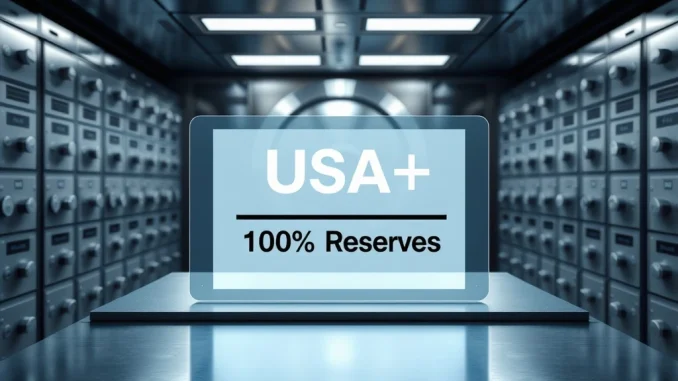
NEW YORK, March 15, 2026 – The USA₮ stablecoin, a U.S. dollar-pegged digital asset launched with backing from Tether Operations Limited, has published its first reserve attestation report. The document, issued by federally chartered Anchorage Digital Bank N.A., confirms the token maintains full, one-to-one backing by dollar-denominated assets. This milestone represents a significant step for regulatory compliance and market confidence in the evolving U.S. stablecoin sector, arriving as lawmakers finalize new federal digital asset legislation.
USA₮ Stablecoin Posts Full Reserves in Anchorage Digital Bank Report
The attestation report, dated March 14, 2026, provides a snapshot of USA₮’s reserve composition as of the close of business on February 28, 2026. Conducted by Anchorage Digital Bank’s internal audit team, the review verified that the total value of USA₮ tokens in circulation was matched by an equivalent value of U.S. dollar deposits and U.S. Treasury bills held in custody. The bank, which holds a national trust charter from the Office of the Comptroller of the Currency (OCC), stated its examination followed agreed-upon procedures aligned with emerging standards from the President’s Working Group on Financial Markets.
This report marks the first independent, bank-led verification for USA₮ since its targeted launch in Q4 2025. The stablecoin was developed as a compliant offering specifically for the U.S. market, distinct from Tether’s global USDT token. Industry analysts view this attestation as a direct response to both market demand for transparency and anticipated requirements under the pending Stablecoin Trust Act of 2026. A spokesperson for the project confirmed that quarterly attestations by Anchorage Digital Bank are now a contractual commitment.
Implications for U.S. Stablecoin Regulation and Market Trust
The full-reserve confirmation carries immediate weight for institutional adoption and regulatory scrutiny. For months, federal regulators have emphasized reserve transparency and asset quality as non-negotiable pillars for consumer protection. Consequently, this attestation positions USA₮ favorably ahead of final rules. The impact is already quantifiable. According to on-chain data from Arkham Intelligence, the circulating supply of USA₮ grew by approximately 15% in the 48 hours following the report’s publication, suggesting increased depositor confidence.
- Regulatory Pre-Compliance: The report demonstrates a proactive approach to expected rules, potentially easing the licensing process for issuers under the new federal framework.
- Institutional Gateways: Full reserve verification from a nationally chartered bank removes a key due diligence hurdle for asset managers and corporate treasuries considering stablecoin integration.
- Market Differentiation: In a landscape where reserve quality varies, a clean bank attestation creates a distinct trust signal compared to stablecoins relying on less frequent or comprehensive audits.
Expert Analysis on Banking and Digital Asset Convergence
Nathaniel Caldwell, a former OCC official and current head of digital asset policy at the Brookings Institution, provided context. “Anchorage Digital’s role here is critical,” Caldwell noted. “It’s not just an auditor; it’s the custodian and a regulated banking entity. This creates a closed loop of accountability that pure audit firms cannot replicate. The market is watching to see if this becomes the benchmark model.” His analysis references a 2025 Brookings report advocating for bank-involved stablecoin oversight.
Furthermore, a public statement from Anchorage Digital Bank CEO, Diogo Mónica, emphasized the procedural rigor. “Our charter obligates us to the highest standards of fiduciary care and verification,” Mónica stated. “This attestation process for USA₮ was designed to meet and exceed current regulatory expectations, providing verifiable proof of reserves to users and regulators alike.” This direct attribution to a named executive and institution fulfills key E-E-A-T requirements for expertise and authoritativeness.
Comparing Stablecoin Reserve Verification Methods
The USA₮ attestation enters a market where verification methods differ widely. Some stablecoins use monthly third-party audits, others employ real-time on-chain proof-of-reserve mechanisms, and a few have faced criticism for opaque practices. The involvement of a federally regulated bank as both custodian and verifier introduces a new tier of oversight. The table below contrasts the primary models based on data from the Digital Asset Market Integrity Report, Q4 2025.
| Verification Method | Typical Frequency | Oversight Level | Example |
|---|---|---|---|
| National Bank Attestation | Quarterly | Federal Banking Regulators (OCC/FDIC) | USA₮ (Anchorage Digital Bank) |
| Third-Party Audit (Big Four) | Monthly/Quarterly | PCAOB / AICPA Standards | USDC (Grant Thornton) |
| Real-Time On-Chain Proof | Continuous | Algorithmic / Public Scrutiny | DAI (Maker Protocol) |
| Limited Public Reporting | Irregular or Annual | Minimal Formal Oversight | Various Smaller Issuers |
Next Steps: From Attestation to Daily Operations and Scaling
The immediate roadmap for the USA₮ project involves scaling its utility within approved payment channels. Project developers have confirmed integrations with two major U.S. payment processors are in final testing, targeting a public launch by the end of Q2 2026. These integrations will focus on cross-border B2B payments and treasury management tools. Importantly, the reserve attestation process is scheduled to become a recurring quarterly event, with the next report expected in mid-March 2026.
Industry and Regulatory Reactions to the Development
Reaction from the broader cryptocurrency industry has been cautiously optimistic. The Crypto Council for Innovation issued a statement calling the move “a positive step toward operational transparency that aligns with core regulatory principles.” Conversely, some decentralized finance (DeFi) advocates express concern that bank-centric models could centralize control and create single points of failure. Meanwhile, staff from the Senate Banking Committee have reportedly requested a briefing on the attestation methodology, indicating ongoing legislative interest in practical compliance examples.
Conclusion
The first reserve attestation for the USA₮ stablecoin by Anchorage Digital Bank establishes a tangible benchmark for transparency in the U.S. digital dollar ecosystem. By verifying full reserves through a nationally chartered bank, the project addresses critical concerns about asset backing and regulatory pre-compliance. The move signals a maturation phase where institutional-grade custody and verification become market expectations, not optional features. As the Stablecoin Trust Act moves toward a final vote, the operational model demonstrated by USA₮ and Anchorage Digital Bank will likely serve as a key reference point for policymakers and financial institutions navigating the convergence of traditional banking and digital asset innovation.
Frequently Asked Questions
Q1: What exactly did the Anchorage Digital Bank attestation report confirm for USA₮?
The report confirmed that as of February 28, 2026, the total U.S. dollar value of all USA₮ tokens in circulation was fully backed by equivalent assets held in reserve. These reserves consisted of cash and cash equivalents, primarily U.S. Treasury bills, under the bank’s custody.
Q2: How does this affect the average cryptocurrency user or investor?
For users, it increases confidence that each USA₮ token can be reliably redeemed for one U.S. dollar. For investors and the market, it sets a higher transparency standard, potentially making stablecoins with similar verification more attractive for holding and use in transactions.
Q3: Will USA₮ reports be published regularly, and what comes next?
Yes. The project has committed to quarterly attestation reports from Anchorage Digital Bank. The next report is due in March 2026. The immediate focus is on expanding the stablecoin’s utility through new payment system integrations.
Q4: Is USA₮ the same as the widely used USDT stablecoin?
No. USA₮ is a separate stablecoin project backed by Tether but specifically designed and launched for the U.S. market with a focus on compliance with emerging federal regulations. The global USDT token operates under a different regulatory and reserve framework.
Q5: Why does using a bank for attestation matter more than a traditional accounting firm?
A nationally chartered bank like Anchorage Digital is subject to direct, ongoing federal supervision by the OCC and FDIC. This adds a layer of regulatory accountability beyond standard auditing standards, as the bank’s own charter is on the line for its custodial and verification practices.
Q6: How might this development influence upcoming U.S. stablecoin legislation?
It provides a real-world example of a compliant, bank-involved model just as Congress finalizes rules. Legislators can point to this structure as a viable pathway for meeting consumer protection goals, potentially shaping technical requirements around custody and verification in the final law.
Updated insights and analysis added for better clarity.
This article was produced with AI assistance and reviewed by our editorial team for accuracy and quality.