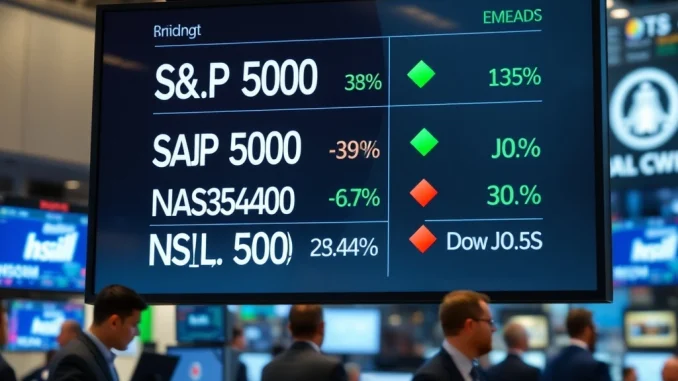
New York, NY – April 15, 2025: The three major US stock indices delivered a mixed performance at Tuesday’s closing bell, reflecting ongoing investor assessment of economic signals and sector-specific dynamics. The S&P 500 declined by 0.13%, the technology-heavy Nasdaq Composite fell 0.72%, while the blue-chip Dow Jones Industrial Average posted a modest gain of 0.11%. This divergence highlights the nuanced forces currently shaping equity markets, from interest rate expectations to corporate earnings outlooks.
Analyzing the Mixed Close of Major US Stock Indices
The trading session presented a classic case of sector rotation, where money flows between different areas of the market create divergent index performances. The Dow Jones Industrial Average’s resilience stemmed primarily from strength in industrial and healthcare components. Conversely, the S&P 500’s slight decline was driven by pressure on consumer discretionary and information technology sectors, which carry significant weight in the broader index. The Nasdaq’s sharper pullback underscored continued sensitivity among growth-oriented technology stocks to macroeconomic factors like bond yields and future profit projections. Market analysts point to the release of March retail sales data, which came in slightly below expectations, as a contributing factor to the cautious sentiment that limited broader gains.
Sector Performance and Market Drivers
Beneath the headline index numbers, individual sector performance told a more detailed story. Energy and utilities sectors outperformed, benefiting from stable commodity prices and their perceived defensive characteristics. The communication services and technology sectors, however, faced headwinds. This pattern often emerges during periods of economic uncertainty or when investors anticipate a shift in Federal Reserve policy. Several key drivers influenced the day’s trading:
- Interest Rate Sensitivity: Comments from Federal Reserve officials regarding the pace of future rate adjustments continue to cause volatility, particularly for long-duration assets like technology stocks.
- Earnings Season Prelude: With the first-quarter earnings season approaching, investors are repositioning portfolios based on early guidance and sector forecasts.
- Geopolitical Developments: Ongoing international trade discussions and commodity supply chains introduced a layer of caution into the market.
- Technical Levels: The S&P 500 encountered resistance near a key psychological level, triggering some automated selling pressure.
Historical Context of Divergent Index Performance
Mixed closes among the three major benchmarks are not uncommon and often signal a healthy, selective market rather than a broad-based downturn. Historically, periods where the Dow outperforms the Nasdaq have sometimes indicated a rotation from high-growth speculation to value and dividend stability. For instance, similar patterns were observed in late 2018 during trade tension escalations and in 2022 as interest rates began rising. The current environment shares characteristics with both: investors are balancing optimism about economic resilience with caution over inflation persistence. The Dow’s composition, with older, established industrial and consumer goods companies, often provides a buffer during times when future earnings growth for tech firms is being reassessed.
Implications for Investors and the Economic Outlook
The day’s mixed results suggest a market in digestion mode, processing recent economic data without a clear directional catalyst. For retail and institutional investors, this environment underscores the importance of diversification across sectors and market capitalizations. A portfolio heavily weighted toward the Nasdaq would have experienced a different day than one anchored in Dow-like stocks. Economists view such divergence as a reflection of the complex current landscape: strong labor markets support consumer-facing Dow companies, while higher financing costs pressure the capital-intensive growth plans of many tech firms in the Nasdaq. The bond market’s reaction, with Treasury yields holding steady, provided little additional momentum for either a strong rally or a significant sell-off.
Expert Perspective on Market Structure
Market structure itself plays a role in these divergences. The rise of passive investing through index funds and ETFs means movements in mega-cap stocks disproportionately affect the S&P 500 and Nasdaq. A few large technology companies experiencing sell-offs can drag down their entire index, even if a majority of smaller components are flat or positive. This concentration effect has been a topic of discussion among financial regulators and academics, as it can amplify volatility and create index-level moves that don’t fully represent the broader market of thousands of publicly traded companies. Understanding this dynamic is crucial for interpreting what a “mixed market close” truly signifies about underlying economic health.
Conclusion
The mixed close of the major US stock indices on Tuesday illustrates the multifaceted nature of modern financial markets. While the Dow Jones Industrial Average eked out a gain, the S&P 500 and Nasdaq Composite finished in negative territory, highlighting ongoing sector rotations and investor recalibration. This performance reinforces that market trends are rarely monolithic and that careful analysis of underlying components and economic drivers is essential. As earnings season commences, the focus will likely shift from macroeconomic speculation to corporate fundamentals, which may provide clearer direction for all three major indices. For now, the mixed signals suggest a market carefully weighing its next move.
FAQs
Q1: What does it mean when stock indices close mixed?
When major indices like the Dow, S&P 500, and Nasdaq finish a session with different results—some up, some down—it indicates sector rotation and divergent investor sentiment across different types of companies, rather than a uniform market move.
Q2: Why did the Nasdaq fall more than the S&P 500 and Dow?
The Nasdaq Composite is heavily weighted toward technology and growth stocks, which are often more sensitive to changes in interest rate expectations and long-term growth forecasts. These sectors faced selling pressure, leading to a larger decline.
Q3: Is a mixed market close a sign of instability?
Not necessarily. Mixed closes are common and can reflect healthy selectivity, where investors are discriminating between sectors based on fundamentals rather than moving the entire market based on a single narrative.
Q4: Which sectors performed well to help the Dow Jones gain?
Industrial, healthcare, and some consumer goods companies—which are well-represented in the Dow—showed strength, offsetting weakness in other areas and contributing to the index’s positive finish.
Q5: How should an investor interpret a day with mixed index results?
Investors should look beneath the index headlines at sector and individual stock performance. It reinforces the importance of a diversified portfolio that isn’t overly reliant on a single index or sector’s performance on any given day.