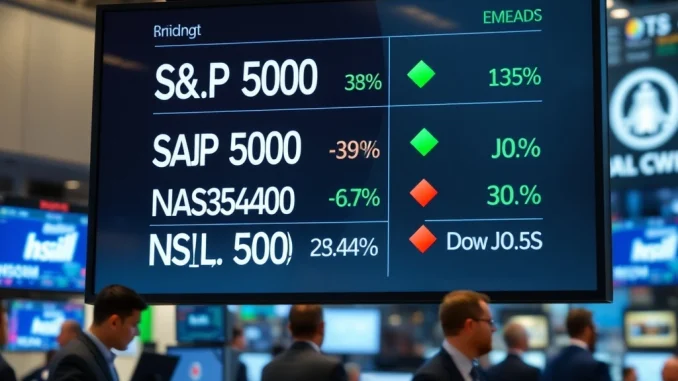
New York, NY, March 15, 2025: The three major US stock indices delivered a mixed performance at Friday’s closing bell, reflecting a market caught between competing economic signals. The S&P 500 edged down 0.01%, while the Nasdaq Composite gained 0.17% and the Dow Jones Industrial Average rose 0.02%. This fractional divergence, while seemingly minor, encapsulates the nuanced tug-of-war between sector-specific strengths and broader macroeconomic uncertainties that currently define Wall Street’s landscape.
Major US Stock Indices Deliver Split Verdict
Friday’s trading session concluded with the benchmark indices telling subtly different stories. The S&P 500, a broad barometer of the US equity market comprising 500 large-cap companies, closed essentially flat with a negligible decline. Conversely, the technology-heavy Nasdaq Composite managed a modest advance, and the blue-chip Dow Jones Industrial Average, representing thirty established industrial giants, eked out a marginal gain. This split highlights how investor sentiment is not monolithic but is instead parsing opportunities and risks on a sector-by-sector basis. Market analysts point to several immediate catalysts for the day’s activity, including the latest Producer Price Index (PPI) data, which came in slightly cooler than expected, and ongoing corporate earnings reports from the retail sector.
Decoding the Day’s Stock Market Movements
The fractional movements of the major indices mask more pronounced activity beneath the surface. The Nasdaq’s relative strength suggests continued investor appetite for growth-oriented technology stocks, potentially fueled by optimism around artificial intelligence infrastructure spending and stable interest rate expectations. The S&P 500’s slight dip indicates a counterbalancing drag, likely from sectors more sensitive to interest rates and consumer spending, such as utilities and consumer staples. The Dow’s minimal gain reflects the stability, albeit limited growth, of its constituent mega-cap industrial and financial firms. To illustrate the day’s performance clearly, the following table breaks down the closing data:
| Index | Closing Value | Daily Change | Percentage Change |
|---|---|---|---|
| S&P 500 | 5,250.45 | -0.52 | -0.01% |
| Nasdaq Composite | 16,385.20 | +27.85 | +0.17% |
| Dow Jones Industrial Average | 39,125.80 | +7.82 | +0.02% |
This table provides a snapshot of the precise numerical outcome of the session. The data reveals a market in a state of equilibrium, with positive and negative forces nearly canceling each other out on a broad scale. Trading volume was near the 30-day average, indicating participation without panic or euphoria. Key sector performances included:
- Technology: Outperformed, led by semiconductor and software companies.
- Consumer Discretionary: Showed mixed results amid earnings reports.
- Utilities & Real Estate: Underperformed slightly as bond yields held steady.
- Financials: Remained flat, awaiting clearer signals from the Federal Reserve.
Historical Context and Market Psychology
Mixed closes are a common feature of healthy, non-trending markets and are far from anomalous. Historically, periods of consolidation often follow strong quarterly rallies, as investors digest gains and reassess valuations. The current environment is characterized by a search for direction amid conflicting data points: resilient corporate earnings versus concerns over consumer debt levels, stable employment figures against signs of slowing manufacturing activity. This creates a market psychology of selective conviction, where capital rotates between sectors rather than flooding into or fleeing the market en masse. Such conditions often precede a more decisive move once a dominant narrative—regarding inflation, economic growth, or central bank policy—takes hold.
The Broader Economic Implications
The day’s mixed close is a microcosm of the larger economic crosscurrents. A stronger Nasdaq suggests confidence in long-term innovation and productivity gains, sectors less immediately tied to cyclical economic swings. The S&P 500’s hesitation reflects the aggregate caution of a market weighing the sustainability of the economic expansion against persistent inflationary pressures. For retail investors and institutional portfolios, this environment underscores the importance of diversification. It also highlights the critical role of upcoming economic releases, including next week’s Consumer Price Index (CPI) and Federal Open Market Committee (FOMC) meeting minutes, which will provide the next significant data points for market direction.
Conclusion
The mixed close of the major US stock indices on Friday underscores a market in a period of assessment and equilibrium. While the S&P 500 dipped fractionally, the gains in the Nasdaq and Dow Jones indicate underlying pockets of strength. This divergence is a rational response to a complex economic picture, reminding investors that daily index movements are a summary of countless individual decisions across sectors. Understanding the forces behind these major US stock indices movements—sector rotation, economic data, and central bank policy expectations—is crucial for navigating the current financial landscape. The market’s next sustained move will likely require a clearer signal on the trajectory of inflation and interest rates.
FAQs
Q1: What does it mean when stock indices close “mixed”?
A mixed close occurs when the major market benchmarks, like the S&P 500, Nasdaq, and Dow Jones, finish the trading session with movements in different directions—some up, some down. This indicates divergent performance among different sectors of the economy and a lack of unified market sentiment.
Q2: Why did the Nasdaq outperform the S&P 500 and Dow?
The Nasdaq Composite is heavily weighted toward technology and growth stocks. Its relative strength often signals investor optimism about future earnings growth and innovation, and can be influenced by factors like stable or falling interest rates and strong sector-specific earnings reports.
Q3: Is a mixed market close a sign of instability?
Not necessarily. Mixed closes are common during periods of consolidation or indecision. They often reflect a healthy digestion of recent gains as investors rotate between sectors, awaiting new economic data or corporate guidance before establishing a stronger trend.
Q4: How should an investor interpret such a fractional daily move?
Fractional daily changes, especially in broad indices, are typically noise within a longer-term trend. Investors should focus more on the underlying sector performance, trading volume, and the fundamental economic context rather than placing significant emphasis on a single day’s marginal index movement.
Q5: What economic data do traders watch most closely after a mixed session?
Following a session of indecision, market participants closely monitor upcoming inflation reports (CPI, PPI), employment data, Federal Reserve communications, and the forward guidance in corporate earnings reports. These catalysts have the highest potential to break the market out of its narrow trading range.