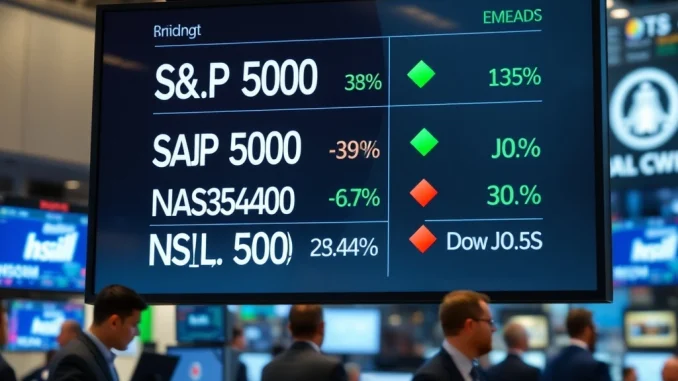
New York, NY – April 9, 2025: The three major U.S. stock indices delivered a split performance at Wednesday’s closing bell, highlighting a market grappling with competing economic narratives. The S&P 500 advanced 0.41%, while the technology-heavy Nasdaq Composite posted a stronger gain of 0.91%. Conversely, the blue-chip Dow Jones Industrial Average declined by 0.83%. This divergence provides a clear snapshot of shifting investor sentiment and sector-specific dynamics at play.
Analyzing the Mixed Close for US Stock Indices
The day’s trading session underscored a classic rotation within the equity markets. The strength in the Nasdaq Composite, which houses many major technology and growth-oriented companies, often signals investor confidence in sectors driven by innovation and future earnings potential. Analysts frequently view its performance as a barometer for risk appetite. Meanwhile, the Dow Jones Industrial Average, composed of 30 established, large-cap companies spanning industries like manufacturing, finance, and consumer goods, can be more sensitive to immediate economic data, interest rate expectations, and cyclical trends. Its decline suggests a more cautious stance toward traditional industrial and financial sectors. The S&P 500’s moderate gain positioned it as a middle ground, reflecting its status as a broad benchmark for the overall U.S. market.
Key Drivers Behind the Market Divergence
Several interrelated factors typically contribute to such a split market performance. Understanding these drivers requires examining recent economic releases, corporate earnings, and monetary policy signals.
- Sector Performance: Technology and communication services stocks, heavily weighted in the Nasdaq, likely outperformed. In contrast, sectors like industrials, financials, and energy—which have significant representation in the Dow—may have faced headwinds.
- Interest Rate Sensitivity: Growth stocks, common in the Nasdaq, can benefit from stable or falling long-term interest rate expectations, as their valuations are based heavily on future cash flows. Value-oriented and dividend-paying stocks, more prevalent in the Dow, can be pressured by the same environment if it coincides with concerns about near-term economic growth.
- Earnings Season Dynamics: Early reports from the quarterly earnings season can create winners and losers. Strong guidance from a major tech firm can lift the Nasdaq, while a warning from an industrial giant can weigh on the Dow.
- Macroeconomic Data: Reports on inflation, employment, or consumer spending released prior to the market open can set the tone, influencing different sectors in varied ways.
Historical Context of Split Market Sessions
Mixed closes are not uncommon in financial markets. They represent a healthy differentiation between asset classes and a move away from blanket correlations. Historically, periods of economic transition, such as shifts in monetary policy or changes in the business cycle, often produce these divergent index performances. For instance, during the early stages of economic recovery, cyclical stocks in the Dow might lead, while during periods of technological disruption or low-rate environments, the Nasdaq often takes precedence. This day’s action fits a pattern observed when investors are selectively allocating capital rather than making broad-based bets on the entire market.
Implications for Investors and the Economy
A mixed market close carries specific implications for different market participants. For retail investors, it underscores the importance of diversification across sectors and market capitalizations. A portfolio heavily weighted toward only one index might experience volatility not reflected in the broader market narrative. For economists, such divergence can offer clues about underlying economic strengths and weaknesses. Strong tech performance might indicate robust business investment and consumer demand for digital services, while weakness in industrials could signal concerns about global trade or capital expenditure. The table below summarizes the key differences between the indices that lead to their divergent paths.
| Index | Primary Composition | Common Driver of Strength | Common Driver of Weakness |
|---|---|---|---|
| Dow Jones Industrial Average | 30 large, established “blue-chip” companies | Strong economic growth, rising interest rates (for financials), infrastructure spending | Economic slowdown, trade tensions, rising input costs |
| S&P 500 | 500 large-cap U.S. companies across 11 sectors | Broad corporate earnings growth, stable economic expansion | Recession fears, systemic financial risk, geopolitical instability |
| Nasdaq Composite | Over 2,500 stocks, heavy weighting in technology and biotech | Innovation breakthroughs, low interest rate environment, strong earnings growth from tech leaders | Rising interest rates, regulatory scrutiny, sector rotation out of growth stocks |
The Role of Market Sentiment and Technical Levels
Beyond fundamentals, technical analysis and trader sentiment play crucial roles. Key psychological levels, such as round numbers for an index, or moving averages, can act as magnets for price action, triggering automated buying or selling. The day’s mixed results may also reflect a market that is consolidating after a recent strong move, with investors taking profits in some areas and redeploying capital in others. This churn is a normal function of a liquid, active market and prevents asset bubbles from forming in any single segment too quickly.
Conclusion
The mixed close for the major US stock indices on Wednesday serves as a potent reminder that the market is not a monolith. The gains in the S&P 500 and Nasdaq Composite, contrasted with the loss in the Dow Jones Industrial Average, illustrate a nuanced investment landscape where sector selection and thematic positioning are paramount. This divergence is a critical data point for anyone assessing the health and direction of the U.S. financial markets, emphasizing that understanding the unique composition and drivers of each index is essential for accurate market analysis.
FAQs
Q1: What does it mean when stock indices close mixed?
It means the major market benchmarks finished the trading session in different directions—some up, some down. This indicates that investor buying and selling pressure was not uniform across all sectors or company types, reflecting selective sentiment rather than a broad market trend.
Q2: Why did the Nasdaq outperform the Dow Jones?
The Nasdaq Composite, with its heavy concentration in technology and growth stocks, likely benefited from positive news or sentiment specific to that sector, such as strong earnings reports or favorable regulatory developments. The Dow Jones, comprising more traditional industrial and financial companies, may have been weighed down by concerns related to interest rates, economic data, or sector-specific challenges.
Q3: Is a mixed market close a sign of instability?
Not necessarily. While it can indicate uncertainty or a lack of clear directional conviction, mixed closes are a normal and frequent occurrence. They often signal a healthy market where investors are discriminating between individual company or sector prospects rather than moving the entire market based on a single macro factor.
Q4: Which index is the best indicator of the overall U.S. stock market?
Most financial professionals consider the S&P 500 the best single indicator of the broad U.S. equity market due to its inclusion of 500 large-cap companies across all major industries. The Dow Jones includes only 30 companies, and the Nasdaq is skewed toward technology, making them less representative of the total market.
Q5: How should an investor react to a day of mixed index performance?
For long-term investors, a single day’s mixed performance typically requires no reaction. It reinforces the importance of maintaining a diversified portfolio aligned with one’s financial goals and risk tolerance. Day-to-day index divergence is common noise within a longer-term trend.