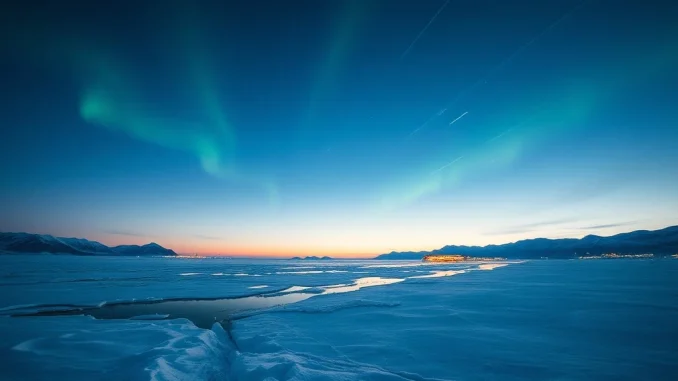
WASHINGTON, D.C. / BRUSSELS – A pivotal security arrangement concerning the strategically vital Arctic region of Greenland remains in limbo, as officials confirm no written agreement has been finalized between the United States and the North Atlantic Treaty Organization. This development follows high-level discussions between U.S. leadership and NATO Secretary General Mark Rutte, which notably included potential amendments to a longstanding military pact and restrictions on foreign investment. Consequently, the absence of a formal document now fuels significant uncertainty among alliance members regarding the precise terms and future implications for Arctic defense posture.
Analyzing the Stalled Greenland Agreement
The reported lack of a written pact directly impacts transatlantic coordination. According to journalist Walter Bloomberg, the previously discussed measures were substantial. They potentially included revising the 1951 U.S.-Denmark-Greenland defense agreement, enacting prohibitions on Russian and Chinese capital in Greenland’s economy, and formally expanding NATO’s operational role in the High North. However, without a signed text, these proposals lack the force of official policy. Therefore, other NATO member states currently operate with incomplete information, hindering unified strategic planning. This situation underscores the complex, often slow-moving nature of international security diplomacy, especially within a 32-member alliance where consensus is paramount.
Furthermore, the geopolitical context makes this delay particularly significant. The Arctic has rapidly evolved from a frozen periphery into a zone of intense strategic competition. Melting ice caps are opening new sea lanes and revealing untapped natural resources. In response, Russia has significantly militarized its northern coastline, reopening Soviet-era bases and deploying advanced anti-access systems. China, declaring itself a “near-Arctic state,” has also pursued scientific and economic interests across the region. Consequently, Greenland’s location between North America and Europe grants it outsized importance for continental defense and resource security.
The Strategic Weight of Arctic Security
Greenland is not merely a remote island; it is a geostrategic linchpin. The United States maintains its northernmost military base, Thule Air Base, on Greenland’s northwest coast. This installation provides critical capabilities for missile warning, space surveillance, and satellite tracking. The existing defense pact with Denmark, which governs Greenland’s foreign and security policy, grants the U.S. unique operational rights there. Any amendment to this foundational treaty would require careful negotiation with the Danish government and Greenland’s own elected officials, who have gained greater autonomy in recent decades.
Moreover, the proposed investment bans target a clear vulnerability. Greenland possesses vast deposits of rare earth elements, uranium, and other minerals essential for modern technology and defense systems. Chinese firms have previously shown interest in mining projects, while Russian entities have explored economic partnerships. NATO allies increasingly view such investments as potential Trojan horses that could compromise security or create economic dependencies. A coordinated, alliance-wide policy to screen or block these investments would represent a major hardening of the West’s Arctic economic defenses.
Expert Perspectives on Alliance Diplomacy
Security analysts note that informal agreements between a U.S. President and a NATO Secretary General, while significant, do not bind the alliance as a whole. “NATO operates on the principle of collective decision-making,” explains Dr. Anya Bergman, a senior fellow at the Transatlantic Security Institute. “Verbal assurances must eventually translate into written directives or amended operational plans to be fully actionable by the military command structure and all national capitals. The current ambiguity creates a planning gap.”
Historical precedent also informs the current situation. In 2019, a previous U.S. administration’s expressed interest in purchasing Greenland caused a diplomatic rift with Denmark. That episode highlighted the sensitive political dynamics between Copenhagen, Nuuk (Greenland’s capital), and Washington. Today, any move to alter the region’s security framework must navigate these same complex relationships with heightened care, ensuring Greenlanders’ self-determination is respected.
The timeline of events is crucial for understanding the current stalemate:
- Early 2024: NATO articulates a renewed focus on Arctic security in its ministerial declarations.
- Mid-2024: High-level talks between U.S. and NATO leadership reportedly include Greenland-specific measures.
- Late 2024: Follow-up discussions occur, but no formal agreement is drafted or signed.
- Present Day (2025): The status remains unresolved, with alliance members seeking clarity on the discussed measures.
Potential Impacts and Future Pathways
The immediate impact of this unwritten status is operational uncertainty. Military planners require clear, documented terms to adjust force posture, allocate resources, and conduct exercises. For instance, an expanded NATO role might involve more frequent allied patrols in Greenlandic airspace and waters or prepositioning of equipment. Without a formal agreement, such activities cannot be systematically planned or funded. Additionally, private sector entities considering investments in Greenland’s mining or infrastructure sectors lack clear guidelines on permissible capital sources, potentially chilling all foreign investment, not just that from adversarial states.
Looking ahead, several pathways exist. First, diplomatic teams could accelerate drafting a formal terms of reference or a joint statement for NATO council approval. Second, the measures might be broken into smaller, more manageable agreements, such as a standalone declaration on investment screening. Third, the issue could be tabled until after key national elections within allied states, potentially delaying action for months or years. The chosen path will signal the alliance’s urgency and capability in addressing Arctic security challenges cohesively.
Conclusion
In conclusion, the absence of a written Greenland agreement between the United States and NATO represents more than a procedural delay; it is a symptom of the intricate challenges in adapting a 20th-century alliance to 21st-century great power competition. The discussed measures—amending the military pact, banning certain investments, and expanding NATO’s role—touch on core issues of sovereignty, economic security, and collective defense. Until these discussions materialize into a formal document, the alliance’s northern flank remains governed by outdated frameworks, creating a potential vulnerability in an increasingly contested Arctic. The resolution of this Greenland agreement will be a key test of transatlantic resolve and strategic agility.
FAQs
Q1: What is the core issue with the US-NATO Greenland agreement?
The core issue is the lack of a formal, written document. While high-level discussions occurred about significant security measures, the absence of signed text leaves other NATO members in the dark and prevents the implementation of any agreed-upon policies.
Q2: Why is Greenland so strategically important to NATO and the US?
Greenland’s geographic position controls access between the North Atlantic and Arctic Ocean. It hosts the U.S. Thule Air Base, a critical site for space and missile surveillance, and its territory contains vast mineral resources essential for modern technology and defense systems.
Q3: What specific measures were reportedly discussed?
Reported discussions included amending the 1951 U.S.-Denmark-Greenland defense pact, instituting bans on Russian and Chinese investment in Greenland’s economy, and formally expanding NATO’s military and surveillance activities in the region.
Q4: How does the lack of a written agreement affect other NATO countries?
It creates uncertainty, hindering their ability to plan defense budgets, participate in coordinated military exercises, or adjust their own national policies regarding Arctic investment and security. They cannot act on details they have not officially seen.
Q5: What happens next in this process?
The next step requires diplomatic teams to translate the high-level discussions into draft text. This draft would then need review and approval by relevant national governments (especially the U.S. and Denmark) and likely the NATO Council for it to become official alliance policy.
Updated insights and analysis added for better clarity.
This article was produced with AI assistance and reviewed by our editorial team for accuracy and quality.