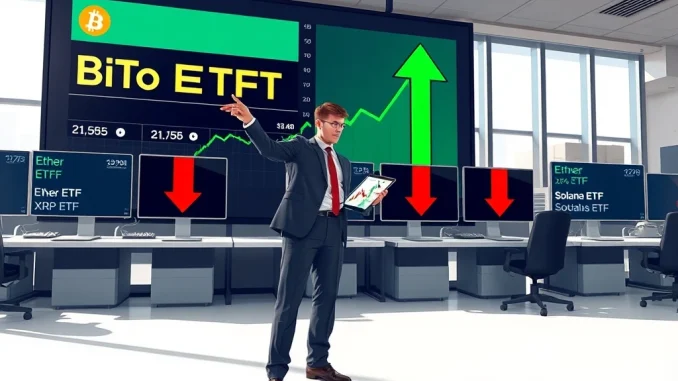
On Monday, March 10, 2026, U.S. financial markets witnessed a stark divergence in cryptocurrency investment vehicles. While spot Bitcoin ETFs snapped a two-day outflow streak with a robust $167 million influx, funds tied to major altcoins like Ether, XRP, and Solana extended their losses for a third consecutive session. This split in investor sentiment emerged even as the broader crypto market staged a modest rebound, highlighting a nuanced shift in capital allocation strategies among institutional and retail participants. The data, sourced from analytics firm SoSoValue, underscores a growing preference for Bitcoin’s perceived stability amid ongoing market recalibration.
US Bitcoin ETFs Rebound with $167 Million Inflow
The $167 million net inflow into U.S. spot Bitcoin ETFs on Monday marked a decisive reversal from the combined $577 million in outflows recorded on the previous Thursday and Friday. This resurgence in demand coincided with Bitcoin’s price climbing back toward the $70,000 threshold, trading at $70,015 at the time of writing according to CoinGecko. Analysts at Fidelity Digital Assets noted in a morning briefing that the return of inflows suggests underlying institutional confidence in Bitcoin’s long-term thesis remained intact despite short-term volatility. The flow reversal was led by established issuers like BlackRock’s iShares Bitcoin Trust and Fidelity’s Wise Origin Bitcoin Fund, which captured the majority of the day’s positive movement.
This recovery aligns with a broader easing of macroeconomic tensions that had pressured risk assets earlier in the month. On the same Monday, remarks from U.S. President Donald Trump regarding a potential de-escalation in Middle East geopolitical strife contributed to a drop in oil prices and a relief rally across equities and digital assets. However, the concentrated inflow into Bitcoin products, while other crypto ETFs languished, tells a more complex story about current risk assessment.
Altcoin Funds Extend Outflows Amid Market Rebound
In sharp contrast to Bitcoin’s ETF fortune, funds offering exposure to major altcoins faced continued selling pressure. According to SoSoValue’s granular data, U.S.-listed ETFs for Ether (ETH), XRP (XRP), and Solana (SOL) posted outflows of $51 million, $18 million, and $2.5 million respectively on Monday. This cemented a three-day outflow streak, with Ether bearing the brunt of the exodus at a cumulative $225 million over the period. Notably, these outflows persisted despite the underlying tokens themselves posting 3-5% gains over the prior 24 hours, a clear signal that ETF investors were decoupling from spot market momentum.
- Ether ETF Pressure: The $225 million three-day outflow from Ether funds represents the most significant capital flight, raising questions about near-term sentiment toward the Ethereum network ahead of its next major protocol upgrade.
- XRP Outflow Acceleration: While outflows for ETH and SOL showed signs of decelerating, XRP fund outflows actually increased, totaling approximately $41 million since the previous Thursday.
- Solana’s Relative Resilience: Despite outflows, Solana’s $16 million total over three days was proportionally smaller, hinting at a potentially more dedicated holder base or differing investor demographics.
Analyst Insights on Market Structure and Stress
Market analysts caution against declaring a definitive market bottom based on a single day’s ETF flow data. CryptoQuant’s lead on-chain analyst, who publishes under the moniker ‘IT’, pointed to key metrics suggesting ongoing stress. “The Bitcoin long-term holder to short-term holder spent output profit ratio (LTH-STH SOPR) has dropped to 0.89,” IT explained, referencing a proprietary dashboard. “This indicates that short-term holders are currently selling at a loss. While stress is building, we have not yet reached the capitulation levels typically associated with a structural market bottom.” This analysis suggests that while Bitcoin ETF flows are encouraging, underlying on-chain dynamics warn that further volatility may be ahead before a sustained upward trend is established.
Divergence in Context: A Flight to Perceived Quality?
The simultaneous inflow into Bitcoin ETFs and outflow from altcoin products is not an isolated event but fits a pattern observed during periods of market uncertainty. Historically, Bitcoin has acted as a “digital gold” or benchmark asset within the crypto ecosystem, often seeing capital rotate into it from higher-beta altcoins when risk appetite wanes. A comparison of cumulative flows since the January 2026 launch of a broader suite of altcoin ETFs reveals this dynamic clearly.
| ETF Asset | Net Flow (March 10) | 3-Day Cumulative Flow | Price Change (24hr) |
|---|---|---|---|
| Bitcoin (BTC) | +$167 Million | -$410 Million | +2.8% |
| Ether (ETH) | -$51 Million | -$225 Million | +4.1% |
| XRP (XRP) | -$18 Million | -$41 Million | +3.5% |
| Solana (SOL) | -$2.5 Million | -$16 Million | +5.2% |
This table illustrates the core divergence: positive price action did not translate into ETF demand for altcoins, whereas Bitcoin attracted capital despite more modest gains. Regulatory clarity, or the lack thereof, also plays a role. Bitcoin’s status as a commodity with established, approved ETF products offers a layer of regulatory certainty that altcoins, particularly those like XRP with ongoing legal proceedings, cannot yet match.
What’s Next for Crypto ETF Investors?
The immediate focus for traders will be whether Monday’s Bitcoin ETF inflow proves sustainable or is a one-day anomaly. Key triggers to watch include the weekly jobless claims data and upcoming commentary from Federal Reserve officials, which will influence broader risk sentiment. Within the crypto space, the release of the Consumer Price Index (CPI) report later this week will be critical. A higher-than-expected inflation print could reignite fears of prolonged restrictive monetary policy, potentially reversing the fragile inflow trend. Conversely, a benign report may solidify Bitcoin’s rebound and test whether capital begins to trickle back into oversold altcoin sectors.
Institutional and Retail Reactions to the Split
Reactions from market participants have been mixed. “We’re seeing a classic flight to liquidity and size,” noted Maya Rodriguez, Head of Digital Asset Strategy at Clearwater Capital, in an interview with Bloomberg. “In times of uncertainty, both traditional and crypto-native institutions consolidate positions into the largest, most liquid asset, which is Bitcoin.” On social media and retail trading forums, however, the mood is more divided. Some retail investors view the altcoin outflows as a contrarian buying signal, arguing that the divergence between ETF flows and spot prices creates a mispricing opportunity. Others are following the institutional lead, rebalancing portfolios toward Bitcoin-centric holdings until the market direction becomes clearer.
Conclusion
The March 10 flow data presents a tale of two crypto markets. The $167 million inflow into US Bitcoin ETFs demonstrates resilient core demand for the flagship cryptocurrency, buoyed by its established regulatory footing and role as a market benchmark. Simultaneously, the extended altcoin fund outflows for Ether, XRP, and Solana reveal a cautious, selective approach from ETF investors, who are unwilling to chase spot price rallies in more speculative assets. While geopolitical developments provided a temporary tailwind, on-chain metrics warn that underlying market stress persists. For investors, this divergence underscores the importance of granular flow analysis beyond headline price moves. The coming days will reveal if this marks the beginning of a sustained rotation into Bitcoin or merely a pause in a broader corrective phase for digital asset ETFs.
Frequently Asked Questions
Q1: What caused US Bitcoin ETFs to see inflows while altcoin ETFs saw outflows?
The divergence likely reflects a “flight to quality” or liquidity, where investors during periods of uncertainty prefer the largest, most established asset (Bitcoin) with clearer regulatory status. Altcoins, while gaining in spot price, are perceived as higher risk.
Q2: How significant is a $167 million inflow for Bitcoin ETFs?
While not a record, a $167 million single-day inflow is a strong positive signal, especially following two days of substantial outflows. It indicates that buyer demand returned quickly, supporting the asset’s price above $70,000.
Q3: Do outflows from an ETF mean the underlying asset (like Ether) is a bad investment?
Not necessarily. ETF flows represent one segment of demand, often from specific institutional or retail ETF products. The underlying Ether spot market was positive on the same day. Outflows can reflect profit-taking, portfolio rebalancing, or risk management within the ETF wrapper itself.
Q4: What is the Bitcoin LTH-STH SOPR ratio mentioned by analysts?
The Long-Term Holder to Short-Term Holder Spent Output Profit Ratio is an on-chain metric. A value below 1.0 indicates that short-term holders (often more speculative) are selling at a loss, which can signal mounting stress but not necessarily the final capitulation before a bottom.
Q5: Should I sell my altcoin ETF holdings based on this news?
Investment decisions should be based on individual financial goals, risk tolerance, and time horizon, not solely on short-term flow data. The outflows highlight current sentiment but do not predict long-term performance of the underlying technology or networks.
Q6: Where can I find reliable data on daily crypto ETF flows?
Analytics platforms like SoSoValue, Farside Investors, and Bloomberg Terminal provide daily aggregated and issuer-level flow data for U.S.-listed cryptocurrency exchange-traded products.