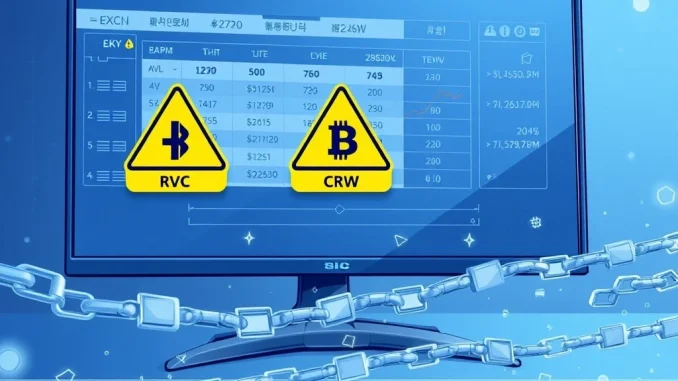
SEOUL, South Korea – March 21, 2025 – In a significant operational update, the prominent South Korean cryptocurrency exchange Upbit has announced a critical suspension of withdrawals for three digital assets: Ravencoin Classic (RVC), Exclusivity (EXCL), and Crown (CRW). The exchange cites a fundamental technical failure—a halt in block generation on their respective blockchain networks—as the primary reason for this protective action, immediately impacting user transactions and highlighting the inherent risks in decentralized finance infrastructure.
Upbit Withdrawal Suspension: A Technical Breakdown
Upbit’s decision to suspend withdrawals is a direct response to a cessation of block production. Block generation is the core process by which transactions are validated and added to a blockchain’s permanent ledger. Consequently, when this process stops, the network cannot confirm new transactions. This renders withdrawal functions on exchanges technically impossible and potentially unsafe. Upbit’s protocol mandates such suspensions to prevent users from initiating transactions that cannot be completed on-chain, which could lead to fund loss or reconciliation errors. The exchange has emphasized that deposits for these assets are also paused and that trading on its internal order books remains unaffected for now. This incident follows a pattern of network instability affecting smaller-cap proof-of-work and proof-of-stake blockchains under specific stress conditions.
The Affected Networks: RVC, EXCL, and CRW
A closer examination of the three impacted cryptocurrencies reveals distinct architectures and communities. Ravencoin Classic (RVC) is a fork of the Ravencoin blockchain, designed for asset tokenization. Exclusivity (EXCL) operates on a hybrid proof-of-work and proof-of-stake system focusing on privacy and smart contracts. Crown (CRW) is a proof-of-stake platform aiming to facilitate decentralized applications and governance. Despite their different goals, all three share a reliance on a distributed network of nodes to maintain consensus and produce blocks. A halt suggests a critical failure in this consensus mechanism, potentially due to a software bug, a significant drop in active nodes (miners or stakers), or a targeted network attack. Historical data from blockchain explorers shows that similar outages, while rare for major networks like Bitcoin or Ethereum, have occurred periodically for smaller chains throughout 2024 and early 2025.
Standard Exchange Protocol for Network Failures
Leading global exchanges like Upbit implement rigorous operational playbooks for network incidents. The standard procedure involves several key steps. First, automated monitoring systems flag the network’s health. Then, exchange engineers verify the issue across multiple independent nodes. Following verification, the exchange’s risk management team enacts a temporary suspension to protect user funds. Finally, the team initiates communication with the project’s development community to resolve the underlying problem. This process underscores the custodial role exchanges play, acting as intermediaries between users and often-unstable blockchain protocols. According to a 2024 report by the Crypto Exchange Security Alliance (CESA), over 78% of major exchanges have similar automatic suspension triggers for network health metrics.
- Immediate User Impact: Users cannot move assets off the exchange, limiting their utility and self-custody options.
- Market Impact: While trading may continue on Upbit, arbitrage opportunities with other exchanges are severed, potentially causing price discrepancies.
- Technical Response: Upbit’s developers are likely engaging with each project’s core team to diagnose the root cause, which could range from a needed protocol upgrade to a more severe consensus failure.
Historical Context and Industry Precedents
Network halts are not unprecedented in the cryptocurrency sector. For instance, the Solana network experienced multiple partial outages between 2021 and 2022 due to resource exhaustion. Similarly, several proof-of-work forks have occasionally stalled when mining hash rate dropped precipitously. The key differentiator in this event is the simultaneous failure of three unrelated networks prompting action from a top-tier exchange. This scenario raises questions about the resilience of smaller blockchain ecosystems and the due diligence exchanges perform before listing assets. Data from CoinGecko indicates that the combined market capitalization of RVC, EXCL, and CRW represents a fraction of a percent of the total crypto market, suggesting the financial systemic risk is low but the reputational and user trust implications for Upbit are significant.
Expert Analysis on Network Stability
Dr. Elena Rodriguez, a blockchain infrastructure researcher at the Seoul National University’s Digital Assets Lab, provides context. “A halt in block generation is one of the most serious non-security events for a blockchain,” she states. “It indicates a breakdown in the fundamental incentive or consensus model. For proof-of-work chains, it often means mining is no longer profitable. For proof-of-stake, it can mean validators are offline or there is a critical software bug. Exchanges are the first line of defense for everyday users against these underlying protocol risks.” This perspective highlights that the suspension is a symptom of a deeper network issue, not an exchange failure. The resolution timeline depends entirely on the responsiveness and technical capability of each asset’s development team to restart the chain, potentially requiring a hard fork or a coordinated validator restart.
Conclusion: A Reminder of Crypto’s Technical Underpinnings
Upbit’s suspension of withdrawals for RVC, EXCL, and CRW serves as a stark, real-time reminder of the complex and sometimes fragile technical infrastructure supporting digital assets. While the exchange’s action is a standard and prudent risk mitigation measure, the incident underscores the importance of network health and decentralization. For investors, it reinforces the need to understand the technical robustness of the blockchains behind the tokens they hold. The situation remains fluid, with users advised to monitor official Upbit announcements for updates on when block generation resumes and normal withdrawal services are restored. This event will likely fuel ongoing discussions about listing standards, network monitoring tools, and user education in the dynamic cryptocurrency landscape of 2025.
FAQs
Q1: Why did Upbit suspend withdrawals for RVC, EXCL, and CRW?
A1: Upbit suspended withdrawals because the underlying blockchain networks for these assets have stopped generating new blocks. This makes confirming and processing withdrawal transactions impossible and unsafe.
Q2: Is my money safe on Upbit during this suspension?
A2: The assets remain on the exchange’s ledger. The suspension is a protective measure to prevent users from initiating failed transactions. The safety of the funds depends on Upbit’s overall security, not the specific network outage.
Q3: Can I still trade RVC, EXCL, and CRW on Upbit?
A3: Typically, during a withdrawal suspension, trading on the exchange’s internal order books continues. However, you cannot deposit or withdraw the tokens to or from an external wallet until the network is restored and Upbit re-enables the service.
Q4: How long will the withdrawal suspension last?
A4: The duration is unpredictable and depends entirely on how quickly each project’s development team can diagnose and fix the block generation issue on their respective networks. It could last hours, days, or longer.
Q5: Has this happened before with other cryptocurrencies?
A5: Yes, network halts or significant slowdowns have occurred with various cryptocurrencies, especially smaller-cap projects. Major exchanges routinely suspend deposits and withdrawals in response to maintain operational integrity and protect users.
Q6: What should I do if I hold these assets on Upbit?
A6: Monitor official Upbit announcements via their website or verified social media channels. Avoid spreading unverified information. Understand that this is a network issue, and patience is required while the technical teams work on a resolution.
This article was produced with AI assistance and reviewed by our editorial team for accuracy and quality.