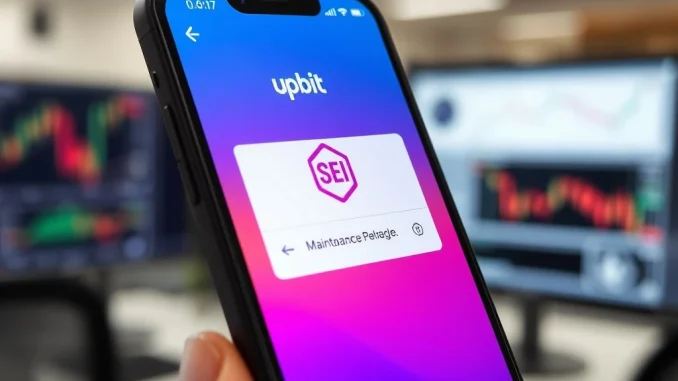
Seoul, South Korea, February 2, 2025: Major South Korean cryptocurrency exchange Upbit has issued a critical notice to its user base, announcing a temporary suspension of all deposit and withdrawal services for the Sei (SEI) token. This essential maintenance window, scheduled to begin at 9:00 a.m. UTC on Monday, February 3, is a direct response to an upcoming network upgrade on the Sei blockchain. The proactive measure highlights the exchange’s operational protocols for managing technical transitions while prioritizing user asset security. For traders and holders of SEI, this announcement necessitates immediate planning to avoid disruption during the suspension period.
Upbit SEI Suspension: Details and Immediate Impact
Upbit’s official announcement provides clear operational parameters for the temporary halt. The suspension applies specifically to the deposit and withdrawal functions for the SEI token. Crucially, trading of SEI against Korean Won (KRW) and other trading pairs on the exchange will remain fully operational during this period. Users can continue to place buy and sell orders within the Upbit order book. The suspension is a standard procedure for cryptocurrency exchanges when a underlying blockchain undergoes a significant protocol change or upgrade. This process allows the exchange’s technical team to safely implement necessary updates to its node software, wallet infrastructure, and security protocols to ensure full compatibility with the upgraded network. Failure to perform this synchronized maintenance could result in failed transactions or loss of funds.
Understanding the Sei Network Upgrade Context
The suspension is not an isolated event but part of a broader ecosystem update. The Sei Network, a blockchain specifically optimized for decentralized exchange (DEX) trading, periodically undergoes upgrades to enhance its performance, security, and feature set. These upgrades can include consensus mechanism improvements, new virtual machine capabilities, or enhanced transaction processing modules. For an exchange like Upbit, which custodies user assets, integrating these changes requires meticulous testing in a controlled environment. The temporary suspension of external transfers effectively isolates the exchange’s systems during this integration phase, preventing any inbound or outbound transactions that might conflict with the transitioning network state. This practice is considered a industry-standard best practice for security and reliability.
Standard Protocol for Exchange Operations
Major global exchanges like Binance, Coinbase, and Kraken routinely employ similar temporary suspensions during network events. The process typically follows a established timeline:
- Pre-announcement: The exchange publishes a notice 24-48 hours in advance, as Upbit has done.
- Snapshot & Pre-closure: The exchange may take a snapshot of user balances for internal reconciliation.
- Suspension Window: Deposits and withdrawals are disabled while technical teams deploy and validate new node software.
- Post-Upgrade Verification: Once the network upgrade is stable and the exchange’s integration is confirmed, services are methodically re-enabled.
- Re-opening Announcement: A follow-up notice confirms the resumption of normal service.
This structured approach minimizes risk and provides users with predictable timelines for managing their assets.
Practical Implications for SEI Traders and Holders
For users of the Upbit platform, this announcement requires specific actions. Any plans to deposit SEI from an external private wallet or hardware wallet to Upbit must be completed before 9:00 a.m. UTC on February 3. Similarly, users wishing to withdraw SEI from Upbit to a private wallet for staking, participation in decentralized finance (DeFi) protocols on the Sei network, or simply for self-custody must initiate those withdrawals before the deadline. Transactions initiated after the suspension time will fail and likely be refunded by the exchange’s system, causing delays. It is also advisable for users to verify the completion of the upgrade and official resumption notice from Upbit before attempting any transactions after the maintenance window, as early attempts may also fail if services are not fully restored.
Historical Precedent and Market Stability
Temporary suspensions for network upgrades, while occasionally causing short-term price volatility due to reduced liquidity flows, are generally viewed neutrally by the market. They signal ongoing development and maintenance rather than operational problems. Historical data from similar events on major exchanges shows that trading activity often resumes normally post-upgrade, with the underlying asset benefiting from the improved network functionality. The key for investors is to distinguish between planned, announced technical maintenance and unplanned, emergency suspensions, which can signal security incidents.
Broader Industry Perspective on Exchange Management
Upbit’s handling of this event reflects its position as a leading regulated exchange in South Korea, operating under strict guidelines from the Financial Services Commission (FSC) and the Financial Intelligence Unit (FIU). Compliance with these regulations mandates transparent communication and demonstrably secure operational procedures. The pre-emptive announcement aligns with global standards for investor protection and market integrity. It also underscores the complex interdependency between centralized exchanges (CEXs) like Upbit and the decentralized blockchains whose tokens they list. The exchange must act as a bridge, ensuring its centralized systems remain perfectly synchronized with the evolving decentralized networks to provide a seamless user experience.
Conclusion
Upbit’s temporary suspension of SEI deposits and withdrawals is a planned, procedural action directly tied to the Sei network’s scheduled upgrade. This essential maintenance window, beginning February 3, underscores the exchange’s commitment to operational security and technical diligence. Users are advised to complete any necessary external SEI transfers before the deadline and to monitor official Upbit channels for the service resumption notice. Such events are a normal part of the cryptocurrency ecosystem’s growth, ensuring networks and the exchanges that support them continue to evolve securely and efficiently.
FAQs
Q1: Can I still trade SEI on Upbit during the suspension?
A1: Yes. The suspension applies only to depositing SEI into your Upbit account from an external wallet and withdrawing SEI from Upbit to an external wallet. Trading SEI against KRW and other pairs on the Upbit exchange platform will continue as normal.
Q2: How long will the SEI deposit and withdrawal suspension last?
A2: Upbit’s announcement specifies the start time but not the exact duration. The length typically depends on the complexity of the network upgrade and the time required for validation. The exchange will publish a separate notice once services resume. Users should monitor Upbit’s official announcement page for updates.
Q3: Is my SEI safe on Upbit during this time?
A3: The suspension is a proactive security and technical measure. User assets remain secured in Upbit’s custody. The process is designed specifically to protect funds during a period of technical change on the underlying blockchain.
Q4: What happens if I send SEI to my Upbit deposit address during the suspension?
A4: Transactions sent to the exchange’s deposit address during the suspension period will not be credited automatically and will likely be lost or require manual recovery, which can be a lengthy process. It is critical to only deposit SEI after Upbit confirms services have fully resumed.
Q5: Why do exchanges need to suspend services for a network upgrade?
A5: Exchanges run their own nodes (software connections) to the blockchain. When the blockchain protocol upgrades, the exchange must update its node software to the new version to remain compatible. Suspending deposits and withdrawals prevents transactions from being sent or received during this transitional state, which could cause failures or double-spends, ensuring the safety of user assets.