Upbit Halts BingX Transactions: A Critical Move for South Korean Crypto Compliance
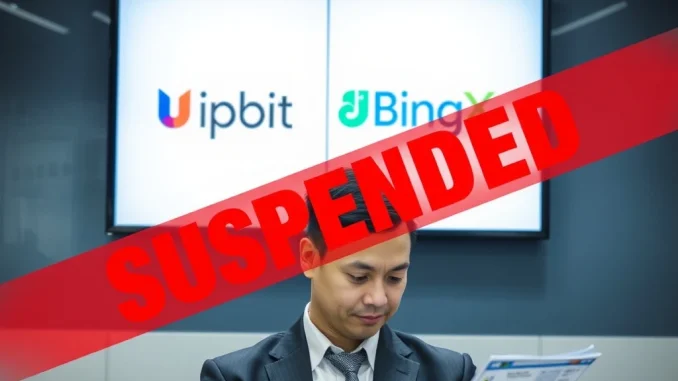
In a significant development for the Asian cryptocurrency sector, South Korea’s premier digital asset exchange, Upbit, has announced an immediate suspension of all deposit and withdrawal services with the global trading platform BingX. This decisive action, confirmed on March 21, 2025, follows direct guidance from South Korean financial authorities and underscores the nation’s stringent approach to digital asset oversight. Consequently, the move removes BingX from Upbit’s verified list of partner exchanges, fundamentally altering operational pathways for users across both platforms.
Upbit BingX Suspension: The Core Regulatory Directive
Upbit’s operational halt with BingX stems from a specific regulatory mandate concerning account holder identification. South Korean law, particularly the Specific Financial Information Act (SFIA), mandates that virtual asset service providers (VASPs) maintain rigorous real-name verification systems. These systems must link directly to domestic bank accounts. Furthermore, exchanges must only interact with foreign VASPs that demonstrate equivalent anti-money laundering (AML) and know-your-customer (KYC) standards. Authorities determined that BingX’s verification protocols no longer met the updated compliance benchmarks required for a trusted partner. Therefore, Upbit initiated the suspension to align fully with national policy, prioritizing systemic security over connectivity.
The Mechanism of Exchange Verification
Upbit maintains a dynamic internal registry of approved external exchanges. This list functions as a whitelist for seamless cross-platform asset movement. For an exchange to gain and retain status on this list, it must undergo periodic audits. These audits assess several critical areas:
- KYC/AML Framework: Depth of user identity checks and transaction monitoring.
- Data Security: Protocols for safeguarding user information and funds.
- Regulatory Standing: Licensing and compliance history in its home jurisdiction.
- Operational Transparency: Willingness to share necessary data with counterparties like Upbit.
BingX’s removal from this list indicates a failure to satisfy one or more of these evolving criteria, as interpreted by South Korean regulators.
Context: South Korea’s Evolving Crypto Landscape
This action does not occur in a vacuum. Instead, it represents the latest step in South Korea’s methodical tightening of cryptocurrency regulations. Following major incidents like the Terra-LUNA collapse, which profoundly impacted Korean investors, financial watchdogs have aggressively enhanced consumer protection measures. The Financial Services Commission (FSC) and the Financial Intelligence Unit (FIU) now exercise heightened scrutiny over all VASP operations, both domestic and international. Their focus has sharply turned to the origins and destinations of user funds, especially those flowing to offshore exchanges with less transparent oversight. This regulatory posture aims to prevent capital flight, tax evasion, and illicit finance, creating a more controlled digital asset ecosystem.
| Date | Action | Governing Body |
|---|---|---|
| Q1 2024 | Enhanced Travel Rule enforcement for transactions over 1 million KRW | FIU |
| Q3 2024 | Mandatory reserve ratio increase for exchange-held user deposits | FSC |
| Q1 2025 | Guidance on re-evaluating foreign VASP partnerships (Leading to Upbit-BingX halt) | FSC/FIU |
Immediate and Long-Term Impacts on Users and the Market
The suspension creates immediate operational friction for users who leveraged both platforms for arbitrage or diversified trading strategies. Users can no longer directly transfer assets between Upbit and BingX wallets. They must now use an intermediary wallet or a different, still-verified exchange, incurring additional transaction fees and time delays. Market analysts observe that such actions can temporarily increase volatility for assets heavily traded across these platforms. Moreover, this event signals to the global market that South Korea is willing to enact operational isolation to enforce its standards. Consequently, other global exchanges seeking access to the lucrative Korean market may face increased pressure to adopt similar compliance frameworks or risk similar exclusion.
Expert Analysis on Compliance Trends
Industry compliance specialists note that this is part of a broader trend of regulatory fragmentation. “We are moving from a period of wild-west growth to one of jurisdictional sovereignty in digital assets,” states Dr. Mina Park, a fintech law professor at Seoul National University. “Nations are defining their own rulebooks, and interoperability is becoming a privilege granted only to those who meet the highest local bar. Upbit’s move is a textbook example of a domestic leader enforcing jurisdictional boundaries as dictated by its regulators.” This perspective highlights that the decision is less about BingX’s specific operations and more about South Korea asserting control over its financial perimeter.
Comparative Look: How Other Korean Exchanges Are Responding
Upbit, as the market leader, often sets a precedent. Other major South Korean exchanges like Bithumb and Korbit are now under scrutiny regarding their own foreign partnerships. While no other suspensions have been announced concurrently, industry observers expect these platforms to conduct urgent reviews of their verified partner lists. The regulatory guidance likely applies industry-wide, suggesting a potential wave of de-listings if other foreign VASPs fail to demonstrate upgraded compliance. This proactive stance helps Korean exchanges mitigate regulatory risk, but it also potentially limits their users’ access to the global market, presenting a complex trade-off between security and openness.
Conclusion
The Upbit BingX suspension is a pivotal event, demonstrating the practical enforcement of South Korea’s rigorous cryptocurrency regulations. Driven by regulatory guidance focused on account holder identification and AML standards, this decision prioritizes national compliance and user protection over unfettered market access. It forces immediate adaptation from users and sends a clear signal to the global crypto industry about the cost of accessing the South Korean market. As regulatory walls continue to rise, the incident underscores the growing importance of standardized, transparent, and robust compliance frameworks for any exchange operating in or connected to major regulated economies.
FAQs
Q1: Can I still trade on BingX if my account is from South Korea?
Yes, the suspension affects direct deposit and withdrawal channels between Upbit and BingX. South Korean users may still access BingX directly, but they cannot move funds to/from their Upbit account directly. They must use alternative methods, which may involve additional verification steps from BingX.
Q2: Will this suspension affect the price of cryptocurrencies on Upbit?
It may cause short-term volatility for specific tokens that had high cross-platform volume between Upbit and BingX. However, the broader market impact is likely contained, as the action is specific to one corridor and reflects regulatory compliance rather than a security breach or insolvency.
Q3: What should users with assets on both platforms do now?
Users should not panic. They should log into both platforms to assess their holdings. To move assets, they must now use a third, compliant wallet or exchange that remains on Upbit’s verified list. They should also account for network fees and potential price changes during the transfer process.
Q4: Is this related to security concerns about BingX?
Upbit’s announcement cites regulatory guidance on verification standards, not a specific security incident. The action is preventative and compliance-based, aiming to align with South Korean law regarding partner due diligence and information sharing.
Q5: Could BingX be re-added to Upbit’s verified list in the future?
Potentially, yes. If BingX successfully upgrades its verification and compliance systems to meet the standards demanded by South Korean authorities and can demonstrate this to Upbit’s satisfaction, the partnership could theoretically be reinstated. However, this process would require time and formal re-approval.
Related News
- USDC Transfer Stuns Market: $300 Million Whale Move to Binance Sparks Intense Scrutiny
- OKX ZORA Futures: Unleash 50x Leverage Trading Opportunities
- Binance Airdrop: Exciting DOOD Tokens Distributed to Eligible Holders
Related: BTC vs Gold Ratio Plummets to Record Low – A Hidden Signal for the Ultimate Bottom?
Related: Stunning 15.48% Surge for Happy Cat Coin as Symmetrical Triangle Breakout Fuels Analyst Optimism
Related: Crypto ETF Shocker: BlackRock Dumps $303.5M as Solana Defies Trend with $13.9M Inflows