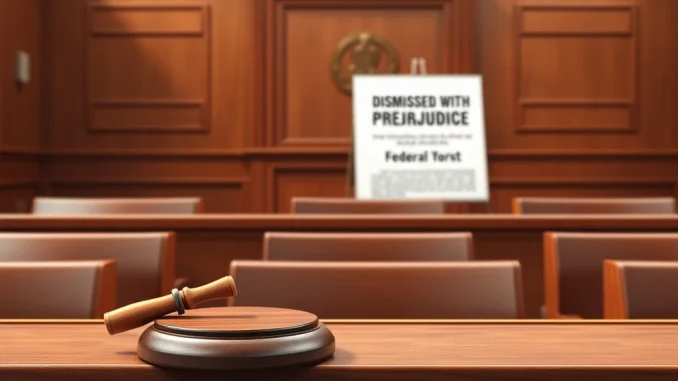
In a landmark decision for the decentralized finance (DeFi) sector, U.S. District Judge Katherine Polk Failla dismissed the high-profile Risley class action lawsuit against Uniswap Labs with prejudice on March 2, 2026. The ruling from the Southern District of New York delivers a decisive victory for the leading decentralized exchange and establishes a critical legal shield for open-source software developers. Consequently, this dismissal with prejudice bars plaintiffs from refiling the same claims, effectively ending a years-long legal battle over liability for scam tokens traded on the protocol.
Court Delivers Final Blow to Uniswap Lawsuit
Judge Failla’s order granted Uniswap Labs’ motion to dismiss all remaining claims, anchoring her decision in established principles of contract and securities law. The plaintiffs had argued that Uniswap Labs, as the primary developer of the Uniswap protocol interface and liquidity provider, should bear responsibility for financial losses users suffered from fraudulent tokens created by third parties. However, the court found no legal basis for this liability. “The protocol’s smart contracts execute autonomously,” the judge noted, drawing a clear line between the tool’s creators and its misuse. This reasoning reinforces a precedent that treats software code as a neutral tool, similar to other technologies.
Background context reveals this lawsuit, filed in late 2023, was a bellwether case closely watched by the entire crypto industry. It tested the limits of intermediary liability in a trustless, automated financial system. The dismissal follows a series of prior motions where Judge Failla had already pared down the plaintiffs’ arguments, signaling skepticism toward extending traditional financial regulations to decentralized protocols. A timeline of key filings shows the case winding through the court for over two years before this definitive conclusion.
Implications for DeFi and Open-Source Development
The ruling’s impact extends far beyond a single company, potentially reshaping the regulatory landscape for thousands of DeFi projects. By affirming that developers of open-source, autonomous protocols are not liable for third-party actions, the decision provides a layer of legal predictability that has been absent. This clarity could accelerate innovation and investment in the sector. Specifically, the judgment influences three key areas.
- Developer Innovation: Teams can build decentralized applications with reduced fear of disproportionate liability for bad actors exploiting their public code.
- Investor Confidence: Legal uncertainty has been a major barrier to institutional capital; this precedent mitigates a significant category of regulatory risk.
- Regulatory Strategy: The ruling may force regulators to pursue targeted legislation rather than applying existing intermediary frameworks, shaping future policy debates.
Legal Experts Weigh In on the Precedent
Prominent legal scholars and industry attorneys immediately recognized the decision’s significance. “This is the most important judicial opinion for DeFi since the Hinman speech,” stated Marta Belcher, general counsel at the Filecoin Foundation, referencing the 2018 SEC guidance on digital assets. She emphasized that the ruling protects the core ethos of permissionless innovation. Meanwhile, a report from the Coin Center research nonprofit highlighted how the dismissal aligns with long-standing arguments that code is speech protected under the First Amendment. Conversely, some consumer protection advocates, like those at the Consumer Federation of America, expressed concern that the decision could leave users without recourse in a rapidly growing but often opaque financial ecosystem.
Broader Context in Crypto Legal Battles
This Uniswap victory contrasts sharply with other ongoing regulatory actions, illustrating the nuanced legal terrain for crypto. While the SEC has pursued enforcement against centralized exchanges and token issuers for alleged securities violations, courts are increasingly distinguishing between centralized entities and decentralized protocols. The table below compares key recent cases to highlight the differing legal theories and outcomes.
| Case | Entity Type | Core Allegation | Current Status |
|---|---|---|---|
| SEC v. Coinbase | Centralized Exchange | Unregistered securities exchange | Ongoing Litigation |
| SEC v. Ripple Labs | Token Issuer | Unregistered securities offering | Partial Summary Judgment |
| Risley v. Uniswap Labs | DeFi Protocol Developer | Secondary liability for scam tokens | Dismissed with Prejudice |
What Happens Next for DeFi Regulation?
The dismissal does not end regulatory scrutiny but redirects it. Legislators are now under increased pressure to provide clear statutory frameworks. The Lummis-Gillibrand Responsible Financial Innovation Act, reintroduced in the 2026 congressional session, proposes specific definitions and safe harbors for decentralized networks. Furthermore, the Commodity Futures Trading Commission (CFTC) may gain a larger oversight role under new bipartisan proposals, focusing on commodity-based DeFi activities rather than treating them as securities. Industry groups are already citing Judge Failla’s opinion in their lobbying efforts, arguing that judicially confirmed principles should guide new laws.
Community and Market Reactions
Within hours of the news, the native UNI token price surged over 15%, reflecting market relief. The developer community across platforms like GitHub and Twitter celebrated the ruling as a validation of decentralized ideals. “This confirms that we are building infrastructure, not financial products,” posted a lead engineer from a competing DeFi protocol. However, some user advocates on Reddit and crypto forums voiced frustration, arguing that while the protocol is decentralized, the for-profit company behind it should still bear some duty of care. This tension between ideological purity and practical consumer protection will likely define the next phase of public debate.
Conclusion
The dismissal of the Uniswap lawsuit marks a pivotal moment, providing judicial affirmation that the architects of decentralized protocols are not liable for every use—or misuse—of their tools. This precedent strengthens the legal foundation for open-source development in finance, reduces a major category of risk for builders, and forces a more precise regulatory conversation. Moving forward, stakeholders should monitor legislative developments in Washington and enforcement priorities at the CFTC, as the battle over DeFi’s future shifts from the courts to the halls of Congress. The ruling offers clarity but not a blanket immunity, setting the stage for the next chapter in defining the rules of decentralized finance.
Frequently Asked Questions
Q1: What does ‘dismissed with prejudice’ mean for the Uniswap lawsuit?
It means the court has terminated the Risley class action case permanently. The plaintiffs cannot refile the same claims against Uniswap Labs in this court, bringing the specific lawsuit to a definitive end.
Q2: How does this ruling protect other DeFi developers?
The ruling establishes a persuasive legal precedent that developers of neutral, open-source software tools are not automatically liable for financial losses caused by third parties who create or list scam tokens on those protocols.
Q3: Can regulators still sue Uniswap Labs or similar companies after this?
Yes. This ruling addresses a specific private class action. Federal agencies like the SEC or CFTC can still bring separate enforcement actions on different legal grounds, such as allegations of operating an unregistered securities exchange.
Q4: What should a user who lost money to a scam token on Uniswap do now?
Their primary recourse is against the anonymous creators of the specific scam token, which is often impractical. This ruling highlights the inherent ‘buyer beware’ risk in permissionless DeFi, underscoring the importance of personal due diligence.
Q5: Does this mean all DeFi activity is unregulated?
No. The decision narrows one avenue of liability but does not create a regulatory vacuum. Activities may still fall under existing laws for money transmission, commodities trading, or securities, depending on their specific structure and marketing.
Q6: How does this affect the future of decentralized app development in the U.S.?
It provides significant positive signal, reducing a major legal uncertainty. Developers may feel more confident building in the U.S., but they must still navigate other complex regulatory areas like sanctions compliance and money transmitter laws.
Updated insights and analysis added for better clarity.
This article was produced with AI assistance and reviewed by our editorial team for accuracy and quality.