NEW YORK, March 15, 2026 — The cryptocurrency market witnessed two significant developments this week that are reshaping investment strategies. According to a Bloomberg report published Thursday, Uniswap could generate approximately $27 million in annual revenue through its proposed fee switch mechanism. Meanwhile, the emerging Pepeto exchange has crossed the $7.4 million mark during its ongoing presale phase. These developments occur against a backdrop of rising memecoin values, with Shiba Inu and Pepe both showing substantial gains over the past month. Market analysts now consider these events crucial indicators for identifying the best crypto to buy now in March 2026.
Uniswap’s $27 Million Fee Switch Proposal
Bloomberg’s cryptocurrency desk reported Thursday morning that Uniswap’s governance community is actively debating a fee switch implementation. This mechanism would redirect a portion of trading fees from liquidity providers to UNI token holders. The proposed 0.05% fee on all trades across Uniswap v3 pools could generate approximately $27 million annually based on current trading volumes. Uniswap founder Hayden Adams first proposed the concept in 2020, but governance discussions gained urgency this month as decentralized exchange competition intensified.
The Uniswap community will vote on the proposal between March 20-27, 2026. Governance delegate Wintermute has already signaled support, citing sustainable protocol funding needs. Conversely, some liquidity providers argue the fee switch could reduce incentives for capital deployment. Historical data shows Uniswap processed over $540 billion in trading volume during 2025, making even small fee percentages economically significant. The protocol currently charges no fees beyond what liquidity providers earn, distinguishing it from centralized competitors like Coinbase.
Pepeto Exchange Crosses $7.4 Million Presale Milestone
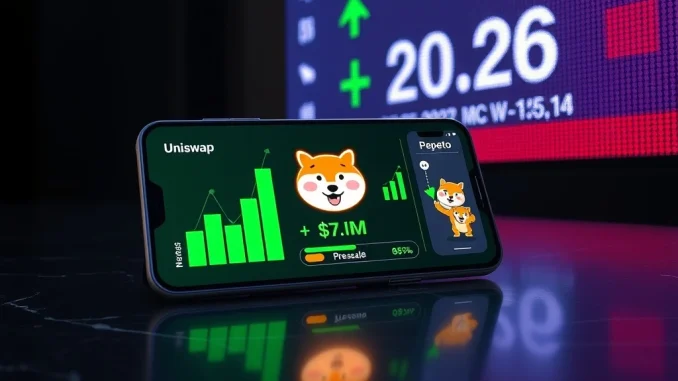
While established protocols debate fee structures, emerging platforms are attracting substantial capital. The Pepeto exchange presale has reached $7.4 million as of Friday morning, according to on-chain data verified by Etherscan. This memecoin-focused decentralized exchange positions itself as a specialized platform for trending tokens. Pepeto’s development team, led by former Binance engineer Marcus Chen, announced the presale would fund enhanced security audits and liquidity pool development.
The presale’s success coincides with renewed interest in memecoin ecosystems. Shiba Inu has gained 42% this month, reaching a market capitalization of $18.7 billion. Similarly, Pepe has surged 67% since February, now valued at $4.3 billion. These movements reflect broader retail investor re-engagement with cryptocurrency markets after 2025’s regulatory clarity. However, the presale structure has drawn scrutiny from some analysts who note similar projects faced challenges maintaining momentum post-launch.
Market Impact and Investor Reactions
The simultaneous developments have created divergent market reactions. Institutional investors appear focused on Uniswap’s potential revenue generation, while retail traders show stronger interest in Pepeto’s presale. Crypto fund manager Arca Capital published analysis Thursday suggesting Uniswap’s fee switch could increase UNI token value by 15-25% if implemented. Meanwhile, decentralized finance researcher Sarah Johnson of Messari cautioned that “presale enthusiasm doesn’t guarantee sustainable protocol usage.”
On-chain metrics reveal distinct capital flows. Approximately $190 million entered UNI-related positions this week, primarily through institutional custody solutions. Conversely, Pepeto’s presale attracted smaller average contributions of $2,100, indicating broader retail participation. The differing investor profiles suggest these developments represent parallel rather than competing trends within the March 2026 cryptocurrency landscape.
Comparative Analysis: Protocol Revenue vs. Presale Momentum
These events highlight two distinct approaches to cryptocurrency value creation. Uniswap represents established protocols seeking sustainable revenue models, while Pepeto exemplifies new platforms leveraging current market trends. The table below compares key metrics:
| Metric | Uniswap Fee Switch | Pepeto Presale |
|---|---|---|
| Potential Annual Value | $27 million | $7.4 million (current) |
| Implementation Timeline | Governance vote March 20-27 | Presale concludes April 5 |
| Primary Investor Type | Institutional/Governance | Retail/Early Adopters |
| Risk Profile | Regulatory/Governance | Execution/Adoption |
| Market Position | Established Market Leader | Emerging Niche Player |
Broader Market Context and Historical Precedents
The current developments occur within specific historical patterns. Fee switch proposals have surfaced periodically since Uniswap’s 2018 launch, but previous votes failed to reach quorum. The closest precedent occurred in June 2023 when a similar proposal gained 42% support before stalling. This time, changed market conditions and clearer regulatory frameworks appear to be shifting sentiment. Meanwhile, successful presales have preceded both major successes and failures. The 2021 SushiSwap migration generated initial enthusiasm but faced early technical challenges, while more recent projects like Sei Network maintained momentum post-launch.
Current trading volumes suggest both developments respond to genuine market needs. Decentralized exchange volumes reached $128 billion in February 2026, up 18% from January. Memecoin trading specifically increased 34% during the same period, indicating sustained interest beyond speculative spikes. These metrics help explain why both established protocols and new platforms are attracting capital simultaneously.
Regulatory Considerations and Compliance
Both developments face distinct regulatory considerations. Uniswap’s fee switch proposal includes legal analysis from firm DeFi Legal Associates, which suggests the structure may qualify for different treatment than traditional securities. The analysis references 2025 SEC guidance on decentralized governance mechanisms. Conversely, Pepeto’s presale includes geographic restrictions excluding U.S. participants, reflecting ongoing regulatory uncertainty around new token offerings. These compliance measures illustrate how cryptocurrency projects are adapting to evolving regulatory frameworks while pursuing growth.
Forward-Looking Analysis: What Happens Next
The coming weeks will determine both projects’ trajectories. Uniswap governance participants must weigh technical implementation details against economic incentives. The voting process itself will serve as a test case for decentralized decision-making under substantial economic stakes. Meanwhile, Pepeto’s team must convert presale momentum into functional platform deployment. Their roadmap indicates mainnet launch scheduled for March 2026, with security audit results due in April.
Market observers should monitor several key indicators. For Uniswap, governance participation rates and delegate alignment will signal community cohesion. For Pepeto, post-presale token distribution and initial liquidity depth will indicate project health. Both projects ultimately face the same fundamental challenge: converting theoretical value into sustainable ecosystem growth. Their divergent approaches provide natural experiments for the broader cryptocurrency industry.
Conclusion
The March 2026 cryptocurrency landscape presents investors with distinct opportunities reflecting different risk profiles and time horizons. Uniswap’s potential $27 million fee switch revenue represents established protocol maturation, while Pepeto’s $7.4 million presale demonstrates continued innovation at the ecosystem edges. Both developments occur alongside Shiba Inu and Pepe’s substantial gains, indicating broad-based market activity rather than isolated events. Investors evaluating the best crypto to buy now should consider how these parallel trends might converge or diverge as market conditions evolve through 2026’s second quarter. The coming governance vote and presale conclusion will provide crucial data points for future investment decisions.
Frequently Asked Questions
Q1: What is Uniswap’s fee switch and how does it work?
The fee switch is a proposed mechanism that would redirect 0.05% of trading fees on Uniswap v3 pools from liquidity providers to UNI token holders. Based on current volumes, this could generate approximately $27 million annually for token holders who stake their UNI.
Q2: Why has Pepeto’s presale reached $7.4 million?
Pepeto’s presale success reflects strong retail interest in memecoin-focused trading platforms, coinciding with Shiba Inu and Pepe’s substantial price increases. The project also benefits from experienced leadership and clear roadmap milestones.
Q3: When will Uniswap governance vote on the fee switch?
The formal governance vote is scheduled for March 20-27, 2026. UNI token holders can delegate voting power or participate directly through Uniswap’s governance portal during this period.
Q4: Are these developments related to Shiba Inu and Pepe’s price increases?
While occurring simultaneously, these are largely separate developments. Uniswap’s fee switch addresses protocol economics, while Pepeto’s presale leverages memecoin popularity. However, all reflect increased cryptocurrency market activity in March 2026.
Q5: What risks should investors consider with these opportunities?
Uniswap’s proposal faces governance and regulatory uncertainties, while Pepeto must successfully launch and attract sustainable usage. Both carry typical cryptocurrency risks including volatility, technical challenges, and market sentiment shifts.
Q6: How do these developments affect average cryptocurrency investors?
For UNI holders, the fee switch could provide staking rewards. For presale participants, early Pepeto access offers potential advantages. Both developments indicate broader industry maturation that may create more stable investment environments long-term.
Updated insights and analysis added for better clarity.
This article was produced with AI assistance and reviewed by our editorial team for accuracy and quality.