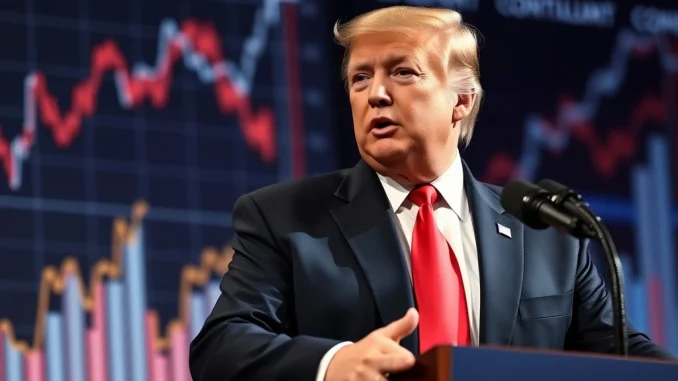
Economic stability significantly influences all financial markets. This includes the cryptocurrency sector. Therefore, understanding global economic statements becomes crucial. Recently, former U.S. President Donald Trump made a notable declaration. He asserted that Trump tariffs have not fueled inflation. He also claimed consumers are not bearing their cost. This statement directly challenged warnings from prominent financial figures. For instance, Goldman Sachs CEO David Solomon had previously cautioned about market impacts. This report came via Walter Bloomberg on X. Trump’s comments followed the release of July’s Consumer Price Index (CPI) data. The CPI rose 2.7% year-over-year. This figure was slightly below the 2.8% forecast. Such economic discussions often spark considerable interest among investors. They seek to gauge potential shifts in US economic policy and market sentiment.
Trump Tariffs Under Scrutiny: A Direct Challenge
Former President Donald Trump recently reiterated his stance on trade tariffs. He firmly stated that these import duties do not cause inflation. Furthermore, he argued that American consumers do not pay for them. This position directly contradicts widely held economic theories. Many economists believe tariffs increase import costs. Consequently, these higher costs can be passed on to consumers. Trump’s assertion comes at a time of heightened economic vigilance. Policy makers and the public closely watch inflation trends. His remarks specifically targeted concerns raised by top financial institutions. David Solomon, CEO of Goldman Sachs, had previously warned about the market impacts of tariffs. Solomon’s warnings suggested tariffs could disrupt supply chains. They might also lead to higher prices for goods. Trump, however, dismissed these market warnings outright. He maintains his trade policies benefit the U.S. economy. He believes they protect domestic industries.
The Ongoing Inflation Debate: Understanding the Nuances
The inflation debate remains a central topic in economic discussions. Inflation refers to the rate at which prices for goods and services rise. This rise leads to a decline in purchasing power. Various factors contribute to inflation. These include supply chain disruptions, consumer demand, and government spending. Tariffs are often cited as one such factor. Proponents of this view argue that tariffs act as a tax on imported goods. This tax increases the cost for businesses. Businesses then pass these increased costs onto consumers. Thus, tariffs contribute to higher consumer prices. Opponents, like Trump, argue differently. They suggest foreign exporters absorb the tariff costs. Alternatively, they contend that domestic production increases. This rise in domestic output could offset import price hikes. The recent CPI data adds another layer to this discussion. July’s CPI showed a 2.7% year-over-year increase. This was slightly below the 2.8% forecast. This marginal difference fuels different interpretations. Some might see it as evidence against significant tariff-induced inflation. Others might argue it simply reflects broader economic trends. They might say it does not negate the tariff impact.
US Economic Policy and Broader Implications
Discussions around US economic policy often involve complex interdependencies. Trade policies, like the implementation of Trump tariffs, have far-reaching effects. These effects extend beyond immediate price changes. They influence international trade relations. They also impact global supply chains. Furthermore, they shape domestic industry competitiveness. The former president’s approach prioritized protecting American jobs. He aimed to reduce trade deficits. His administration imposed tariffs on goods from several countries. China was a primary target. These actions sparked retaliatory tariffs from other nations. Such trade disputes can create uncertainty for businesses. They can also affect investment decisions. Consequently, this uncertainty might slow economic growth. However, supporters argue these policies force fairer trade practices. They contend that such policies ultimately strengthen the U.S. economy. The long-term impact of these policies remains a subject of ongoing study. Economists continue to analyze their effects on various sectors. They also examine their influence on overall economic stability.
Analyzing Consumer Prices and Market Warnings
Understanding consumer prices is vital for assessing economic health. The Consumer Price Index (CPI) measures the average change over time. It tracks prices paid by urban consumers. These prices are for a market basket of consumer goods and services. A lower-than-forecast CPI rise, like July’s 2.7%, can offer mixed signals. On one hand, it might suggest inflationary pressures are not as severe as anticipated. On the other hand, it does not mean inflation is absent. It simply indicates a specific rate of increase. Financial institutions like Goldman Sachs issue market warnings based on their economic models. These models consider various factors. They include global trade dynamics, supply and demand, and geopolitical events. When David Solomon voiced concerns, he likely factored in potential disruptions. These disruptions could stem from trade barriers. His warnings reflected a conventional economic view. This view suggests tariffs introduce inefficiencies. These inefficiencies can lead to higher costs for businesses and consumers. Therefore, a divergence of opinion exists between political leaders and financial experts. This divergence highlights the complexity of economic forecasting. It also underscores the varied interpretations of economic data.
Future Outlook and Economic Trajectories
The debate surrounding Trump tariffs and their inflationary impact will likely continue. Future economic data will provide further insights. Policymakers will continue to weigh the benefits and drawbacks of trade protectionism. They must balance domestic industry support with potential consumer costs. The global economic landscape also plays a significant role. Geopolitical events and supply chain resilience influence inflation. They also affect overall economic growth. Businesses must adapt to evolving trade environments. Consumers, too, monitor price changes closely. The interplay between political rhetoric and economic realities shapes market expectations. Ultimately, the long-term trajectory of consumer prices depends on many factors. These factors include fiscal policies, monetary policies, and global trade agreements. The ongoing inflation debate reflects a dynamic economic environment. It requires continuous analysis and careful consideration of all viewpoints.
Frequently Asked Questions (FAQs)
Q1: What are Trump tariffs?
Trump tariffs refer to the import duties imposed by the administration of former U.S. President Donald Trump. These duties primarily targeted goods from countries like China. They aimed to reduce trade deficits and protect domestic industries.
Q2: How do tariffs typically affect inflation?
Economists generally believe tariffs can contribute to inflation. They increase the cost of imported goods. Businesses might then pass these higher costs onto consumers. This process can lead to higher consumer prices.
Q3: What was Donald Trump’s main argument regarding tariffs and inflation?
Donald Trump argued that his tariffs did not cause inflation. He asserted that foreign exporters or producers absorbed the costs. He also claimed that American consumers did not pay these tariffs directly.
Q4: How does the Consumer Price Index (CPI) relate to this discussion?
The CPI measures changes in consumer prices over time. July’s CPI rising 2.7% year-over-year was mentioned. This data point provides a factual context for the inflation debate. It helps economists and policymakers assess current price trends.
Q5: Why did Goldman Sachs issue warnings about tariffs?
Goldman Sachs, through its CEO David Solomon, issued warnings about tariffs. These warnings highlighted potential negative market impacts. They suggested tariffs could disrupt supply chains and increase costs. This view aligns with conventional economic analysis regarding trade barriers.
Q6: What is the broader impact of US economic policy on global markets?
US economic policy, including trade measures, significantly influences global markets. It affects international trade relations, supply chains, and investment flows. These policies can create uncertainty or foster stability, impacting economies worldwide.