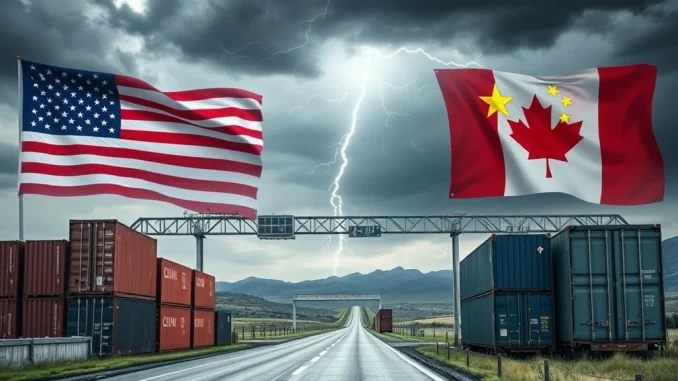
Washington D.C., March 21, 2025: Former President Donald Trump has issued a stark warning to Canada, threatening to impose a 100% tariff on Canadian products if the country proceeds with a potential trade agreement with China. The explosive declaration, made via his Truth Social platform, immediately sent shockwaves through diplomatic and financial circles, raising the specter of a severe new trade conflict within North America. This threat represents a significant escalation in rhetoric concerning the economic relationships between the United States, its closest ally, and its primary strategic competitor.
Trump Threatens 100% Tariff in Truth Social Post
In a post published early Friday, Trump framed the potential Canada-China deal in starkly adversarial terms. “If Canada proceeds with this terrible trade agreement with China, I will impose a 100% Tariff on all goods coming into the United States from Canada,” he wrote. He further characterized the negotiations, stating, “China is successfully and completely taking over Canada,” and labeled the prospective pact “one of the worst in history.” The post lacked specific details about the alleged deal’s status or provisions, but its intent was unambiguous. Trade analysts note that a 100% tariff would effectively double the cost of Canadian imports, making them largely non-competitive in the U.S. market and crippling a trade relationship worth nearly $700 billion annually.
Historical Context of US-Canada-China Trade Relations
To understand the gravity of this threat, one must examine the complex trade triangle involved. The United States and Canada share the world’s most comprehensive bilateral trade relationship, underpinned by the USMCA (United States-Mexico-Canada Agreement), which succeeded NAFTA. China, meanwhile, is Canada’s second-largest trading partner after the U.S. The dynamics are inherently tense; U.S. policy across administrations has sought to limit Chinese economic influence and technology transfer, especially among close allies.
- The USMCA ‘Poison Pill’ Clause: A critical article (32.10) in the USMCA allows any member country to terminate the entire agreement with six months’ notice if another member enters a free trade agreement with a “non-market country”—a clause widely understood to target China. Trump’s threat acts as a drastic enforcement mechanism for this clause.
- Recent Canadian Overtures: Following years of strained relations with China, including the detention of Canadian citizens, Ottawa has cautiously explored stabilizing economic ties. Reports suggest discussions have focused on sectors like agriculture, clean energy, and critical minerals, not a comprehensive free trade agreement.
- Precedent of Trump-Era Tariffs: During his presidency, Trump imposed tariffs on Canadian steel and aluminum under Section 232 national security grounds, causing significant bilateral friction before a resolution was reached.
Immediate Economic and Political Repercussions
The immediate reaction from markets and governments was one of deep concern. The Canadian dollar weakened against the U.S. dollar upon the news, and stocks for major Canadian exporters to the U.S. dipped in pre-market trading. Politically, the threat places Canadian Prime Minister Justin Trudeau in a difficult position. His government must balance the economic desire for diversified trade against the overwhelming reality of its dependence on the U.S. market.
Officially, the Canadian government has been measured in its response. A spokesperson for Global Affairs Canada stated, “Canada engages in trade discussions with partners around the world to create economic growth and good jobs for Canadians. Our relationship with the United States remains paramount, and we are committed to the rules-based trading system.” The statement notably did not confirm or deny the existence of active trade talks with China. In Washington, the current Biden administration has not formally commented on the statement from the former president, highlighting the unusual nature of a policy threat from a non-incumbent shaping international discourse.
Potential Consequences for Key Industries
A 100% tariff would be catastrophic for integrated North American supply chains. The auto industry, which seamlessly moves parts and vehicles across the border dozens of times, would face existential disruption. Agriculture, energy, and forestry—bedrocks of Canadian exports—would be similarly devastated.
| Canadian Export Sector | Approx. Value to U.S. (Annual) | Potential Impact of 100% Tariff |
|---|---|---|
| Vehicles & Parts | $70+ Billion | Production shutdowns, massive price hikes for U.S. consumers. |
| Energy (Oil, Gas, Electricity) | $120+ Billion | U.S. energy security risk, higher fuel costs. |
| Agriculture & Food | $40+ Billion | Supermarket inflation, waste of perishable goods. |
| Forestry & Lumber | $20+ Billion | U.S. housing construction costs would skyrocket. |
Experts warn that such an action would also violate World Trade Organization (WTO) rules, likely triggering a lengthy dispute and retaliatory measures from Canada, harming U.S. exporters in turn. The result would be a lose-lose scenario of inflation, job losses, and economic contraction on both sides of the border.
Strategic Analysis: More Than Just Trade
Beyond economics, this threat touches on core issues of national security and geopolitical alignment. The U.S. foreign policy establishment, broadly, views deeper Canada-China ties with suspicion, fearing it could create a backdoor for Chinese influence or technology acquisition close to home. Trump’s statement amplifies this strategic anxiety into an explicit economic ultimatum. It also serves as a potent reminder of how trade policy is increasingly wielded as a tool of geopolitical competition, with allies pressured to choose sides in a bifurcating global economy.
Conclusion
Former President Donald Trump’s threat of a 100% tariff on Canada over a potential China trade deal marks a dangerous escalation in trade rhetoric. While the specifics of any Canada-China agreement remain unclear, the warning leverages the profound economic interdependence between the U.S. and Canada as a weapon to enforce foreign policy alignment. The move highlights the fragile state of rules-based trade and the ongoing politicization of global supply chains. Whether a negotiating tactic or a stated intent, this threat underscores that the future of North American trade stability may hinge on decisions made not just in Ottawa and Washington, but in Beijing as well.
FAQs
Q1: What exactly did Donald Trump say about Canada and China?
In a Truth Social post, former President Trump stated he would impose a 100% tariff on all Canadian goods entering the United States if Canada proceeds with a potential trade agreement with China, which he called “one of the worst in history.”
Q2: Can a former president actually impose tariffs?
No, a former president holds no executive power. This is a statement of intent should he win the upcoming election and return to office. It is, however, influencing current market and diplomatic perceptions.
Q3: How would a 100% tariff impact the average American consumer?
Prices for a vast range of goods—from cars and lumber to food and energy—would increase dramatically due to the deeply integrated supply chains, leading to significant inflation.
Q4: Is Canada currently negotiating a free trade deal with China?
The Canadian government has not confirmed active negotiations for a comprehensive free trade agreement. Reports indicate exploratory talks on specific sectors, but nothing equivalent to the USMCA.
Q5: What is the USMCA “poison pill” clause mentioned?
Article 32.10 of the USMCA allows a member country to terminate the agreement if another member signs a free trade deal with a “non-market country” (like China). Trump’s threat is a drastic extension of this clause’s logic.