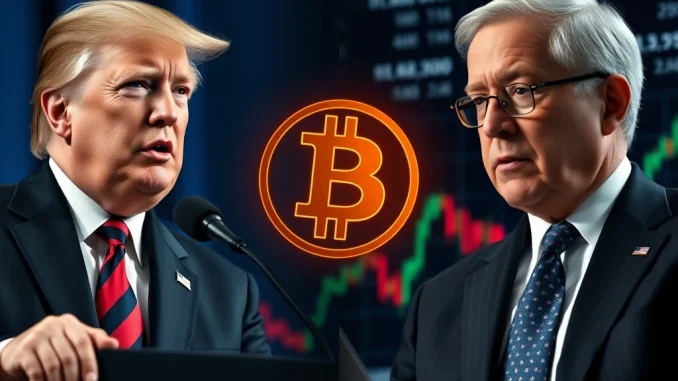
Washington, D.C., April 2025: A recent public statement by former President Donald Trump, suggesting Federal Reserve Chair Jerome Powell would be “gone soon,” has sent ripples through global financial markets. Bitcoin traders and cryptocurrency analysts are now scrutinizing this political commentary for potential signals about future U.S. monetary policy, interest rates, and dollar strength, factors that historically exhibit a significant correlation with digital asset valuations.
Bitcoin Traders Parse Political Rhetoric for Market Clues
The relationship between central bank policy and cryptocurrency markets is well-documented. As a decentralized asset class often viewed as an alternative to traditional finance, Bitcoin’s price discovery mechanism reacts sharply to changes in macroeconomic liquidity, inflation expectations, and the value of fiat currencies. The Federal Reserve, under Chair Powell’s leadership, has navigated a complex post-pandemic economic landscape, shifting from aggressive rate hikes to a more measured stance. Any uncertainty regarding the continuity of this leadership introduces a new variable into the market’s calculus.
Market participants are not reacting to the political statement itself but to the potential implications for the policy path. A change in Fed leadership could signal a shift in priorities—perhaps toward more dovish policies to stimulate growth or a renewed focus on inflation control. Bitcoin traders are assessing whether such a change would accelerate or decelerate trends like quantitative tightening, which directly impacts the liquidity environment that digital assets thrive in.
The Historical Context of Fed Leadership and Market Volatility
Transitions in Federal Reserve leadership are not uncommon, but they rarely occur amid casual political remarks. The modern Fed prioritizes its independence, a principle established to insulate monetary policy from short-term political cycles. Historical precedents, however, show that markets experience heightened volatility during periods of leadership uncertainty.
- The Volcker to Greenspan Transition (1987): Marked by the Black Monday crash shortly after Alan Greenspan took office, highlighting how new leadership is tested by immediate crises.
- The Bernanke to Yellen Transition (2014): A carefully communicated succession that provided market stability, demonstrating the value of clear, forward guidance.
- The Yellen to Powell Transition (2018): Initially seen as continuity, but markets later grappled with Powell’s “Fed Put” and his response to rising inflation.
Each transition brought subtle shifts in communication style and risk tolerance, which asset markets, including cryptocurrencies, eventually priced in. The current speculation arises outside the typical, predictable succession framework, adding a layer of political unpredictability.
Expert Insight: Decoupling Signal from Noise
Financial analysts emphasize the importance of distinguishing political rhetoric from actionable policy change. “The cryptocurrency market, particularly Bitcoin, has matured to become a macro asset,” notes Dr. Anya Sharma, Chief Economist at Digital Horizon Research. “Traders are not simply buying or selling on a headline. They are building complex models that weigh the probability of a leadership change against the established Fed meeting calendar, inflation data prints, and balance sheet runoff schedules. The comment raises the *probability* of a shift, which adjusts risk premiums across all assets, digital and traditional.”
This analytical approach involves monitoring Treasury yield curves, the DXY Dollar Index, and futures contracts for Fed funds rates. A sudden shift in these traditional metrics often precedes or accompanies movement in Bitcoin, which acts as a sentiment gauge for global liquidity.
Implications for Monetary Policy and the Digital Dollar Landscape
Beyond interest rates, Fed leadership plays a crucial role in long-term projects like the research and potential development of a Central Bank Digital Currency (CBDC). Chair Powell has presided over a cautious, research-oriented approach to a digital dollar. A change in leadership could potentially accelerate, decelerate, or redirect this project, which carries profound implications for the native structure of the cryptocurrency ecosystem.
Furthermore, the regulatory posture of the United States towards digital assets is shaped in part by Treasury and Fed coordination. A new Fed Chair would influence the pace and nature of banking sector engagement with crypto, stablecoin regulation, and the integration of blockchain-based settlement systems. This regulatory clarity—or lack thereof—is a fundamental driver of institutional adoption of Bitcoin and other cryptocurrencies.
Conclusion
While the immediate market reaction to political statements can be fleeting, the underlying vigilance of Bitcoin traders highlights the asset’s entrenched role in the global macroeconomic dialogue. The focus remains squarely on the trajectory of U.S. monetary policy, interest rates, and dollar strength. Whether Chair Powell remains or departs, the cryptocurrency market’s intense scrutiny of the Federal Reserve confirms that digital asset valuation is now inextricably linked to the same fundamental forces that govern traditional bonds, equities, and currencies. The episode underscores the critical importance of central bank transparency and stability for all financial markets in the digital age.
FAQs
Q1: Why do Bitcoin traders care about who leads the Federal Reserve?
The Federal Reserve controls U.S. monetary policy, which directly influences interest rates, inflation, and the value of the U.S. dollar. Bitcoin is traded globally against the dollar, and its price is sensitive to changes in liquidity and macroeconomic stability, making Fed policy a primary concern for traders.
Q2: Has the Fed Chair ever been removed by a President?
No. While the Fed Chair is appointed by the President and confirmed by the Senate, the position is designed to be independent. A Chair serves a four-year term and can only be removed for cause, not over policy disagreements, a precedent upheld to protect central bank independence.
Q3: What is the most direct link between Fed policy and Bitcoin prices?
The most direct link is through liquidity and the dollar. When the Fed engages in quantitative easing (creating more dollars) or lowers interest rates, it can weaken the dollar and increase liquidity, conditions that have historically correlated with rising Bitcoin prices. Tightening policy has the opposite effect.
Q4: How quickly do cryptocurrency markets react to Fed announcements compared to traditional markets?
Cryptocurrency markets operate 24/7 and often react in real-time to Fed news, sometimes with greater volatility than traditional markets. However, the sustained, longer-term trend depends on the same fundamental analysis of the policy’s economic impact.
Q5: Could a change in Fed leadership affect cryptocurrency regulation?
Indirectly, yes. The Fed works with other agencies like the SEC and CFTC on financial stability. A new Chair might prioritize different aspects of fintech innovation, payment systems, or banking sector rules, which could alter the regulatory landscape for crypto institutions and products like stablecoins.
Updated insights and analysis added for better clarity.
This article was produced with AI assistance and reviewed by our editorial team for accuracy and quality.