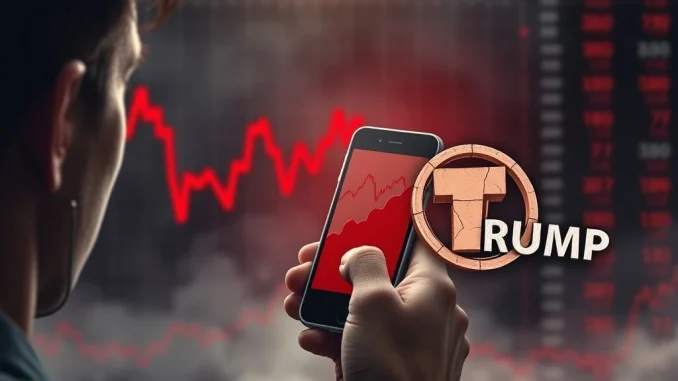
Global, March 2025: The cryptocurrency market has witnessed a devastating collapse this week, with retail investors bearing catastrophic losses exceeding $4.3 billion. The primary drivers of this financial wipeout are the near-total devaluation of two high-profile, politically themed digital assets: the Melania Meme ($MELANIA) and Official Trump ($TRUMP) tokens. Market data confirms these Trump-linked memecoins have plummeted by 98.8% and 91.8% respectively, erasing virtually all investor value in a stunningly rapid downturn.
Trump Memecoins Collapse: A Timeline of the Crash
The descent of the MELANIA and TRUMP tokens from speculative peaks to near-zero valuations did not happen overnight. Analysts trace the initial instability to late February 2025, when trading volumes began to diverge sharply from social media hype. The first significant drop occurred on March 10, when the MELANIA token lost 40% of its value in a single 24-hour period. This triggered a cascade of sell-offs. By March 15, both assets entered a death spiral, with liquidity evaporating as panic spread through investor communities on platforms like Telegram and Reddit. The final, decisive crash happened over a brutal 48-hour window ending March 17, where the tokens shed their remaining value, leaving countless portfolios decimated.
Anatomy of a Memecoin Catastrophe
To understand the scale of these losses, one must examine the structure and appeal of these specific assets. Unlike cryptocurrencies with underlying technology or utility, memecoins derive their value almost exclusively from community sentiment, online virality, and speculative trading.
- The TRUMP Token: Marketed as the “official” digital asset supporting the political figure, it leveraged a strong, pre-existing community. At its peak, it reached a fully diluted valuation of over $3.1 billion, attracting investors betting on political momentum.
- The MELANIA Token: Positioned as a companion asset, it capitalized on name recognition and niche community engagement. Its valuation was always more modest but still reached hundreds of millions of dollars.
The critical flaw was the lack of fundamental utility. When social media trends shifted and a few large holders, often called “whales,” began exiting their positions, the thin liquidity pools on decentralized exchanges could not sustain the price. The table below illustrates the precipitous fall:
| Token | Peak Price (USD) | Price at Crash (USD) | Percentage Drop | Estimated Investor Loss |
|---|---|---|---|---|
| $MELANIA | $0.85 | $0.01 | 98.8% | ~$1.7B |
| $TRUMP | $2.40 | $0.20 | 91.8% | ~$2.6B |
Expert Analysis on Market Dynamics and Risk
Financial analysts and blockchain specialists point to a perfect storm of factors. “This is a classic case of hyper-speculative asset inflation meeting reality,” explains Dr. Lena Chen, a fintech professor at Stanford University. “These tokens had no revenue model, no governance utility, and were not officially endorsed by the individuals they referenced. Their value was purely narrative-driven, making them extraordinarily vulnerable to sentiment shifts.” Chen further notes that the collapse mirrors historical speculative bubbles, from Dutch tulips to the dot-com era, but compressed into a digital, global timeframe of weeks rather than years. The event underscores the extreme volatility and unregulated nature of the memecoin sector, where projects can rise and fall on social media trends alone.
The Human Impact: Stories from Retail Investors
Behind the staggering $4.3 billion figure are individual stories of significant financial harm. Retail investors, often enticed by online communities promising quick riches, poured savings into these assets. Many used leveraged trading or invested funds they could not afford to lose. Online forums are now filled with testimonials of loss. One investor, who wished to remain anonymous, stated, “I put $15,000 from my savings into $TRUMP after seeing it touted everywhere. I believed the ‘to the moon’ hype. Now it’s worth less than $300. It’s a devastating lesson.” This sentiment is echoed widely, highlighting the human cost of a market driven more by FOMO (Fear Of Missing Out) than fundamental analysis.
Regulatory Implications and the Future of Political Tokens
This collapse has immediately drawn the attention of financial regulators worldwide. The U.S. Securities and Exchange Commission (SEC) has previously warned that many memecoins could be considered unregistered securities. A wipeout of this magnitude, explicitly linked to public figures, increases the likelihood of investigative and enforcement actions. The event may accelerate calls for clearer regulation of decentralized finance (DeFi) platforms and asset listing standards. Furthermore, it casts a long shadow over the future of politically themed cryptocurrencies. While they may continue to emerge, investor trust has been severely damaged, and exchanges may impose stricter listing criteria for such speculative assets.
Conclusion
The devastating collapse of the Trump-linked memecoins, resulting in over $4.3 billion in retail investor losses, serves as a stark and costly reminder of the inherent risks in the cryptocurrency market. The MELANIA and TRUMP token crash exemplifies how assets built on social sentiment rather than tangible value can evaporate with breathtaking speed. For the broader market, this event underscores the critical need for investor education, heightened due diligence, and potentially, more robust regulatory frameworks to protect participants from similar catastrophic losses in the future.
FAQs
Q1: What exactly are MELANIA and TRUMP memecoins?
They are cryptocurrency tokens created on blockchain networks like Solana or Ethereum, themed around public figures Donald Trump and Melania Trump. They functioned primarily as speculative digital assets with no official endorsement or utility.
Q2: How did these tokens lose almost all their value so quickly?
The crash was caused by a combination of waning social media hype, sell-offs by large holders (whales), and a subsequent liquidity crisis on decentralized exchanges where they were traded. With no fundamental value to support the price, the sell-off became a panic-driven collapse.
Q3: Are the developers or creators legally responsible for these losses?
This is a complex legal question. Unless fraud or specific securities law violations can be proven, memecoin creators often operate with limited liability. The decentralized and pseudonymous nature of many projects makes legal recourse for investors extremely difficult.
Q4: Could this happen to other popular memecoins like Dogecoin or Shiba Inu?
While all memecoins carry high risk, larger, more established ones like Dogecoin have deeper liquidity, broader exchange support, and more resilient communities. However, the fundamental risk of high volatility and sentiment-driven value remains present across the entire category.
Q5: What should investors do after such a crash?
Investors should conduct a thorough financial assessment, document all transactions for tax purposes, and report suspected fraud to authorities like the FTC or SEC. Most importantly, this event should inform future investment strategy, emphasizing research and risk management over speculative hype.
This article was produced with AI assistance and reviewed by our editorial team for accuracy and quality.