Trump Meme Tokens Crash: Devastating $4.3B Wipeout Leaves Retail Investors Reeling
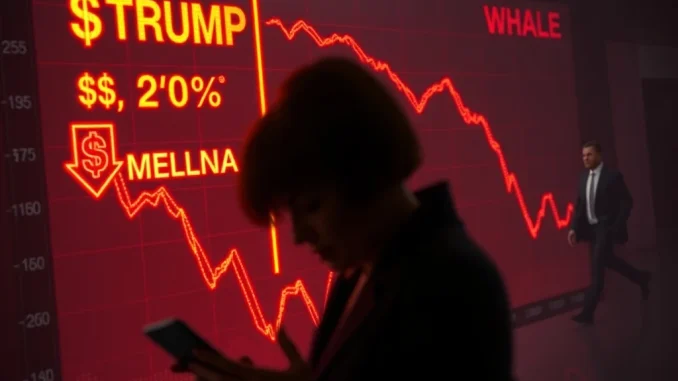
Global Cryptocurrency Markets, April 2025: The speculative frenzy surrounding politically-themed meme tokens has culminated in a catastrophic crash, with tokens linked to former U.S. President Donald Trump plunging over 90% from their all-time highs. This collapse has erased an estimated $4.3 billion in value primarily held by retail investors, while on-chain data reveals that insiders and large-scale “whale” wallets extracted over $1.8 billion in profits before and during the downturn. The official $TRUMP and $MELANIA tokens now stand as a stark case study in the high-risk volatility of the meme coin sector.
Trump Meme Tokens Crash: A Timeline of the Collapse
The rise and fall of Trump-themed cryptocurrencies followed a pattern familiar to market analysts. Initial launches, often coinciding with political events or social media commentary, generated intense speculative interest. Trading volumes for $TRUMP and similar assets skyrocketed, drawing in retail traders hoping for parabolic gains akin to earlier meme coin successes. However, this growth was largely detached from fundamental utility or sustainable economic models.
Data from blockchain analytics firms shows the peak market capitalization for the primary Trump-related tokens exceeded $4.8 billion in early 2024. The subsequent decline was not a single event but a series of precipitous drops. The first major correction saw a 40% loss, followed by a dead-cat bounce that lured in more capital. The final, sustained collapse began in Q1 2025, with prices entering a near-vertical descent. On-chain analysis indicates that during this period, a concentrated group of early wallets began executing large sell orders, increasing sell-side pressure and triggering panic among smaller holders.
Analyzing the $4.3 Billion Retail Investor Loss
The scale of losses highlights the disproportionate impact on everyday traders. Retail investors, often entering the market during hype cycles, typically buy at higher price points. When the market turns, they are the last to exit, if they can exit at all. Analysis of wallet activity reveals telling patterns:
- Entry Points: A significant volume of retail purchases occurred within 20% of the all-time high price, representing the worst possible timing.
- Liquidity Crunch: As prices fell, liquidity on decentralized exchanges dried up, causing “slippage” where sale executions occurred at far worse prices than expected.
- Hold Behavior: Many small wallets showed no movement during the decline, suggesting holders were either unable to sell or hoping for a recovery that never materialized.
This event has renewed discussions about the asymmetric risk profile in highly speculative crypto assets, where information and timing advantages are not evenly distributed.
The Mechanics of Insider and Whale Profits
While retail investors faced devastating losses, blockchain data presents a different story for insiders and whales. These entities, often holding large pre-allocated token supplies or accumulating positions very early, executed a classic “pump and dump” strategy, albeit on a massive scale. Their profit-taking followed a clear sequence:
- Accumulation Phase: Acquiring tokens at minimal cost during creation or immediately post-launch.
- Promotion Phase: Leveraging social media and online communities to generate buzz and retail demand.
- Distribution Phase: Systematically selling holdings into rising retail demand, often using multiple wallets to obscure the total volume of sales.
Ethereum and Solana blockchain explorers show that several wallets associated with the deployment contracts of these tokens transferred millions of dollars worth of assets to centralized exchanges weeks before the peak. This $1.8 billion profit figure represents a direct wealth transfer from late-arriving retail participants to a small group of early entrants.
Historical Context and Regulatory Implications
The Trump token crash is not an isolated incident but part of a recurring pattern in cryptocurrency history. It echoes the 2021 meme coin mania and subsequent crashes, as well as the 2022 collapse of the Terra-Luna ecosystem, where retail investors also bore the brunt of losses. The key difference lies in the overt political branding, which may attract investors based on sentiment rather than financial analysis.
This event has immediate implications for regulatory bodies worldwide. The U.S. Securities and Exchange Commission (SEC) and other global regulators have long warned about the risks of unregistered, speculative digital assets. A crash of this magnitude, with clear evidence of insider profit-taking, provides a concrete case for stricter enforcement of existing securities laws and potential new legislation targeting token distribution and insider disclosures. The debate over whether certain meme coins constitute unregistered securities is likely to intensify.
Broader Impact on the Cryptocurrency Ecosystem
Beyond the direct financial loss, the collapse damages the credibility of the broader cryptocurrency industry. It reinforces negative stereotypes of the space as a purely speculative casino, undermining efforts to highlight blockchain’s utility in payments, decentralized finance, and digital ownership. Mainstream adoption efforts face a steeper climb when headlines spotlight billions in losses from volatile assets.
Furthermore, the crash may trigger a cooling effect in the meme coin sector overall, as retail investors become more wary. Capital may flow toward projects with clearer roadmaps and fundamentals, potentially leading to a healthier, if less frenetic, market environment. However, the cyclical nature of crypto markets suggests that after a period of fear, a new speculative narrative will eventually emerge.
Conclusion
The dramatic Trump meme tokens crash serves as a severe reminder of the inherent risks in speculative cryptocurrency investing. The transfer of $4.3 billion from retail investors to insiders and whales underscores critical issues of market structure, transparency, and investor protection that the digital asset industry must address. While meme coins will likely remain a part of the crypto landscape, this event highlights the paramount importance of due diligence, understanding tokenomics, and recognizing the extreme volatility of assets driven primarily by social sentiment rather than underlying value. For the market to mature, learning from these devastating losses is essential.
FAQs
Q1: What exactly are Trump meme tokens?
Trump meme tokens are cryptocurrencies created on blockchains like Ethereum or Solana that use the name, image, or branding associated with former U.S. President Donald Trump. They are typically created as joke or tribute tokens, similar to Dogecoin, and their value is driven almost entirely by community sentiment and speculative trading rather than utility.
Q2: How did insiders profit while retail investors lost money?
Insiders and “whales” (holders of very large amounts) typically received tokens at very low initial costs. They then sold their holdings gradually as retail investors bought in and drove the price up. By the time the price peaked and began to crash, many insiders had already sold most of their tokens for massive profits, leaving retail investors holding assets that were rapidly losing value.
Q3: Are $TRUMP and $MELANIA tokens officially associated with Donald Trump or his family?
In most cases, no. The vast majority of these tokens are created by anonymous developers and are not officially endorsed, launched, or controlled by Donald Trump, Melania Trump, or any affiliated organization. They are speculative assets trading on the use of their names and imagery.
Q4: Can the investors who lost money recover their funds?
In the decentralized cryptocurrency market, there is usually no recourse for investors who lose money due to price declines. Unlike regulated stock markets, there are often no official governing bodies to file complaints with, and transactions are typically irreversible. Recovery is only possible if the market price of the tokens increases again in the future.
Q5: What should investors consider before buying meme coins?
Investors should treat meme coins as extremely high-risk speculation, not investment. Key considerations include: understanding that losses can total 100%, recognizing the high likelihood of insider advantages, being aware of extreme volatility, never investing more than one can afford to lose, and conducting thorough research on the token’s contract, distribution, and liquidity before any purchase.
Related News
- Floki Partners with Kings World Cup Nations to Reach 600+ Million Video Views
- Is Pepe Unchained, Wall Street Pepe, or Pepeto the Next 100x Meme Coin?
- OKX Unleashes Exciting Opportunity: DASH and ZEC Perpetual Futures Go Live
Related: Global Stablecoin Access: Alchemy Pay Integrates USA₮ for Compliant Payments in 173 Countries