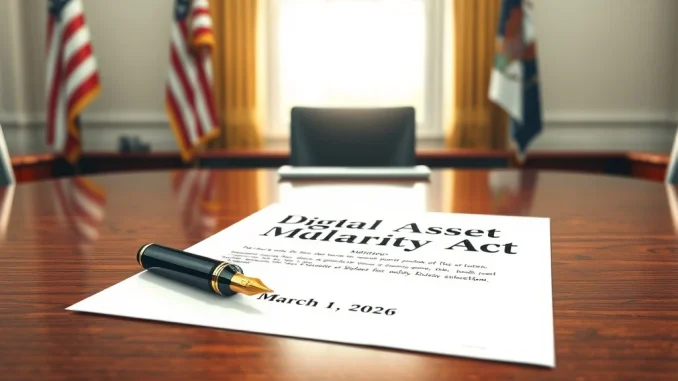
WASHINGTON, D.C. — February 15, 2026: The Trump administration has established a critical March 1, 2026 deadline to advance the landmark Digital Asset Market Clarity Act, commonly called the Crypto CLARITY Act. This urgent timeline, confirmed by multiple White House and congressional sources, aims to shepherd the comprehensive cryptocurrency regulatory framework through Congress for potential passage by Spring 2026. The move represents the most significant push for federal digital asset regulation in U.S. history and follows intense lobbying from major industry players including Ripple and Coinbase. Administration officials are now working directly with key lawmakers on Capitol Hill to draft final legislative language and secure bipartisan support before the fast-approaching cutoff.
The March 1 Deadline and the CLARITY Act’s Core Provisions
The informal March 1 deadline serves as a clear directive from the White House to congressional committees. Essentially, it marks the point by which administration officials want final bill text agreed upon, clearing the path for committee markups and floor votes in the following months. A senior administration official, speaking on background, stated the goal is “regulatory certainty by the second quarter of 2026.” The Crypto CLARITY Act itself seeks to resolve years of jurisdictional ambiguity between the Securities and Exchange Commission (SEC) and the Commodity Futures Trading Commission (CFTC). Notably, the legislation proposes a definitive test to classify digital assets as either securities or commodities, a distinction that has fueled numerous high-profile legal battles.
Furthermore, the Act outlines a new registration pathway for cryptocurrency exchanges and custodians, moving beyond the current state-by-state money transmitter license system. It also addresses stablecoin issuance, proposing federal oversight for dollar-pegged tokens. The bill’s drafters incorporated substantial feedback from a 2025 series of roundtables that included blockchain developers, legal scholars, and consumer protection advocates. This collaborative approach, while time-consuming, is viewed as crucial for crafting durable legislation that can adapt to technological evolution.
Immediate Impacts on the Cryptocurrency Industry and Markets
The announcement of a firm deadline has immediate, tangible consequences for the multi-trillion dollar digital asset ecosystem. Market analysts observed a swift, positive reaction in the prices of tokens associated with companies actively backing the legislation. More importantly, the deadline creates a concrete planning horizon for businesses that have operated under a cloud of regulatory uncertainty. Venture capital firms can now assess investments with clearer regulatory risk parameters, and crypto startups can align their product roadmaps with anticipated federal rules.
- Legal Clarity for Firms: Companies like Ripple, engaged in a long-running SEC lawsuit over whether XRP is a security, could see their legal standing fundamentally altered based on the Act’s classification criteria. This provides a potential off-ramp from costly litigation.
- Operational Shifts for Exchanges: Major trading platforms, including Coinbase and Kraken, must begin preparing for a new federal registration regime, which may require significant changes to compliance, reporting, and custody operations.
- Banking Integration: Traditional financial institutions, previously hesitant to engage deeply with crypto due to unclear rules, may accelerate plans for custody services, tokenization, and blockchain-based payment systems, foreseeing a regulated environment.
Expert Analysis and Institutional Response
Michelle Alvarez, a former CFTC commissioner and current director of the Georgetown University Law Center’s FinTech Initiative, provided critical context. “The March 1 deadline isn’t arbitrary,” Alvarez explained. “It aligns with the congressional calendar and provides enough runway for hearings, amendments, and debate ahead of the summer recess and election season pressures. This is a textbook example of the executive branch setting the legislative agenda.” Alvarez’s analysis underscores the strategic political calculation behind the timeline.
Conversely, some skepticism emerged from consumer advocacy groups. Sarah Chen, Policy Lead at the Consumer Federation of America, issued a statement urging caution: “While clarity is needed, speed must not compromise robust investor protections. Any final bill must have strong provisions against fraud, market manipulation, and ensure adequate disclosures for retail participants.” This perspective highlights the balancing act lawmakers face between fostering innovation and ensuring market integrity, a tension referenced in a recent Brookings Institution report on digital asset policy.
Broader Context: A Global Race for Crypto Regulation
The U.S. push for the Crypto CLARITY Act occurs within a highly competitive global landscape. Other major economies have already enacted or proposed their own comprehensive frameworks, creating a potential regulatory arbitrage where companies relocate to friendlier jurisdictions. The European Union’s Markets in Crypto-Assets (MiCA) regulation, fully implemented in 2025, currently sets the global standard. The United Kingdom, Singapore, and Japan have also advanced detailed regulatory regimes. The U.S. deadline, therefore, is partly a competitive response to avoid ceding leadership in financial technology innovation.
| Jurisdiction | Key Regulation | Status (as of Feb 2026) |
|---|---|---|
| European Union | Markets in Crypto-Assets (MiCA) | Fully Implemented |
| United Kingdom | Financial Services and Markets Act 2023 (Crypto Provisions) | Phased Implementation |
| Singapore | Payment Services Act | Active, with ongoing updates |
| United States | Digital Asset Market Clarity Act (Proposed) | Targeting Spring 2026 Passage |
What Happens Next: The Path to Spring 2026 Passage
The immediate next steps are intensely procedural. Staff from the House Financial Services Committee and the Senate Banking Committee are now in daily coordination with Treasury Department and White House officials. The weeks between now and March 1 will involve resolving remaining contentious points, such as the precise role of state regulators and the treatment of decentralized finance (DeFi) protocols. Following the deadline, the bill is expected to be formally introduced by a bipartisan group of sponsors. Committee hearings will likely commence in early March, with markups targeted for late March or early April. This schedule sets up potential floor votes in both chambers before the Memorial Day recess, meeting the administration’s “Spring 2026” goal.
Stakeholder Reactions and Market Sentiment
Industry reaction has been overwhelmingly positive but measured. Brad Garlinghouse, CEO of Ripple, stated, “This deadline is a welcome signal that the U.S. is serious about establishing clear rules of the road. We are committed to working with policymakers to ensure the final legislation fosters innovation while protecting consumers.” Similarly, a Coinbase spokesperson emphasized the need for “a practical framework that allows the U.S. to lead the next generation of the internet.” However, some segments of the crypto community, particularly Bitcoin maximalists and certain DeFi advocates, express concern that federal regulation could stifle the permissionless ethos of blockchain technology. These divergent views will play out in the coming weeks of public commentary.
Conclusion
The Trump administration’s March 1, 2026 deadline for the Crypto CLARITY Act marks a pivotal moment in the journey toward comprehensive U.S. digital asset regulation. By setting this firm timeline and aligning with industry giants like Ripple and Coinbase, the White House has injected urgent momentum into a long-stalled process. The Act’s success hinges on navigating complex technical details, balancing competing interests, and maintaining bipartisan support in a charged election year. For investors, entrepreneurs, and consumers, the next six weeks will be critical in shaping the regulatory landscape that will govern the American cryptocurrency industry for decades to come. All eyes are now on Capitol Hill as the March 1 deadline approaches.
Frequently Asked Questions
Q1: What exactly is the Crypto CLARITY Act?
The Digital Asset Market Clarity Act (CLARITY Act) is proposed U.S. legislation designed to create a comprehensive federal regulatory framework for cryptocurrencies. Its main goals are to clarify whether digital assets are securities or commodities, establish a registration system for exchanges, and provide rules for stablecoin issuers.
Q2: Why is the March 1, 2026 deadline significant?
The March 1 deadline is an internal White House target for finalizing the bill’s language with Congress. It is strategically set to allow enough time for committee hearings, debates, and votes with the goal of passing the law by Spring 2026, before election season politics intensify.
Q3: How will this Act affect companies like Coinbase and Ripple?
Companies will face a new federal registration and compliance regime. For Ripple, the Act’s asset classification test could directly impact its ongoing SEC lawsuit. For all exchanges, operational changes to meet new custody, reporting, and consumer protection standards will be required.
Q4: What happens if Congress misses the Spring 2026 target?
Delay risks pushing the entire process into late 2026 or 2027, as the political focus shifts to elections and a potential new Congress. This would prolong the current regulatory uncertainty, which many in the industry argue hinders investment and innovation in the United States.
Q5: How does this U.S. effort compare to crypto regulation in Europe?
The EU’s MiCA regulation is already law, giving Europe a first-mover advantage. The U.S. CLARITY Act shares similar goals but is tailored to the American regulatory structure involving both the SEC and CFTC. The race is on for the U.S. to catch up and set a competitive global standard.
Q6: How might this legislation impact everyday cryptocurrency investors?
Investors could benefit from clearer rules on disclosures, custody protections, and recourse in cases of fraud. However, the regulatory clarity may also lead to the delisting of some tokens deemed non-compliant, potentially changing the available investment landscape on U.S. exchanges.
Updated insights and analysis added for better clarity.
This article was produced with AI assistance and reviewed by our editorial team for accuracy and quality.