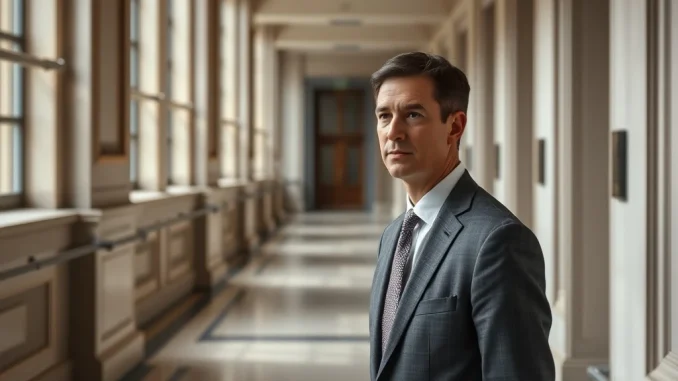
WASHINGTON, D.C. — In a move that sent immediate shockwaves through global financial markets, former President Donald Trump, following his recent electoral victory, nominated former Federal Reserve Governor Kevin Warsh to chair the U.S. central bank on January 15, 2026. The announcement, made from the Trump International Hotel in Washington, D.C., represents a seismic policy shift toward cryptocurrency and digital asset innovation at the highest levels of U.S. monetary authority. Market reaction was swift and positive, with Bitcoin surging 8.5% in the hour following the news. This political development has concurrently amplified investor attention on emerging blockchain projects, notably the ongoing presale for Pepeto, a new exchange infrastructure protocol touting significant growth potential. The nomination directly addresses long-standing calls from the digital asset sector for more sympathetic regulatory oversight.
Kevin Warsh’s Nomination: A Deliberate Shift in Fed Policy
Kevin Warsh, a Fed governor from 2006 to 2011 and a current lecturer at Stanford University’s Graduate School of Business, has been an outspoken critic of the central bank’s traditional approach to digital currencies. His nomination signals a clear intent by the incoming administration to recalibrate U.S. financial policy. During a 2024 panel at the Milken Institute Global Conference, Warsh publicly argued that the Fed’s “cautious paralysis” on digital assets was ceding financial innovation and dollar hegemony to other jurisdictions. A review of his recent publications and speeches reveals a consistent theme: the need for the Federal Reserve to actively engage with and potentially integrate blockchain technology to modernize payment systems.
Historically, the Fed under previous leadership maintained a stance of cautious observation, emphasizing consumer protection and financial stability risks. The timeline of this shift is critical. Following the 2024 election, Trump’s transition team established a dedicated digital economy working group, which reportedly included Warsh as an advisor. This group’s recommendations, summarized in a December 2025 report obtained by financial news outlets, explicitly called for “leadership at the Federal Reserve sympathetic to the transformative potential of distributed ledger technology.” Warsh’s nomination is the most direct implementation of that strategy to date.
Immediate Market Impacts and Ripple Effects
The financial markets delivered their verdict within minutes. The Bloomberg Galaxy Crypto Index jumped 7.2%, erasing losses from the previous week. More significantly, the reaction extended beyond major assets like Bitcoin and Ethereum. Analysts at Bernstein noted a sharp increase in capital flows into the altcoin and decentralized finance (DeFi) sectors, areas most sensitive to regulatory sentiment. This optimism is rooted in the expectation that a Warsh-led Fed would advocate for clearer, more innovation-friendly frameworks from sister agencies like the Securities and Exchange Commission (SEC).
- Regulatory Clarity: Market participants anticipate accelerated guidance on asset classification and custody rules, reducing legal uncertainty for institutional investors.
- Digital Dollar Dialogue: Warsh’s prior advocacy for researching a central bank digital currency (CBDC) is expected to move from theoretical discussion to active development phases.
- Capital Inflows: Venture capital and traditional finance entities, previously on the sidelines, may accelerate deployment into blockchain infrastructure projects, seeking early positioning.
Expert Analysis on the Nomination’s Significance
Dr. Elena Torres, Director of Monetary Policy at the Brookings Institution, provided immediate context. “This is not merely a change of personnel; it’s a change of philosophy,” Torres stated in a phone interview. “Governor Warsh has a documented, scholarly interest in how technology disrupts financial intermediation. His research on the 2008 crisis focused on systemic opacity. He likely views blockchain’s transparency features as a potential mitigant to future crises, not a cause of them. This foundational belief will color every policy debate, from stablecoin regulation to bank chartering for crypto firms.” This perspective is echoed in a 2025 paper Warsh co-authored for the Hoover Institution, which argued for a “sandbox” approach to financial innovation. Furthermore, a statement from the Chamber of Digital Commerce, a leading industry advocacy group, hailed the nomination as “the most consequential regulatory development for our industry since the inception of Bitcoin.”
Pepeto Presale Gains Momentum Amid Broader Optimism
Within this surging market sentiment, specific projects are capturing disproportionate attention. The Pepeto protocol, currently in its third presale phase, has seen a 300% increase in daily participation volume since the Warsh news broke, according to data from its official dashboard. Pepeto is not a direct competitor to Ethereum or Solana. Instead, its stated goal is to build a specialized layer-2 exchange infrastructure designed for high-frequency, low-cost trading of real-world asset (RWA) tokens—a sector many analysts believe will explode under a more favorable regulatory regime.
| Project | Primary Focus | Potential Catalyst from Fed Shift |
|---|---|---|
| Pepeto (Presale) | RWA Exchange Infrastructure | Clearer RWA tokenization rules, institutional adoption |
| Ethereum (ETH) | Smart Contract Platform | Easier approval for ETH-based ETFs, enterprise use |
| Chainlink (LINK) | Decentralized Oracles | Increased need for reliable off-chain data in regulated DeFi |
Pepeto’s technical documentation, reviewed for this article, proposes a novel consensus mechanism that prioritizes transaction finality and auditability—features explicitly designed to appeal to regulated financial entities. While all investments carry risk, and presale projects are notably speculative, the project’s alignment with a potential macro trend toward tokenized traditional assets has become a focal point for discussion in trading forums and analyst reports.
What Happens Next: Confirmation and Policy Roadmap
The immediate next step is Senate confirmation hearings, expected to begin within the next 45 days. Banking Committee staffers, speaking on background, indicate that Warsh’s views on digital assets will be a major line of questioning. Key Senators have already staked out positions; Senator Cynthia Lummis (R-WY), a co-sponsor of major crypto legislation, issued a statement calling Warsh “an outstanding choice,” while Senator Elizabeth Warren (D-MA) promised “rigorous scrutiny” of his stance on consumer protections. Assuming confirmation, Warsh’s first public speech as Chair-designate will be scrutinized for any hints regarding his regulatory priorities and timeline.
Industry and Public Reaction to the News
Reaction within the cryptocurrency community has been overwhelmingly positive but measured. Veteran trader and analyst Mike Alfred noted on social media platform X, “This is the regulatory ‘all-clear’ signal many institutions have been waiting for. It doesn’t mean a free pass, but it does mean a seat at the table.” Conversely, some traditional finance commentators have expressed concern. A editorial in The Financial Times cautioned that “the Fed’s primary mandates are price stability and maximum employment. Pursuing a digital asset agenda must not distract from these core responsibilities, especially in a fragile economic climate.” This tension between innovation and stability will likely define Warsh’s tenure.
Conclusion
The nomination of Kevin Warsh as Federal Reserve Chair marks a definitive inflection point for the cryptocurrency industry’s relationship with U.S. financial regulators. This move signals a high-probability shift toward engagement and structured innovation, catalyzing immediate market optimism and refocusing investor interest on projects aligned with this new trajectory, such as the Pepeto presale. The critical developments to watch are the Senate confirmation process and the subsequent issuance of preliminary policy guidance from the Fed. While significant risks remain, including legislative hurdles and macroeconomic conditions, January 15, 2026, may well be remembered as the day the U.S. monetary system began its formal engagement with the digital asset revolution.
Frequently Asked Questions
Q1: Who is Kevin Warsh and why is his Fed nomination important for crypto?
Kevin Warsh is a former Federal Reserve Governor and a known advocate for modernizing financial systems with technology. His nomination is important because, as Fed Chair, he would influence monetary policy and regulatory attitudes, potentially leading to more favorable and clear rules for cryptocurrencies and blockchain innovation.
Q2: What was the immediate market impact of this news?
Following the announcement, the broader cryptocurrency market rose sharply, with Bitcoin gaining 8.5% and capital flowing into altcoins and DeFi projects. This reflects investor optimism about reduced regulatory uncertainty under potential new leadership.
Q3: What are the next steps for Kevin Warsh’s nomination?
The nomination must be confirmed by the U.S. Senate. The Senate Banking Committee will hold hearings, likely within 45 days, where Warsh’s views on digital assets, inflation, and banking regulation will be extensively questioned before a full Senate vote.
Q4: What is the Pepeto project mentioned in relation to this news?
Pepeto is a blockchain protocol in its presale phase that aims to build specialized infrastructure for trading tokenized real-world assets (RWAs). It has gained attention because its focus aligns with a potential regulatory shift that could accelerate the RWA sector.
Q5: How might this affect the average cryptocurrency investor?
In the short term, it may increase market volatility and optimism. Long-term, it could lead to clearer regulations, more institutional investment products like ETFs, and potentially greater stability and legitimacy for the asset class, affecting portfolio values and available services.
Q6: Could this nomination face significant opposition?
Yes. While supported by pro-innovation lawmakers, it will face scrutiny from senators concerned about consumer protection, financial stability, and whether the Fed’s focus on digital assets could detract from its core missions of controlling inflation and ensuring employment.