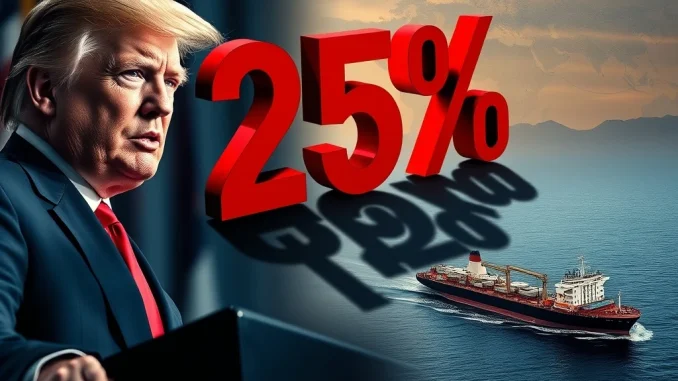
WASHINGTON, D.C., October 26, 2025 – Former President Donald Trump has issued a stark warning to the international community, threatening to impose a sweeping 25% tariff on all nations that continue trading with Iran. This dramatic escalation in economic pressure immediately sent shockwaves through global markets and diplomatic circles. Consequently, analysts are now scrambling to assess the potential ramifications for international trade, energy security, and geopolitical stability. The Trump Iran tariff proposal represents one of the most aggressive unilateral trade measures floated in recent memory, targeting a critical node in the global energy supply chain.
Decoding the Trump Iran Tariff Threat
President Trump’s announcement specifically targets any country engaging in commerce with the Islamic Republic. This broad directive would encompass a wide range of goods and services. Primarily, it aims to cripple Iran’s oil exports, which remain a vital source of revenue for its government. Historically, the United States has employed sanctions against Iran, but a blanket tariff on third-party nations marks a significant escalation. This policy would leverage America’s immense market power to force a global economic isolation of Tehran. Therefore, the mechanics of enforcement would involve U.S. Customs applying the levy at ports of entry for goods from non-compliant countries.
The immediate context for this threat lies in the ongoing tensions over Iran’s nuclear program. Despite diplomatic efforts in previous administrations, significant disagreements persist. The Trump administration has consistently advocated for a “maximum pressure” campaign. This new tariff threat amplifies that strategy exponentially. Furthermore, it directly challenges major global economies like China, India, and European Union members, which maintain varying levels of trade with Iran. The policy’s design creates a binary choice for U.S. allies and partners: cease trade with Iran or face substantial new costs when exporting to the United States.
Historical Precedents and Legal Authority
This proposal operates under legal authorities like Section 301 of the Trade Act of 1974 and the International Emergency Economic Powers Act (IEEPA). Past administrations have used these tools, but never on such a comprehensive, country-conditional scale. For instance, the Trump administration previously imposed tariffs on Chinese goods and global steel and aluminum imports citing national security. However, the conditional nature of this threat—penalizing countries for their trade with a third nation—is relatively novel in modern U.S. trade policy. Legal experts anticipate immediate challenges at the World Trade Organization (WTO), though the U.S. has historically disputed the WTO’s jurisdiction over national security matters.
Potential Global Economic Impacts and Market Reactions
Financial markets reacted with pronounced volatility following the announcement. Brent crude oil futures initially surged by over 8% on fears of a significant supply disruption from Iran. Simultaneously, major stock indices in Europe and Asia dipped. The potential disruption to global energy flows is the most immediate concern. Iran currently exports approximately 1.5 million barrels of oil per day, primarily to Asian markets. A successful blockade via tariffs could remove a meaningful volume from the global market, applying upward pressure on prices worldwide. Consequently, consumers could face higher costs for gasoline, heating oil, and goods with high transportation costs.
The ripple effects extend far beyond energy. Consider the following potential impacts on key trading nations:
- China: As Iran’s largest trading partner, China faces a direct confrontation between its energy security interests and access to the U.S. market. Chinese imports of Iranian oil are crucial for its manufacturing sector.
- India: A major buyer of Iranian crude, India must balance its growing energy needs with its strategic partnership with the United States, potentially seeking costly alternatives.
- European Union: EU nations have sought to preserve the 2015 nuclear deal (JCPOA) and maintain limited trade channels with Iran. This tariff forces a difficult political and economic choice.
- Global Supply Chains: Many finished goods and intermediate products incorporate components or raw materials sourced from Iran. Tariffs could disrupt complex manufacturing networks in automotive, electronics, and petrochemicals.
Table: Top Importers of Iranian Crude Oil & Potential Tariff Exposure
| Country | Estimated Imports (Barrels Per Day) | Key U.S. Exports at Risk |
|---|---|---|
| China | ~800,000 | Aircraft, Agricultural Products, Semiconductors |
| India | ~300,000 | Refined Fuels, Machinery, Medical Equipment |
| South Korea | ~200,000 | Electronics, Vehicles, Pharmaceuticals |
| Turkey | ~100,000 | Industrial Goods, Defense Equipment |
Geopolitical Ramifications and Diplomatic Fallout
The diplomatic repercussions of this tariff threat are profound. Essentially, it positions the United States against any nation refusing to sever ties with Tehran. This approach risks fracturing international alliances that have been cornerstone elements of post-World War II foreign policy. For example, NATO allies in Europe may view this as an extraterritorial application of U.S. law that undermines their sovereignty. Meanwhile, rivals like Russia could seek to capitalize by offering Iran and affected nations alternative financial and trade systems to circumvent U.S. pressure. The move also threatens to further destabilize the Middle East by applying extreme economic pressure on Iran, which could respond with asymmetric actions in the region.
Expert Analysis on Feasibility and Consequences
Trade policy analysts express significant skepticism about the long-term feasibility of such a blanket tariff. Dr. Elena Rodriguez, a senior fellow at the Peterson Institute for International Economics, notes, “While the threat is powerful, implementation would be extraordinarily complex. Tracking and verifying the origin of all components to enforce a third-country tariff requires immense administrative capacity and would likely lead to widespread trade litigation.” Furthermore, experts warn of potential blowback. Retaliatory tariffs on U.S. exports could target politically sensitive agricultural and manufacturing sectors. The policy could also accelerate de-dollarization efforts as affected countries seek to reduce their exposure to the U.S. financial system for international trade.
Conclusion
President Trump’s threat of a 25% tariff on nations trading with Iran represents a pivotal moment in global economic statecraft. This Trump Iran tariff policy is not merely a trade tool but a potent geopolitical instrument designed to force a global realignment. Its potential to disrupt energy markets, strain international alliances, and trigger retaliatory measures is significant. While the ultimate implementation and enforcement remain uncertain, the announcement alone has injected a new layer of risk and volatility into the world economy. The coming weeks will reveal whether this threat becomes policy and how the international community chooses to respond to this unprecedented economic ultimatum.
FAQs
Q1: What exactly did President Trump propose regarding Iran?
President Trump stated he would impose a 25% tariff on all goods imported into the United States from any country that continues to trade with Iran. This is a conditional tariff aimed at coercing global economic isolation of Tehran.
Q2: Which countries would be most affected by this tariff threat?
China, India, South Korea, Turkey, and members of the European Union would be most affected, as they are currently among the largest trading partners with Iran, particularly for oil imports.
Q3: How would this tariff impact global oil prices?
The threat has already caused oil prices to spike due to fears of supply disruption. If enforced, it could remove up to 1.5 million barrels per day from the market, likely leading to sustained higher prices for gasoline and other petroleum products worldwide.
Q4: What legal authority does the U.S. President have to impose such tariffs?
The administration would likely cite authorities under Section 301 of the Trade Act of 1974 (addressing unfair practices) and the International Emergency Economic Powers Act (IEEPA), which allows broad powers during a declared national emergency.
Q5: Could this lead to a trade war with U.S. allies?
Yes, that is a significant risk. Allies like those in the EU and Asia could view the tariff as an overreach and retaliate with targeted duties on U.S. exports, potentially sparking a new, multi-front trade conflict.
Q6: Has a conditional tariff like this been used before?
While the U.S. has used tariffs for national security (e.g., steel/aluminum) and against specific countries (e.g., China), a blanket tariff conditional on a third country’s trade partners is a novel and largely untested approach in modern trade policy.
Updated insights and analysis added for better clarity.
This article was produced with AI assistance and reviewed by our editorial team for accuracy and quality.