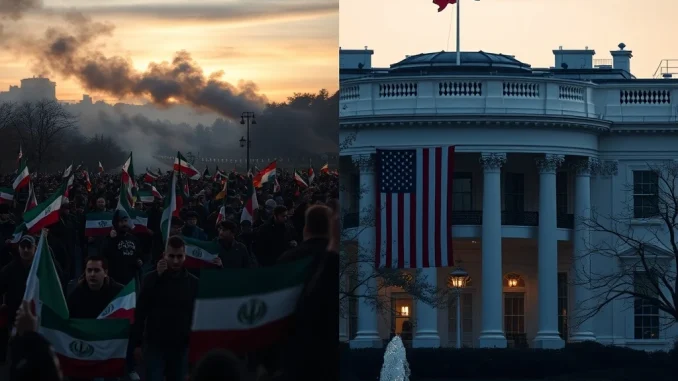
WASHINGTON, D.C. – January 15, 2025: President Donald Trump announced today that his administration is closely monitoring ongoing anti-government protests in Iran while actively weighing strong response options, according to reports from Walter Bloomberg. This development marks a significant escalation in U.S. engagement with Iranian domestic affairs and raises important questions about regional stability.
Trump Iran Protests Monitoring: A Strategic Overview
The White House confirmed President Trump’s statement regarding Iranian protests. Consequently, administration officials have intensified their monitoring efforts. The President specifically mentioned considering “strong response options” during a briefing with national security advisors. This announcement follows weeks of escalating demonstrations across multiple Iranian cities.
Iranian citizens have protested economic conditions and political restrictions for several months. However, recent weeks witnessed a significant increase in participation. Security forces have responded with various measures to contain the demonstrations. The international community continues to watch these developments with considerable concern.
Historical context provides essential perspective on current events. The United States and Iran have maintained tense relations for decades. Furthermore, the 2015 nuclear deal created temporary diplomatic engagement. The Trump administration withdrew from that agreement in 2018. Since then, bilateral relations have deteriorated significantly.
Iran Anti-Government Protests: Causes and Consequences
Economic factors primarily drive the current protest movement. Specifically, inflation has reached approximately 50% annually. Unemployment remains persistently high, particularly among youth. Additionally, international sanctions have severely impacted ordinary citizens. These conditions create widespread public frustration.
The protest movement began in provincial cities before spreading nationally. Initially, demonstrations focused on economic grievances. Gradually, political demands became more prominent. Protesters now frequently chant anti-government slogans. Security forces have occasionally used force to disperse crowds.
Regional experts identify several key characteristics of these protests:
- Decentralized leadership: No single organization coordinates activities
- Digital communication: Social media platforms facilitate organization
- Youth participation: Younger demographics dominate demonstrations
- Economic focus: Immediate grievances center on living conditions
Geopolitical Implications and Expert Analysis
Middle East analysts express cautious concern about potential escalation. Dr. Sarah Chen, a regional security specialist, explains the situation clearly. “The U.S. response will influence regional dynamics significantly,” she states. “Furthermore, neighboring countries watch developments closely.”
The following table illustrates recent protest patterns in Iran:
| Time Period | Protest Locations | Primary Issues | Government Response |
|---|---|---|---|
| October 2024 | 5 cities | Fuel prices | Limited engagement |
| November 2024 | 12 cities | Economic conditions | Increased security |
| December 2024 | 22 cities | Political freedoms | Internet restrictions |
| January 2025 | 31 cities | Multiple grievances | Mixed approaches |
International reactions vary considerably among global powers. European nations generally advocate for diplomatic solutions. Meanwhile, regional actors pursue different strategic interests. Saudi Arabia and Israel particularly monitor U.S. decisions. Their security calculations depend heavily on American actions.
US Iran Response Options: Strategic Considerations
The Trump administration reportedly evaluates multiple response scenarios. These options range from diplomatic statements to economic measures. Additionally, military possibilities remain theoretically available. However, officials emphasize diplomatic channels initially.
Economic sanctions represent the most likely immediate response. The United States already maintains extensive sanctions against Iran. Therefore, additional measures would expand existing restrictions. Specifically, secondary sanctions could target international entities. These would pressure Iran’s remaining economic connections.
Diplomatic actions provide alternative approaches. The United States might coordinate with European allies. International organizations offer additional forums for action. However, diplomatic consensus remains challenging to achieve. Different nations maintain varying Iran policies.
Military options exist as theoretical possibilities. Nevertheless, most analysts consider direct intervention unlikely. Regional stability concerns discourage dramatic escalation. Instead, limited shows of force might demonstrate resolve. Naval deployments could signal American commitment.
Historical Precedents and Contemporary Applications
Previous U.S. administrations faced similar decisions regarding Iran. The Obama administration responded cautiously to 2009 protests. Conversely, the Trump administration previously supported 2018 demonstrations. These historical examples inform current decision-making processes.
International law provides important frameworks for response options. The United Nations Charter prohibits interference in domestic affairs. However, human rights considerations create potential exceptions. Legal experts debate appropriate boundaries for international responses. These discussions influence policy formulation significantly.
Regional stability remains the paramount concern for most analysts. Middle East experts emphasize interconnected security dynamics. Specifically, Iranian actions influence multiple neighboring conflicts. Therefore, U.S. decisions create ripple effects throughout the region.
Middle East Tensions: Broader Regional Context
The Iranian protest movement occurs within complex regional dynamics. Multiple Middle Eastern nations experience internal challenges simultaneously. Additionally, interstate conflicts continue in several areas. These overlapping crises create particular sensitivity.
Syria represents one critical connection point. Iran maintains substantial military presence there. Consequently, domestic instability might affect Syrian commitments. Regional actors monitor potential redeployments carefully. Security calculations adjust accordingly.
Yemen provides another important connection. Iranian support for Houthi forces continues despite international pressure. Domestic protests could potentially affect this support. Regional observers watch for any changes in Yemen policy.
Nuclear negotiations create additional complexity. The United States seeks renewed discussions about Iran’s nuclear program. However, domestic instability complicates diplomatic engagement. Negotiators must account for internal Iranian dynamics.
Conclusion
President Trump’s announcement regarding Iran protests signals significant U.S. engagement. The administration monitors developments while considering response options. Regional stability remains the primary concern for all parties. Furthermore, international observers await concrete policy decisions. The situation continues evolving daily. Therefore, careful analysis remains essential for understanding developments. The Trump Iran protests situation demonstrates interconnected global dynamics. Ultimately, diplomatic solutions would benefit regional security most substantially.
FAQs
Q1: What specifically did President Trump say about Iran protests?
President Trump stated he is “closely monitoring” anti-government protests in Iran and “considering strong response options” according to Walter Bloomberg reports.
Q2: What are the main causes of protests in Iran?
The protests primarily stem from economic grievances including high inflation (approximately 50%), unemployment, and international sanctions impacting living conditions, though political demands have become more prominent recently.
Q3: What response options might the U.S. consider?
Options range from diplomatic statements and coordinated international action to expanded economic sanctions and, as last resorts, limited military demonstrations, though most analysts consider direct intervention unlikely.
Q4: How have previous U.S. administrations handled Iranian protests?
The Obama administration responded cautiously to 2009 protests, while the Trump administration previously expressed support for 2018 demonstrations, creating different precedents for current decision-making.
Q5: Why do Iran protests matter for regional stability?
Iran influences multiple regional conflicts including Syria and Yemen, so domestic instability could affect these commitments and alter security calculations throughout the Middle East.
This article was produced with AI assistance and reviewed by our editorial team for accuracy and quality.