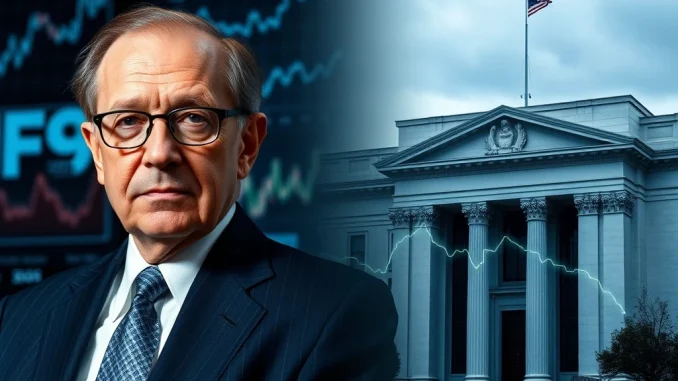
In a statement reverberating through financial circles, former President Donald Trump has explicitly framed Alan Greenspan, the iconic Federal Reserve Chair of the 1990s, as his ideal model for central bank leadership, a powerful signal interpreted as direct pressure for a significant shift toward growth-focused and flexible monetary policy as the 2024 election cycle concludes.
Trump’s Fed Chair Vision and the Greenspan Benchmark
Speaking to supporters recently, Trump praised the monetary policy landscape during Alan Greenspan’s tenure, which spanned from 1987 to 2006. He specifically highlighted the period’s growth-friendly stance. Consequently, his remarks are not merely historical reflection. Instead, they represent a clear political and economic directive. Financial analysts immediately viewed the statement as renewed advocacy for lower interest rates. This perspective challenges the current Federal Reserve’s more cautious, data-dependent approach to inflation.
To understand the weight of this comparison, one must examine the Greenspan era’s core tenets. Greenspan famously presided over a period of robust economic expansion, technological boom, and low inflation—often termed “The Great Moderation.” His leadership style was characterized by several key principles:
- Pragmatic Flexibility: Greenspan was known for avoiding rigid monetary rules, famously stating, “I know you think you understand what you thought I said but I’m not sure you realize that what you heard is not what I meant.” This allowed for nimble responses to economic shocks.
- Growth Prioritization: His policies were generally accommodative during economic contractions, aiming to sustain expansion and maximize employment.
- Market Communication: While often cryptic, his testimony before Congress and public speeches were major market-moving events, establishing the Fed Chair’s voice as a critical economic tool.
Trump’s endorsement, therefore, advocates for a Fed less constrained by post-2008 crisis protocols and more willing to use monetary policy aggressively to stimulate economic activity, even if it risks higher inflation.
The Context of Current Monetary Policy Debates
This call for a Greenspan-like Fed arrives at a pivotal juncture. The current Federal Reserve, under Chair Jerome Powell, has navigated the highest inflation in four decades. After an aggressive hiking cycle, the Fed has now paused and is contemplating its first rate cuts. Trump’s statement injects a potent political dimension into this technically complex decision-making process. Historically, presidents have avoided direct commentary on Fed actions to preserve its independence. However, Trump has consistently blurred this line, both during his presidency and now.
The table below contrasts the core economic environments of the Greenspan benchmark era with today’s landscape:
| Policy Context | Greenspan Era (Mid-90s Focus) | Current Environment (2025) |
|---|---|---|
| Primary Inflation Driver | Technology-led productivity gains | Post-pandemic supply chains, fiscal stimulus, services |
| Global Economic Backdrop | Relative stability, globalization ascent | Geopolitical fragmentation, trade realignments |
| Federal Debt Level | Manageable, declining in late 1990s | Historically high and rising |
| Fed’s Mandate Focus | Dual mandate, with emphasis on growth | Dual mandate, recent intense focus on price stability |
This starkly different backdrop raises questions among experts about the direct applicability of a 1990s playbook. The economy now faces unique structural challenges that Greenspan did not confront.
Expert Analysis on the Feasibility and Impact
Monetary policy historians and economists offer nuanced perspectives on Trump’s proposed return to a Greenspan-style framework. Dr. Sarah Jensen, a political economist at the Brookings Institution, notes, “The appeal to Greenspan is symbolic. It evokes a period of American economic dominance and smooth sailing. However, it selectively recalls the boom while overlooking the seeds of the 2008 crisis—excessive deregulation and asset bubbles—that were sown during that same era.”
Furthermore, the institutional memory of the Fed itself acts as a constraint. The consensus-driven model established post-Greenspan deliberately moved away from a single, dominant “maestro” figure. Instead, it emphasizes collective decision-making and clearer forward guidance. A potential future Fed chair would operate within this evolved structure, making a pure return to the Greenspan model operationally difficult.
The immediate market impact of Trump’s comments was a slight steepening of the yield curve. Bond traders priced in a marginally higher probability of more aggressive rate cuts in 2025. This reaction underscores how political signals can directly influence financial conditions, potentially complicating the Fed’s own messaging and policy implementation.
Historical Precedent and Political Pressure on Fed Independence
The relationship between the White House and the Federal Reserve has always been delicate, but public comparisons to past chairs are a notable tactic. President Lyndon B. Johnson famously confronted Fed Chair William McChesney Martin over rate hikes. More recently, President Trump openly criticized Chair Jerome Powell during his term, labeling Fed policy a mistake. This latest Greenspan commentary continues that pattern but uses a different, more nostalgic rhetorical strategy.
This public pressure creates a complex environment for the Federal Reserve. Its legitimacy hinges on its perceived independence from short-term political cycles. When a major political figure advocates for a specific policy path, the Fed must carefully balance its data-driven mandate with the reality of political expectations. The central bank’s next moves on interest rates will now be scrutinized through this political lens, regardless of the underlying economic data.
Conclusion
Donald Trump’s explicit desire for a Fed chair modeled on Alan Greenspan has significantly shaped the monetary policy conversation. It champions a return to a more flexible, growth-oriented central bank philosophy. This vision directly contrasts with the recent inflation-fighting posture. While evoking a period of economic success, the comparison overlooks the distinct challenges of the modern economy. Ultimately, the statement serves as a powerful political marker. It pressures the Federal Reserve toward rate cuts and frames the future of monetary policy as a key ideological battleground. The central bank’s response will test its cherished independence and define its role in the coming economic chapter.
FAQs
Q1: Who is Alan Greenspan and why is he significant?
Alan Greenspan served as Chairman of the Federal Reserve from 1987 to 2006. His tenure is associated with a long period of economic growth, low inflation, and the rise of the technology sector, making him a symbol of successful, growth-focused monetary policy for many.
Q2: What does Trump mean by a “growth-friendly” Fed?
This typically refers to a central bank that prioritizes stimulating economic growth and maintaining low unemployment, even if it means keeping interest rates lower for longer or being more tolerant of slightly higher inflation than current standards might allow.
Q3: How does the current Fed Chair, Jerome Powell, differ from Greenspan’s style?
Jerome Powell leads a more consensus-based, transparent Fed that relies heavily on forward guidance and strict data dependency. Greenspan’s style was more idiosyncratic and discretionary, with famously opaque public communications that allowed for greater policy flexibility.
Q4: Could a future Fed chair actually return to Greenspan’s methods?
While a chair could adopt a more flexible, discretionary approach, the post-2008 financial crisis institutional reforms, a heightened focus on financial stability, and the current high-debt environment make a full return to the 1990s policy framework highly unlikely and potentially risky.
Q5: What is the main risk of applying a 1990s monetary policy model today?
The primary risk is misjudging inflation dynamics. The Greenspan era benefited from disinflationary forces like globalization and tech productivity that are now weaker or reversing. Applying overly accommodative policy today could re-ignite persistent inflation or fuel asset bubbles in a high-debt economy.
Updated insights and analysis added for better clarity.
This article was produced with AI assistance and reviewed by our editorial team for accuracy and quality.