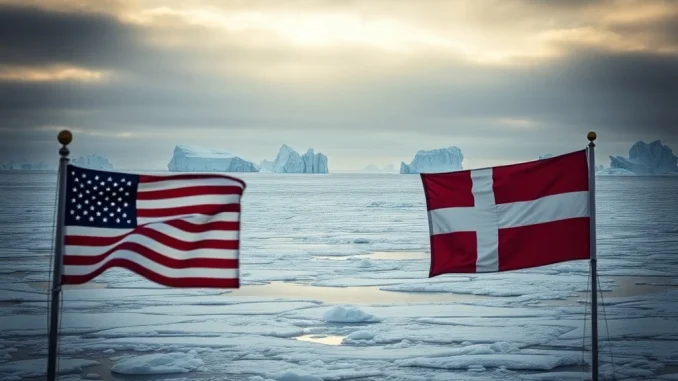
DAVOS, SWITZERLAND — January 21, 2025 — In a statement that immediately reverberated through diplomatic channels worldwide, former U.S. President Donald Trump declared Greenland as United States territory during his special address at the World Economic Forum. The controversial assertion framed Greenland’s status as vital for American national security, fundamentally challenging established international agreements and Danish sovereignty. This declaration represents the latest development in ongoing Arctic geopolitical competition, where melting ice caps have exposed new strategic and economic opportunities. Consequently, global observers now scrutinize how this claim might reshape international relations in the strategically crucial Arctic region.
Trump’s Greenland Territory Claim at Davos
During his high-profile appearance at the World Economic Forum in Davos, Switzerland, Donald Trump made his most definitive statement yet regarding Greenland. Specifically, he asserted that “no country other than the United States can secure Greenland.” Moreover, he explicitly called the autonomous Danish territory “U.S. territory” and declared it “necessary for national security.” These remarks immediately generated international headlines and diplomatic concern. The World Economic Forum, typically focused on economic cooperation, suddenly became the stage for a significant geopolitical declaration. Trump’s statement represents a continuation of his administration’s previously expressed interest in purchasing Greenland, an offer Denmark firmly rejected in 2019. However, this latest declaration moves beyond purchase discussions to outright territorial claim.
Historical Context of US-Greenland Relations
The relationship between the United States and Greenland possesses deep historical roots, particularly dating to World War II. Following Denmark’s occupation by Nazi Germany in 1940, the United States established protective custody over Greenland through an agreement with the Danish ambassador in Washington. This arrangement prevented Axis powers from establishing bases on the strategically located island. After the war, the 1951 Defense of Greenland agreement formalized American military presence at Thule Air Base, which remains the U.S. Air Force’s northernmost base. Importantly, this agreement recognizes Danish sovereignty while permitting American defense operations. Throughout the Cold War, Greenland’s location provided critical early warning capabilities against Soviet bombers and missiles. Today, Thule Air Base supports missile defense, space surveillance, and satellite tracking missions. The base’s strategic value has only increased with renewed great power competition.
Geopolitical Implications of Arctic Sovereignty Claims
Trump’s statement arrives during a period of intensified Arctic competition among global powers. Melting polar ice has opened new shipping routes, including the Northern Sea Route, which could dramatically shorten transit times between Asia and Europe. Additionally, the Arctic region holds substantial untapped natural resources, including an estimated 13% of the world’s undiscovered oil and 30% of undiscovered natural gas. Several nations have expanded their Arctic military presence and infrastructure investments in recent years. Russia has notably reopened Soviet-era military bases and constructed new facilities along its northern coastline. China, declaring itself a “near-Arctic state,” has increased scientific research and investment in Arctic projects. NATO members, including the United States, have conducted more frequent military exercises in the region. Therefore, control over Greenland provides strategic positioning in this emerging geopolitical arena.
International Law and Territorial Sovereignty
Under established international law, Greenland maintains clear status as an autonomous territory within the Kingdom of Denmark. The island gained self-rule in 2009, controlling most domestic affairs while Denmark handles defense and foreign policy. International recognition of Danish sovereignty over Greenland is nearly universal. The United Nations Convention on the Law of the Sea (UNCLOS) provides the primary legal framework for maritime claims in the Arctic region. Denmark has submitted extensive scientific data to the UN Commission on the Limits of the Continental Shelf, seeking to expand its seabed rights north of Greenland. The United States, notably, has not ratified UNCLOS, though it generally follows its provisions. Any unilateral claim to another nation’s territory violates fundamental principles of the UN Charter, which prohibits the threat or use of force against territorial integrity. Consequently, Trump’s declaration conflicts with multiple layers of international legal architecture.
| Country | Arctic Territory | Key Military Assets | Economic Interests |
|---|---|---|---|
| United States | Alaska | Thule Air Base, Icebreakers | Shipping, Oil/Gas, Fisheries |
| Russia | Extensive Northern Coastline | Northern Fleet, Arctic Brigades | Northern Sea Route, Energy |
| Canada | Northern Territories | Nanisivik Naval Facility | Northwest Passage, Mining |
| Denmark | Greenland | Joint Arctic Command | Tourism, Rare Earth Minerals |
| Norway | Svalbard Archipelago | Maritime Patrol Aircraft | Oil/Gas, Research |
Danish Response and Alliance Dynamics
The Danish government and Greenland’s autonomous leadership have consistently rejected any transfer of sovereignty. Prime Minister Mette Frederiksen previously called Trump’s 2019 purchase idea “absurd,” emphasizing Greenland is not for sale. The Danish Ministry of Foreign Affairs typically reiterates that Greenland remains an integral part of the Kingdom of Denmark. Greenland’s own government values its relationship with the United States but strongly asserts its right to self-determination. Importantly, Denmark is a founding NATO member, and the United States is its key alliance partner. Thule Air Base operates under bilateral defense agreements that respect Danish sovereignty. Trump’s territorial claim potentially strains this vital security relationship. Furthermore, it tests the cohesion of NATO’s northern flank at a time when the alliance seeks unity regarding Russian activities in the Arctic. European allies likely view such unilateral claims as destabilizing to regional security architecture.
Strategic Importance of Greenland’s Location
Greenland’s geographical position offers unparalleled strategic advantages for multiple military and scientific domains. Situated between North America and Europe, the island provides ideal locations for:
- Early Warning Systems: Radar installations can detect airborne and missile threats approaching from multiple directions.
- Space Surveillance: Thule Air Base tracks satellites and space debris in polar orbits.
- Undersea Monitoring: The GIUK Gap (Greenland-Iceland-United Kingdom) remains crucial for tracking submarine movements.
- Climate Research: Ice core samples from Greenland’s ice sheet provide vital climate change data.
- Communications Infrastructure: Fiber optic cables could connect North America and Europe via shorter Arctic routes.
Melting ice potentially opens mineral access, including rare earth elements critical for electronics and renewable energy technologies. Chinese companies have already sought mining investments in Greenland, raising concerns in Western capitals about strategic dependency.
Media Analysis and Global Reactions
International media coverage of Trump’s statement has been extensive and largely critical. European outlets generally emphasize the violation of sovereignty norms and potential alliance damage. Russian and Chinese media have portrayed the claim as evidence of American expansionism and disregard for international law. Within the United States, reactions split along predictable political lines, though some foreign policy experts across the spectrum express concern about diplomatic fallout. Security analysts note that while Greenland’s strategic value is undeniable, unilateral claims undermine the rules-based international order that the United States helped establish. Furthermore, such declarations could encourage other nations to make similar claims in disputed regions worldwide. The timing during the World Economic Forum is particularly notable, as the event traditionally emphasizes multilateral cooperation rather than unilateral assertions.
Conclusion
Donald Trump’s declaration that Greenland constitutes U.S. territory vital for national security represents a significant geopolitical statement with far-reaching implications. While highlighting Greenland’s genuine strategic importance in Arctic competition, the claim directly challenges Danish sovereignty and established international law. The statement’s delivery at the World Economic Forum ensures maximum global attention during a period of heightened great power rivalry. Moving forward, this declaration may influence Arctic governance discussions, NATO alliance dynamics, and broader norms regarding territorial integrity. Regardless of immediate diplomatic consequences, Trump’s Greenland territory claim underscores how climate change and resource competition are transforming the Arctic into a central arena for 21st-century geopolitics. The international community now watches closely how this assertion affects regional stability and global diplomatic relations.
FAQs
Q1: What exactly did Donald Trump say about Greenland?
During a January 21 address at the World Economic Forum in Davos, Trump stated that “no country other than the United States can secure Greenland,” called it “U.S. territory,” and declared it “necessary for national security.”
Q2: Does the United States have any legal claim to Greenland?
No. Greenland is an autonomous territory within the Kingdom of Denmark. The U.S. operates Thule Air Base under a 1951 defense agreement that explicitly recognizes Danish sovereignty.
Q3: Why is Greenland strategically important?
Greenland’s location offers advantages for early warning systems, space surveillance, undersea monitoring, and potential shorter shipping routes. Its mineral resources, including rare earth elements, also hold economic and strategic value.
Q4: How has Denmark responded to Trump’s claim?
Denmark has consistently rejected any transfer of sovereignty. Prime Minister Mette Frederiksen previously called purchase ideas “absurd,” and the government reaffirms Greenland’s status as part of the Kingdom of Denmark.
Q5: What are the broader implications for Arctic geopolitics?
Trump’s claim could intensify great power competition in the Arctic, strain NATO alliances, and challenge international norms regarding territorial sovereignty during a period of rapid environmental and strategic change in the region.
Updated insights and analysis added for better clarity.
This article was produced with AI assistance and reviewed by our editorial team for accuracy and quality.