WASHINGTON, D.C., March 2025 – In a significant geopolitical development, former President Donald Trump announced today that the United States will secure all necessary military access rights in Greenland, fundamentally altering Arctic security calculations and potentially reshaping relations with Denmark. This declaration, first reported by Walter Bloomberg, represents a strategic pivot toward the resource-rich Arctic region where global powers increasingly compete for influence.
Trump’s Greenland Military Access Announcement Reshapes Arctic Strategy
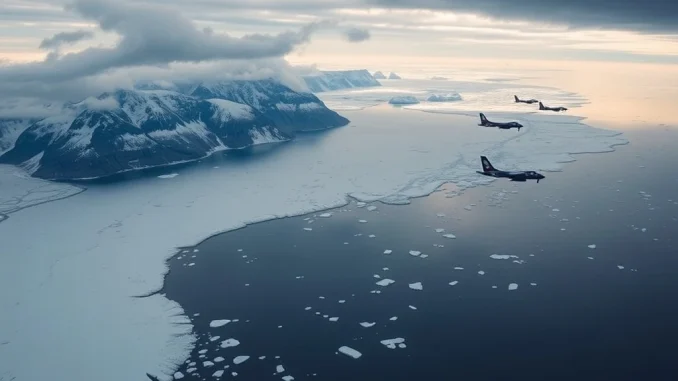
The United States has pursued enhanced military access in Greenland for decades, particularly since the Cold War. Consequently, Trump’s announcement accelerates existing strategic priorities rather than creating entirely new ones. Greenland’s geographic position offers unparalleled advantages for early warning systems, submarine tracking, and satellite communications. Moreover, the island’s location provides critical monitoring capabilities for both the North Atlantic and Arctic Ocean approaches.
Historically, the U.S. maintained the Thule Air Base in northwestern Greenland since 1951 under a 1951 defense agreement with Denmark. This base serves as the northernmost U.S. military installation, hosting missile warning radars and space surveillance systems. However, recent geopolitical shifts have prompted calls for expanded access. For instance, Russia’s military modernization in the Arctic and China’s declared “Polar Silk Road” ambitions have heightened Western security concerns.
Military analysts note that securing comprehensive access rights would enable several strategic advantages:
- Enhanced Surveillance: Improved monitoring of Russian submarine activity in the GIUK Gap (Greenland-Iceland-United Kingdom)
- Missile Defense: Expanded capabilities for ballistic missile early warning systems
- Rapid Deployment: Forward positioning of assets for Arctic emergency response
- Research Access: Military support for scientific research in changing Arctic conditions
Geopolitical Context and Regional Implications
Greenland’s autonomous government within the Kingdom of Denmark complicates military access negotiations significantly. While Denmark handles foreign and security policy, Greenland’s Home Rule Act of 1979 and subsequent Self-Government Act of 2009 grant substantial control over mineral resources and local governance. Therefore, any comprehensive military agreement requires navigating this dual sovereignty structure carefully.
The timing of this announcement coincides with several critical developments. First, climate change continues to open new Arctic shipping routes, increasing the region’s strategic value. Second, rare earth mineral discoveries in Greenland have attracted international interest, particularly from China. Third, NATO’s renewed focus on Arctic security following Russia’s invasion of Ukraine has elevated regional priorities.
| Country | Primary Bases | Key Capabilities |
|---|---|---|
| United States | Thule Air Base (Greenland), Fort Greely (Alaska) | Missile defense, surveillance, air operations |
| Russia | Northern Fleet bases, Arctic brigades | Submarine warfare, icebreakers, air defense |
| Canada | Nanisivik Naval Facility, Alert Station | Maritime patrol, search and rescue |
| Norway | Evenes Air Station, Porsangermoen Garrison | Intelligence, surveillance, reconnaissance |
Expert Analysis on Strategic Implications
Dr. Anya Petrova, Senior Fellow at the Arctic Security Institute, explains the broader context: “This move represents a logical extension of existing U.S. Arctic strategy. The 2019 Department of Defense Arctic Strategy already identified Greenland as vital for homeland defense. However, securing ‘all necessary access rights’ suggests a more comprehensive approach than previous agreements.”
Petrova continues: “The real question involves implementation details. Will this include new infrastructure investments? How will it affect Greenland’s environmental protections? What consultation mechanisms will be established with local populations? These operational questions will determine the announcement’s long-term significance.”
Meanwhile, former U.S. Northern Command advisor General Mark Richardson (ret.) emphasizes the technological aspects: “Greenland’s position offers unique advantages for space domain awareness and hypersonic missile tracking. The island’s eastern coastline provides optimal geometry for monitoring launches from Eurasia. Consequently, enhanced access could significantly improve North American aerospace defense capabilities.”
Historical Precedents and Diplomatic Considerations
Trump’s interest in Greenland is not unprecedented. In 2019, he publicly floated the idea of purchasing the territory, causing diplomatic friction with Denmark. That episode highlighted both Greenland’s strategic value and the sensitivities surrounding its status. Today’s announcement appears more focused on access rights rather than sovereignty questions, potentially making it more diplomatically feasible.
The U.S.-Denmark defense relationship has strengthened considerably in recent years. In 2020, the two countries signed an updated defense agreement specifically addressing Greenland. This agreement already expanded U.S. investment authority at Thule Air Base. Therefore, Trump’s announcement may represent an acceleration of existing trends rather than a completely new direction.
Regional reactions will likely vary significantly. NATO allies generally welcome enhanced U.S. commitment to Arctic security. However, some European diplomats express concerns about escalating tensions with Russia. Meanwhile, environmental groups monitor potential impacts on Greenland’s fragile ecosystems. Additionally, indigenous communities rightfully seek assurances about consultation processes and economic benefits.
Economic and Resource Dimensions
Beyond military considerations, Greenland possesses substantial mineral resources including rare earth elements critical for electronics and renewable energy technologies. China has shown particular interest in these resources, with Chinese companies holding exploration licenses for several sites. Enhanced U.S. military presence could influence these economic developments indirectly.
Greenland’s government faces complex calculations. While some political factions welcome increased U.S. investment and security guarantees, others prioritize environmental protection and full independence. The island’s population of approximately 56,000 people maintains diverse views on foreign military presence. Consequently, local consultations will prove essential for any lasting agreement.
Climate change adds another layer of complexity. Melting ice reveals new resources and shipping routes while threatening traditional livelihoods. Military infrastructure must adapt to changing environmental conditions, including thawing permafrost and increased coastal erosion. These practical considerations require careful planning and substantial investment.
Conclusion
President Trump’s announcement regarding U.S. military access rights in Greenland represents a significant development in Arctic security policy. This move aligns with broader strategic trends while potentially accelerating U.S. engagement in the region. The implementation details will determine its ultimate impact on regional stability, U.S.-Denmark relations, and global power dynamics. As Arctic competition intensifies, Greenland’s strategic importance continues growing, making this announcement particularly timely and consequential for international security arrangements.
FAQs
Q1: What existing U.S. military presence exists in Greenland?
The United States operates Thule Air Base in northwestern Greenland under a 1951 defense agreement with Denmark. This base hosts approximately 600 personnel and supports missile warning, space surveillance, and satellite command functions.
Q2: How does Greenland’s political status affect military agreements?
Greenland is an autonomous territory within the Kingdom of Denmark. While Denmark handles foreign and defense policy, Greenland’s government controls mineral resources and must be consulted on matters affecting its territory, creating a complex dual-sovereignty situation.
Q3: Why is the Arctic region becoming more strategically important?
Climate change is opening new shipping routes, revealing untapped resources, and increasing military accessibility. Meanwhile, Russia has significantly modernized its Arctic military capabilities, and China has declared Arctic ambitions, heightening competition among major powers.
Q4: How have other countries reacted to this announcement?
NATO allies generally view enhanced U.S. Arctic engagement positively for collective defense. Russia will likely condemn it as escalation, while China may express concerns about militarization. Regional actors will monitor implementation details carefully.
Q5: What environmental considerations accompany military expansion in Greenland?
Military infrastructure must address thawing permafrost, sensitive ecosystems, and potential pollution. Environmental impact assessments and consultation with local communities are essential components of responsible development in the fragile Arctic environment.
Updated insights and analysis added for better clarity.
This article was produced with AI assistance and reviewed by our editorial team for accuracy and quality.