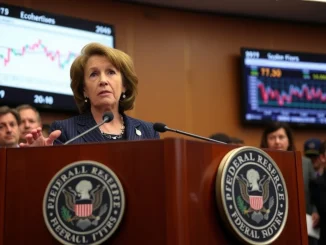
WASHINGTON, D.C. – November 2025 – President Donald Trump will determine the next chair of the Federal Reserve within the coming weeks, according to a White House statement reported by Walter Bloomberg. This pivotal decision arrives at a crucial juncture for the U.S. economy, potentially influencing interest rates, inflation control, and financial stability for years. Consequently, markets and policymakers globally await this announcement with intense scrutiny.
Federal Reserve Chair Appointment Enters Final Phase
The White House confirmed the timeline for this significant decision recently. President Trump reportedly considers several qualified individuals suitable for the position. The Federal Reserve chair wields enormous influence over the world’s largest economy. Therefore, this appointment carries profound implications for both domestic and international financial systems.
Historically, Fed chairs serve four-year terms, with many serving multiple terms if reappointed. The current chair’s term concludes in early 2026, making this selection process timely. The President typically nominates a candidate, who then faces confirmation by the Senate. This process ensures thorough vetting and congressional oversight.
Context and Background of the Federal Reserve Leadership
The Federal Reserve System, established in 1913, functions as the United States’ central bank. Its primary mandates include maximizing employment, stabilizing prices, and moderating long-term interest rates. The Chair leads the Federal Open Market Committee (FOMC), which sets key interest rates. These rates directly affect borrowing costs for consumers and businesses.
Previous chairs have navigated diverse economic challenges. For instance, Alan Greenspan guided policy during the dot-com boom and bust. Ben Bernanke confronted the 2008 global financial crisis. Janet Yellen oversaw post-crisis recovery and initial rate hikes. Jerome Powell managed the economic response to the pandemic and subsequent inflation surge.
Potential Candidates and Selection Criteria
While the White House has not named specific individuals, financial analysts and political observers speculate about potential contenders. The selection pool likely includes current Fed officials, academic economists, and former policymakers. Key qualifications typically involve:
- Monetary Policy Expertise: Deep understanding of economics and central banking.
- Political Savvy: Ability to navigate congressional relations and public communication.
- Crisis Management: Experience handling financial stress and economic shocks.
- Market Credibility: Trust from investors and international counterparts.
The President’s decision may reflect his administration’s economic priorities. These could include inflation control, financial deregulation, or employment growth. Furthermore, the nominee’s philosophical alignment on key issues will prove crucial.
Immediate Impacts on Markets and Economic Policy
Financial markets react sensitively to Federal Reserve leadership signals. Bond yields, stock prices, and currency values often fluctuate during appointment periods. Investors particularly watch for hints about future policy direction. A perceived hawkish chair might signal tighter monetary policy, while a dovish chair could indicate continued accommodation.
The transition period itself requires careful management. Monetary policy continuity remains essential for economic stability. Consequently, the outgoing and incoming chairs typically coordinate to ensure smooth operational handover. This cooperation minimizes market disruption and maintains policy credibility.
Historical Precedents and Appointment Patterns
Presidents from both parties have occasionally reappointed sitting chairs from opposing administrations. This tradition underscores the position’s nonpartisan nature. For example, President Obama reappointed Ben Bernanke, originally appointed by President Bush. President Trump initially retained Janet Yellen before appointing Jerome Powell.
The table below illustrates recent Federal Reserve chair appointments:
| Chair | Appointing President | Term Start | Key Challenges |
|---|---|---|---|
| Alan Greenspan | Ronald Reagan | 1987 | Black Monday, Dot-com Bubble |
| Ben Bernanke | George W. Bush | 2006 | Global Financial Crisis |
| Janet Yellen | Barack Obama | 2014 | Post-Crisis Recovery |
| Jerome Powell | Donald Trump | 2018 | Pandemic Response, High Inflation |
Global Ramifications of the Fed Chair Decision
International observers closely monitor U.S. Federal Reserve appointments. The dollar serves as the world’s primary reserve currency. Therefore, U.S. monetary policy decisions create spillover effects across global economies. Emerging markets often feel particular impact from Fed interest rate changes.
Foreign central banks coordinate with the Fed on various issues. These include currency swap lines, financial stability monitoring, and crisis response protocols. The new chair’s approach to international cooperation will influence these relationships significantly. A collaborative stance generally supports global economic stability.
Expert Perspectives on the Selection Process
Economic analysts emphasize the appointment’s long-term significance. “The Federal Reserve chair influences policy for years beyond any single presidential term,” notes Dr. Eleanor Vance, a former Fed economist now at the Brookings Institution. “Selection criteria should prioritize technical competence and institutional integrity over short-term political considerations.”
Market strategists highlight the confirmation process’s importance. Senate Banking Committee hearings provide public scrutiny of the nominee’s views. These hearings often reveal detailed policy positions on critical issues like:
- Inflation targeting frameworks and flexibility
- Balance sheet normalization strategies
- Financial regulation approaches
- Digital currency development oversight
Conclusion
President Trump’s impending Federal Reserve chair decision represents a defining moment for U.S. economic stewardship. The selection will shape monetary policy direction through potential economic transitions. Moreover, this appointment carries substantial weight for global financial stability and international policy coordination. The coming weeks will reveal not just a name, but a philosophical direction for the world’s most influential central bank. Consequently, all economic participants should prepare for consequential policy evolution.
FAQs
Q1: What is the Federal Reserve chair’s primary responsibility?
The Federal Reserve chair leads the central bank in fulfilling its dual mandate: maximizing employment and stabilizing prices through monetary policy tools like interest rate setting.
Q2: How long does a Federal Reserve chair serve?
The standard term is four years, but chairs often serve multiple terms if reappointed by sitting presidents, sometimes spanning different administrations.
Q3: What happens during the transition between Fed chairs?
The outgoing and incoming chairs typically coordinate extensively to ensure policy continuity, with staff briefings and overlapping periods minimizing market disruption.
Q4: Can the President remove a sitting Federal Reserve chair?
No, Federal Reserve governors, including the chair, serve fixed terms and cannot be removed by the President for policy disagreements, ensuring central bank independence.
Q5: How quickly does a new Fed chair influence policy decisions?
While immediate changes are possible, most chairs gradually implement their approaches over several FOMC meetings, building consensus within the committee.
Updated insights and analysis added for better clarity.
This article was produced with AI assistance and reviewed by our editorial team for accuracy and quality.