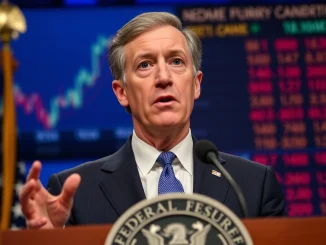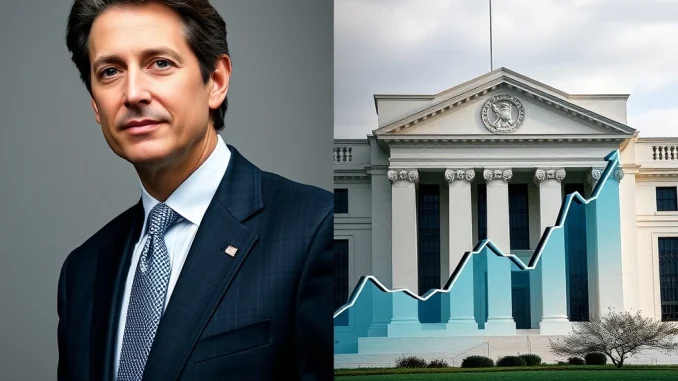
Washington D.C., October 26, 2023: In a statement that has ignited significant discussion within financial and political circles, former President Donald Trump indicated that his preferred nominee for Federal Reserve Chair, Kevin Warsh, would pursue a policy of interest rate cuts without requiring external pressure. This assertion, reported by Walter Bloomberg, places a renewed spotlight on the critical intersection of presidential influence, central bank independence, and the future trajectory of U.S. monetary policy. The comment arrives as markets and economists closely analyze the potential composition and direction of the Federal Reserve’s leadership.
Kevin Warsh and the Future of Federal Reserve Policy
The core of President Trump’s statement centers on the anticipated policy leanings of Kevin Warsh, a former member of the Federal Reserve’s Board of Governors. Warsh served from 2006 to 2011, a period encompassing the global financial crisis. His tenure was marked by a reputation as a monetary policy hawk, often expressing concerns about inflation and the risks of prolonged ultra-low interest rates. However, Trump’s recent characterization suggests a potential shift or a specific alignment with the former president’s long-stated preference for lower borrowing costs to stimulate economic growth. This perceived alignment raises immediate questions about the traditional firewall between the White House and the Fed’s Open Market Committee.
Central bank independence is a cornerstone of modern economic policy, designed to insulate crucial decisions on interest rates from short-term political cycles. Public statements from a president or presidential candidate about a nominee’s specific policy actions, especially before any formal nomination or Senate confirmation hearings, are unusual. They challenge the norm of allowing the Fed to operate based on its dual mandate of maximum employment and price stability, free from direct executive branch influence.
Historical Context of Presidential Influence on the Fed
The relationship between U.S. presidents and the Federal Reserve has often been complex, but overt pressure regarding specific rate decisions is historically fraught. To understand the significance of Trump’s comment, it is essential to examine past interactions:
- The Nixon Era: President Richard Nixon famously pressured Fed Chair Arthur Burns to keep rates low ahead of the 1972 election, contributing to the stagflation of the 1970s.
- The Reagan-Appointed Volcker: President Ronald Reagan supported Paul Volcker’s brutally high-interest rate policy to crush inflation, despite it causing a severe recession, demonstrating respect for Fed independence during a crisis.
- Trump’s First Term: President Trump frequently and publicly criticized Fed Chair Jerome Powell for raising rates, breaking with decades of precedent by openly challenging the central bank’s policy decisions.
Trump’s latest statement about Warsh can be seen as a continuation of his first-term approach, but with a forward-looking framing focused on a potential future appointee’s inherent disposition. It shifts the discussion from criticizing current policy to shaping expectations for future policy leadership.
Analyzing Warsh’s Record and Potential Philosophy
Kevin Warsh’s own writings and speeches provide a more nuanced picture than the simplified “rate-cutter” label. As a governor, he was often critical of the Fed’s post-crisis quantitative easing programs, warning about asset bubbles and market distortions. His policy philosophy appeared rooted in a rules-based approach and a wariness of overactive intervention. However, analysts note that economic contexts change. The post-2020 economic landscape, marked by a pandemic recovery, supply chain shocks, and periods of high inflation, requires different tools and considerations than the post-2008 era.
A potential Warsh-led Fed might prioritize normalizing the balance sheet and reinforcing policy predictability. The suggestion of rate cuts would likely be contingent on specific economic data, particularly signs of weakening demand or a deteriorating labor market, rather than a pre-ordained path. The key question for markets is whether a Chair Warsh would interpret economic data through a more accommodative lens than his prior hawkish reputation would suggest.
Immediate Market Reactions and Long-Term Implications
Financial markets are sensitive to any signals about the path of monetary policy. Statements linking a potential Fed chair to a specific policy direction can influence:
- Bond Yields: Expectations for lower future rates can cause Treasury yields to fall, flattening the yield curve.
- Equity Markets: Stocks often rally on the prospect of lower borrowing costs and higher corporate profitability.
- Currency Values: The U.S. dollar might weaken if future rate cuts are anticipated relative to other central banks.
- Market Volatility: Uncertainty about Fed leadership and philosophy can increase volatility indices.
The longer-term implication is one of institutional credibility. If the public perceives that Federal Reserve governors are selected primarily for their alignment with a president’s preferred interest rate level, the hard-won trust in the apolitical nature of the institution could erode. This could make it more difficult for the Fed to implement necessary but politically unpopular policies, such as raising rates to combat inflation during an economic boom.
Conclusion
Former President Donald Trump’s statement regarding Kevin Warsh and interest rate cuts serves as a pivotal moment for discussing the future of U.S. monetary policy governance. It transcends a simple personnel announcement and touches on fundamental principles of central bank independence, the politicization of economic stewardship, and the expectations-setting process for financial markets. Whether Warsh is formally nominated or not, the conversation highlights the intense scrutiny the next Fed chair will face in balancing data-driven decision-making with the political environment. The ultimate impact on interest rates will depend not on presidential commentary, but on the evolving economic data that the Federal Reserve is sworn to analyze objectively.
FAQs
Q1: Who is Kevin Warsh?
Kevin Warsh is a former investment banker and served as a Governor on the Federal Reserve Board from 2006 to 2011. He is currently a distinguished visiting fellow at the Hoover Institution and is frequently mentioned as a potential candidate for Federal Reserve Chair.
Q2: What does it mean that the Fed should be “independent”?
Federal Reserve independence means its monetary policy decisions—primarily setting interest rates—are intended to be made free from direct political pressure from the President or Congress. This allows the Fed to make decisions based on long-term economic health, even if they are politically unpopular in the short term.
Q3: Why do lower interest rates matter?
Lower interest rates reduce the cost of borrowing for businesses and consumers. This can stimulate economic activity by encouraging investment, hiring, and large purchases like homes and cars. Conversely, the Fed raises rates to cool an overheating economy and control inflation.
Q4: Has a president ever directly chosen a Fed chair who cut rates?
Presidents appoint Fed chairs, but they do not typically direct them to cut or raise rates. The chair and the Federal Open Market Committee make decisions based on economic data. Historical pressure, like that from President Nixon in the 1970s, is widely viewed by economists as a policy mistake that led to higher inflation.
Q5: What is the process for appointing a Federal Reserve Chair?
The President nominates a candidate for Fed Chair. The nominee must then be confirmed by the U.S. Senate. The term is four years, and chairs can be (and often are) re-nominated by subsequent presidents, as was the case with Alan Greenspan, Ben Bernanke, and Jerome Powell.