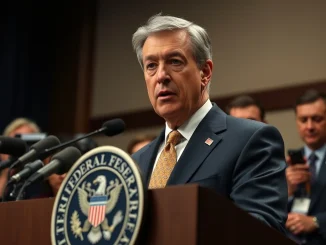
March 17, 2026 — President Donald Trump has intensified pressure on Federal Reserve Chair Jerome Powell to cut interest rates immediately, using public remarks and social media to argue that lower borrowing costs are urgently needed for the U.S. economy.
Public Pressure at the White House
Speaking at a White House meeting, Trump suggested the central bank should hold a “special meeting” to reduce rates. Videos shared on social media platform X captured the president’s comments. “What’s a better time to cut interest rates than now? A third-grade student would know that,” Trump said.
This public criticism follows a post Trump made on Truth Social last Thursday. In that post, he stated the Federal Reserve chair “should be dropping interest rates, IMMEDIATELY.” The president has consistently advocated for lower rates since the start of the year.
Economic and Political Rationale
In January, Trump argued the United States should have “substantially lower” rates, labeling Powell’s approach as “too late.” He claimed maintaining higher interest levels was “hurting our country, and its National Security.” A primary argument centers on the cost of servicing the national debt, which stands at approximately $39 trillion.
Lower interest rates would reduce government borrowing costs. They could also stimulate economic growth, housing activity, and stock market performance. Industry analysts note that cheaper borrowing costs typically increase market liquidity. This environment often pushes investors toward higher-risk assets, including stocks and cryptocurrencies.
Market Expectations for This Week’s Meeting
The Federal Reserve begins its two-day policy meeting on Tuesday, with a rate decision announcement scheduled for Wednesday. Market indicators, however, suggest no change is imminent. Data from CME futures markets show a 99% probability that rates will remain in the current 3.50% to 3.75% range.
A similar outlook exists for the late April meeting, with a 97% probability of no change. This consensus persists despite the expected leadership transition at the central bank. Powell’s term concludes in mid-May, and Trump’s nominee, Kevin Warsh, is seen as potentially more open to rate reductions.
Complicating Factors for the Fed
Geopolitical tensions are creating headwinds for monetary policy. Conflict with Iran has caused a surge in global oil prices. Higher fuel costs typically translate into increased prices for food and other goods through elevated transport expenses.
This dynamic could push inflation higher, potentially forcing the Fed to consider raising rates instead of cutting them. The U.S. inflation rate held steady at 2.4% in February, according to data from Trading Economics. Many economists anticipate an increase for March due to these energy price pressures.
Jeff Mei, chief operations officer at the BTSE exchange, provided context on market sentiment. “With the US-Iran conflict’s impact on rising oil prices, traders have already priced in the likelihood of zero cuts this year,” Mei told Cointelegraph. He suggested this could mean “less downward pressure on crypto asset prices,” as the inflation impact remains unclear and the Fed will likely “continue to wait out the situation.”
Policy Stalemate and Future Outlook
The Federal Reserve has held interest rates unchanged since December. The central bank now faces conflicting pressures: political calls for stimulus and economic factors that may require a restrictive stance to combat inflation.
President Trump’s public campaign highlights the unusual direct pressure on the nominally independent Federal Reserve. The outcome of this week’s meeting will signal how the central bank weighs these competing demands. For more information on the Federal Reserve’s policy framework, visit the Federal Reserve’s official monetary policy page.
Market participants will closely watch the post-meeting statement and any press conference remarks for clues about future policy direction, especially with the impending leadership change. Historical data on interest rates and inflation is available from sources like the Federal Reserve Economic Data (FRED) repository.
Updated insights and analysis added for better clarity.
This article was produced with AI assistance and reviewed by our editorial team for accuracy and quality.