
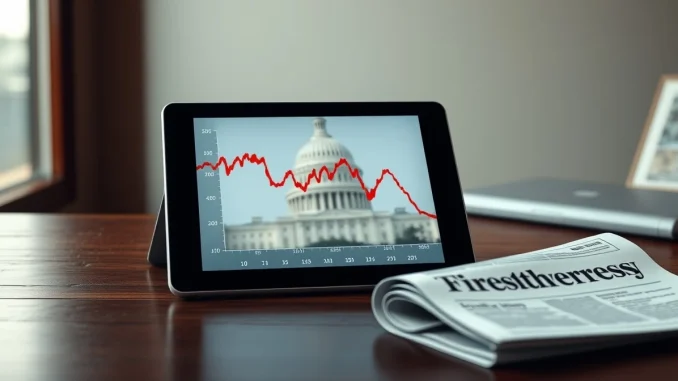
WASHINGTON, D.C. — April 12, 2026. Cryptocurrency tokens promoted by or linked to former U.S. President Donald Trump have plunged to historic lows, triggering a fresh wave of political criticism and raising significant questions about the intersection of digital assets and political influence. Data from CoinGecko and CoinMarketCap shows the so-called ‘Official Trump token’ (TRUMP) and a governance token from the World Liberty Financial (WLFI) platform have lost nearly all value since their peaks last year. This collapse has drawn sharp rebukes from Democratic lawmakers and some investors, who characterize the ventures as potential vehicles for political corruption.
Trump Crypto Tokens Crash to Historic Lows
According to market data, the TRUMP memecoin hit a record low of approximately $2.73 in March 2026. It has recovered only marginally, trading around $2.86 as of April 12. This represents a staggering decline of about 90% from its all-time high of over $73 in January 2025, shortly after its launch. The token’s value has effectively evaporated. Meanwhile, the WLFI governance token, associated with a decentralized finance platform co-founded by Trump’s sons, fell to just $0.07 over the weekend. Data from CoinMarketCap indicates WLFI is down nearly 75% from its September 2025 high of about $0.31.
Also read: Crypto News Alert: Privacy Warnings and Token Turmoil Shake Markets as Bitcoin Holds Firm
These crashes are not happening in a vacuum. They coincide with increased regulatory attention and a broader market correction for speculative digital assets. But the political connections make this situation unique. Industry watchers note that the precipitous drop suggests a lack of sustainable utility or demand beyond initial hype. This could signal deeper problems for celebrity or politically-linked crypto projects.
Lawmakers Launch Scrutiny Over ‘Access-for-Tokens’ Event
The financial decline has been amplified by political controversy. Senators Elizabeth Warren (D-Mass.), Richard Blumenthal (D-Conn.), and Adam Schiff (D-Calif.) recently sent a letter to Bill Zanker, the individual behind the TRUMP memecoin. Politico obtained a copy of the letter. In it, the lawmakers demand details about a planned gala for token holders at Trump’s Mar-a-Lago resort, scheduled for April 25, 2026. They argue the event’s organizers are “dangling access” to the former president, as attendance requires holding a specific amount of TRUMP tokens.
Also read: Bitcoin Price Reversal Looms as Key $76K Level Nears, Investor Warns of Inflation Impact
“Trump and his family members stand to benefit from increased sales of the Trump memecoin,” the Senators wrote. The implication is clear: they view this as a form of influence peddling, where financial support via token purchases is exchanged for political access. This scrutiny adds a legal and ethical dimension to the financial collapse. What this means for investors is heightened regulatory risk on top of market volatility.
Expert Criticism Echoes Investor Concerns
Academic and legal experts are weighing in on the debacle. Professor Tonya Evans, a scholar of law and technology, offered a blunt assessment. “We thought Sam Bankman-Fried or Gary Gensler were the worst things to happen to the crypto industry, and they were horrible,” Evans said. She added a pointed critique of the Trump-linked model: “But, turns out, it was the guy who surrounds himself with sycophants, siphons every bit of value he can for himself, and then expeditiously bankrupts companies and casinos without consequence.”
This criticism reflects a growing sentiment that politically-branded tokens may prioritize promotional gains over project fundamentals. The crash of WLFI, a platform with purported DeFi ambitions, suggests even projects with more structure than a pure memecoin are not immune. The connection to Trump’s family has not provided a stability floor.
A Timeline of Decline and Controversy
The story of these tokens follows a predictable yet dramatic arc. It began with the launch of the TRUMP memecoin in January 2025, which saw a meteoric and speculative rise to its $73 high within its first weeks. The WLFI platform and its token launched later, peaking in September 2025. Since then, the trajectory has been almost entirely downward.
Key Data Points:
- TRUMP Token (CoinGecko Data): All-Time High: >$73 (Jan 2025). Current Price: ~$2.86 (Apr 12, 2026). Decline: ~90%.
- WLFI Token (CoinMarketCap Data): All-Time High: ~$0.31 (Sep 2025). Current Price: ~$0.07 (Apr 12, 2026). Decline: ~75%.
- Political Action: U.S. Senators send inquiry letter (Late March 2026). Mar-a-Lago gala announced for token holders (April 25, 2026).
This timeline shows how financial performance and political scrutiny have become intertwined. The announcement of the gala, rather than boosting token value, appears to have accelerated regulatory interest and possibly accelerated the sell-off.
Broader Implications for Crypto and Politics
The collapse of the Trump-linked tokens serves as a case study for several pressing issues in the digital asset space. First, it highlights the extreme volatility and risk associated with celebrity-endorsed or politically-branded cryptocurrencies. These assets often derive value from sentiment and fame rather than technological utility or financial metrics. Second, it forces a conversation about regulation. The lawmakers’ letter indicates a focus on whether such token-based promotions might violate securities laws or ethics rules concerning political donations and graft.
Industry analysts suggest this episode may lead to more aggressive proposals for regulating political figures’ involvement with digital assets. The Securities and Exchange Commission (SEC) has previously cracked down on celebrity endorsements of crypto assets that were deemed unregistered securities. The current situation presents a more complex test, blending political speech, financial product promotion, and exclusive access benefits.
Conclusion
The dramatic crash of Trump-linked crypto tokens like TRUMP and WLFI is more than a market story. It is a convergence of finance, politics, and regulation. As these tokens trade near record lows, they have ignited a serious political backlash, with Democratic senators launching inquiries into potential influence peddling. For the crypto market, this saga underscores the perils of assets built on personality over substance. For the political world, it raises new questions about how influence is monetized in the digital age. The coming weeks, particularly surrounding the planned token-holder gala, will likely determine if this scrutiny escalates into formal investigations or new legislation.
FAQs
Q1: What are the Trump-linked tokens that crashed?
The main tokens are the “Official Trump token” (TRUMP), a memecoin, and the WLFI governance token from the World Liberty Financial platform, which was co-founded by Trump’s sons.
Q2: How much value have these tokens lost?
According to CoinGecko, the TRUMP token is down about 90% from its all-time high in January 2025. Data from CoinMarketCap shows the WLFI token has fallen nearly 75% from its peak in September 2025.
Q3: Why are U.S. lawmakers investigating?
Senators Warren, Blumenthal, and Schiff are concerned that an upcoming gala for TRUMP token holders at Mar-a-Lago constitutes “dangling access” to Donald Trump in exchange for financial support through token purchases, which they view as potential influence peddling.
Q4: What has been the expert reaction to the crash?
Experts like Professor Tonya Evans have criticized the model, suggesting it extracts value for promoters without building sustainable projects, drawing parallels to other controversial figures in crypto history.
Q5: What does this mean for other celebrity or political cryptocurrencies?
This event likely increases regulatory and reputational risk for similar ventures. It demonstrates how quickly value can evaporate and how such projects can attract immediate political and legal scrutiny, potentially setting a precedent for future oversight.

This article was produced with AI assistance and reviewed by our editorial team for accuracy and quality.


Be the first to comment