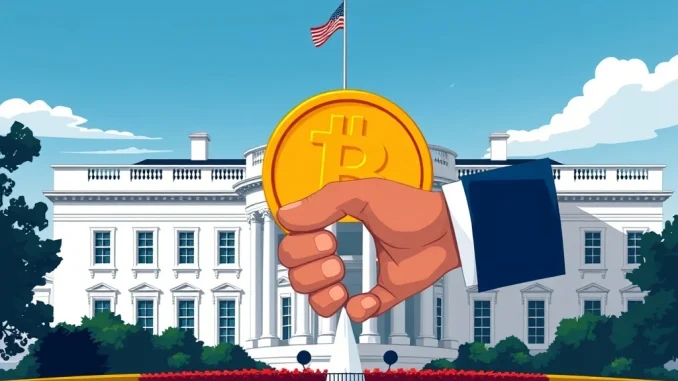
A significant declaration from the White House has sent ripples through the cryptocurrency community. White House Press Secretary Karoline Leavitt recently announced that President Donald Trump has officially concluded the Biden administration’s perceived ‘war on crypto.’ This statement, reported by Watcher.Guru, signals a potentially revolutionary shift in the Trump crypto policy landscape. The exact context for this remark, including the specific question asked, was not immediately available. Nevertheless, the announcement has sparked considerable discussion regarding the future of US crypto policy and its implications for the digital asset sector.
The End of the Biden Crypto War?
The Biden administration has often been seen as taking a cautious, if not adversarial, approach to cryptocurrencies. Many in the industry felt that regulatory bodies, under the current administration, engaged in a targeted crackdown. For example, the Securities and Exchange Commission (SEC) launched numerous enforcement actions against crypto firms. Critics frequently characterized these actions as stifling innovation and creating an uncertain environment. Consequently, the perception of a Biden crypto war became widespread among crypto enthusiasts and businesses.
This perspective suggested that existing laws were being applied aggressively to an emerging technology. Industry leaders often called for clearer guidelines and a more supportive regulatory framework. Therefore, Leavitt’s statement represents a stark contrast to this perceived approach. It suggests a new direction, aiming to foster growth rather than impose strict limitations on the digital asset space.
Understanding the Previous Regulatory Climate
During the Biden presidency, various federal agencies increased their scrutiny of the crypto market. The Treasury Department, the Federal Reserve, and the SEC all played roles in shaping the regulatory narrative. These efforts often focused on consumer protection, financial stability, and combating illicit finance. However, many industry participants argued that these initiatives lacked coordination and clarity. This lack of clear guidance hindered the growth of legitimate crypto businesses. It also pushed some innovation overseas.
Furthermore, the debate over whether certain cryptocurrencies constitute securities remained a central point of contention. This unresolved question fueled much of the regulatory uncertainty. Thus, the idea of a ‘war’ emerged from a feeling of constant pressure and a lack of clear pathways for innovation within the United States. This environment made developing new projects challenging. It also made attracting investment difficult for many startups.
The Shift in Trump Crypto Policy
Donald Trump’s stance on cryptocurrencies has evolved over time. Initially, he expressed skepticism about Bitcoin. He preferred the stability of the US dollar. However, his views have become notably more positive in recent months. He has increasingly positioned himself as a champion for the crypto community. This change aligns with a broader political trend. Many politicians now recognize the growing influence of crypto voters.
The new Trump crypto policy, as hinted by Leavitt, aims to reverse the perceived hostility. It seeks to create an environment where digital assets can thrive. This approach could involve several key changes. These might include:
- **Clearer Regulatory Frameworks:** Establishing precise rules for crypto companies.
- **Reduced Enforcement Actions:** Shifting from a ‘regulation by enforcement’ model.
- **Support for Innovation:** Encouraging technological advancements in blockchain and digital currencies.
- **Protecting US Leadership:** Ensuring the US remains a leader in the global crypto space.
These potential shifts could dramatically alter the landscape for businesses and investors. They could also boost confidence in the US market.
Implications for Crypto Industry Regulation
The prospect of an end to the ‘Biden crypto war’ carries significant implications for crypto industry regulation. A more favorable regulatory climate could attract substantial investment back into the US. Many companies previously considered relocating due to regulatory uncertainty. This new approach might encourage them to stay or return. Consequently, the US could solidify its position as a global hub for crypto innovation.
Moreover, clearer regulations would provide much-needed certainty for developers and entrepreneurs. They could build and operate with greater confidence. This stability fosters long-term planning and reduces operational risks. Such an environment is crucial for any emerging industry seeking mainstream adoption. Furthermore, a supportive federal stance might encourage states to adopt more consistent crypto policies. This could create a more unified national approach.
Potential Impact on US Crypto Policy and Beyond
The announcement directly impacts the trajectory of US crypto policy. A pro-crypto administration could introduce legislation designed to support the industry. This might include tax incentives for crypto businesses or clearer guidelines for stablecoins. Such moves would differentiate the US from countries with more restrictive regimes. Ultimately, this could enhance the nation’s competitiveness in the global digital economy.
Beyond national borders, a shift in US policy could influence international crypto discourse. Other nations often look to the US for leadership in financial regulation. A pro-crypto stance from the White House could encourage other governments to reconsider their own approaches. This could lead to a more globally harmonized and supportive regulatory environment for digital assets. It would mark a significant departure from previous trends.
The Role of the White House Crypto Stance
The explicit statement from the White House holds considerable weight. It signals a top-down commitment to embracing, rather than combating, the digital asset revolution. This proactive approach by the White House crypto policy team could lead to several positive outcomes. Firstly, it could foster greater collaboration between government and industry stakeholders. Secondly, it might accelerate the development of critical infrastructure for digital currencies. Lastly, it could increase public confidence in the legitimacy and future of crypto.
However, implementing these changes will require careful planning and execution. The crypto industry is complex and rapidly evolving. Therefore, any new policies must be well-thought-out and adaptable. They must balance innovation with necessary safeguards. This delicate balance will be key to long-term success. It will also ensure the stability of the financial system.
Looking Ahead: Challenges and Opportunities
While the announcement is positive, challenges remain. Crafting effective crypto industry regulation requires input from diverse experts. It also needs bipartisan support in Congress. Furthermore, the global nature of crypto means that domestic policies must consider international implications. Yet, the opportunities are immense. A supportive federal framework could unlock trillions in economic value. It could also create countless jobs in the tech sector.
The coming months will reveal the specifics of this new direction. Stakeholders across the crypto ecosystem will watch closely. They will observe how the administration translates its stated intent into concrete policy actions. The potential for growth and innovation is significant. This marks a pivotal moment for the future of digital assets in the United States.
The White House’s declaration of an end to the ‘war on crypto’ marks a potentially transformative moment. It promises a new era for digital assets under a future Trump administration. This shift could usher in clearer regulations, foster innovation, and solidify the US position in the global crypto landscape. The crypto community eagerly anticipates the concrete policies that will define this new chapter.
Frequently Asked Questions (FAQs)
Q1: What does ‘ending the Biden administration’s war on crypto’ mean?
A1: This statement suggests a shift away from perceived aggressive regulatory enforcement and a more cautious approach towards cryptocurrencies. It implies a move towards creating a more supportive and clear regulatory environment for the crypto industry, contrasting with the previous administration’s perceived stance.
Q2: How might the new Trump crypto policy differ from previous approaches?
A2: The new Trump crypto policy is expected to focus on fostering innovation, establishing clearer regulatory frameworks, and potentially reducing the number of enforcement actions against crypto firms. It aims to encourage growth within the US digital asset sector rather than imposing strict limitations.
Q3: What are the potential benefits of this shift for crypto industry regulation?
A3: A more favorable approach to crypto industry regulation could attract significant investment, encourage innovation, and provide much-needed certainty for businesses. This could solidify the US as a leader in the global crypto market and promote long-term stability.
Q4: How could this impact the broader US crypto policy landscape?
A4: A supportive US crypto policy could lead to new legislation, tax incentives, and clearer guidelines for various digital assets, including stablecoins. This could differentiate the US from other nations and influence global regulatory trends, promoting a more harmonized environment.
Q5: What challenges might this new White House crypto stance face?
A5: Implementing new policies will require careful planning, bipartisan support, and consideration of the global nature of crypto. Balancing innovation with necessary consumer protection and financial stability will be a key challenge for the White House crypto team.