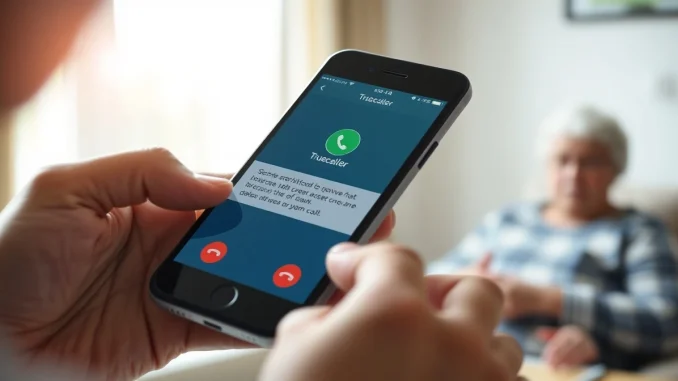
March 15, 2026 — Caller identification service Truecaller has launched a global rollout of a new feature designed to protect family members from fraudulent calls. The “Family Protection” feature allows a designated administrator to monitor and remotely end suspected scam calls for up to five group members.
How the Family Protection Feature Works
The feature enables a tech-savvy individual to create and administer a group. Once other members join, the admin receives alerts about potentially fraudulent calls those members receive. If the admin believes a call could lead to a scam, they can remotely terminate it on the member’s behalf.
This remote hang-up function currently works only for group members using Android devices. Admins can receive alerts for both iOS and Android users. On Android, members can grant additional permissions allowing the admin to see real-time activity status, such as whether the member is walking or driving, their battery level, and sound settings.
“This helps admins keep tabs on elderly members and only call them when they are not walking or driving,” a company representative explained. The admin can also block specific numbers and international calling codes, sharing this blocklist with the entire group.

A Response to Rising Global Fraud
Truecaller, which boasts over 450 million users globally, first tested the feature in December 2025 in Sweden, Chile, Malaysia, and Kenya. Following positive results, the company decided to expand it worldwide, including to its largest market, India.
“I think, unfortunately, all of us know somebody or another in our families or friends who have been impacted by fraud,” Kunal Dua, chief product officer at Truecaller, told TechCrunch. “In that sense, it’s a fundamental shift for Truecaller in terms of what we’ve been focusing on as a problem.”
The company identified over 7.7 billion fraud calls last year. Scam calls have caused significant financial losses, particularly in India, prompting authorities to launch various counter-initiatives.
Privacy Protections and AI Integration
Truecaller emphasized privacy safeguards within the feature. The admin cannot view the non-spam call history or SMS history of group members. The system is designed to intervene only during active, suspected fraudulent calls.
The company is exploring artificial intelligence to enhance the feature further. One approach involves using AI to screen calls and automatically disconnect them when specific scam-associated keywords are detected. Terms like “digital arrest,” a tactic where perpetrators impersonate law enforcement, could trigger an automatic block.
This follows the introduction of an AI-powered voicemail assistant for Indian users last year. The company is considering a similar AI model for family protection to alert admins about the nature of a fraud call a member is receiving.
Navigating Market Challenges
The launch comes as Truecaller faces several business headwinds. The company’s stock has declined by over 80% in the past twelve months. Its Q4 2025 report showed a 49% year-on-year dip in EBITDA, with advertising revenue falling 31%.
Another challenge emerges from India’s Caller Name Presentation (CNAP) system, which displays a caller’s name as registered with their telecom carrier. Truecaller argues its platform offers more comprehensive protection through community-based spam reports.
“CNAP is partially rolled out, and so far, the impact on our user growth is limited,” Truecaller CEO Rishit Jhunjhunwala said during the Q4 2025 earnings call. “Our focus continues to be on delivering a superior product… where we provide a lot more information and a lot more context.”
The Family Protection feature is free and available to all users, including those not on a paid Truecaller plan. The global availability marks a significant expansion of the company’s tools against communication-based fraud.
This article was produced with AI assistance and reviewed by our editorial team for accuracy and quality.