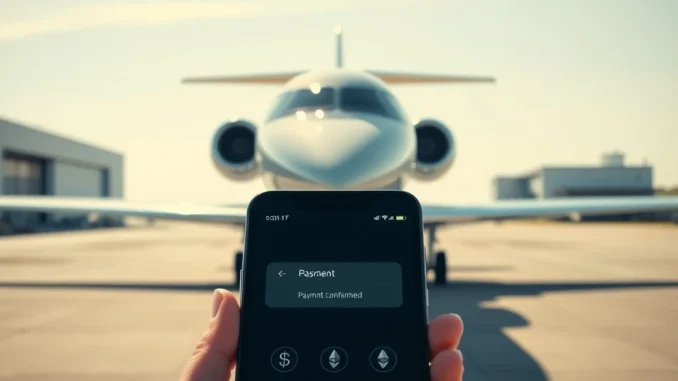
TALLINN, Estonia — March 4, 2026 — In a landmark move for luxury travel and digital finance, the leading payment processor Transacta has announced a strategic partnership with elite charter service CryptoJets. Consequently, this collaboration directly supports the surging demand for cryptocurrency payments within the private aviation sector. The deal, finalized today, enables clients to book private jet flights using major digital assets like Bitcoin and Ethereum. This partnership marks a critical inflection point, merging high-net-worth mobility with the maturing blockchain economy. Industry analysts immediately flagged the announcement as a bellwether for broader crypto adoption in luxury services.
Transacta and CryptoJets Forge a New Path for Aviation Crypto Payments
The partnership integrates Transacta’s certified payment gateway directly into CryptoJets’ booking platform. Therefore, clients can now seamlessly convert holdings from over fifteen cryptocurrencies into fiat to settle charter invoices instantly. “Our data showed a 300% year-over-year increase in client inquiries about crypto payment options,” stated CryptoJets CEO, Alistair Vance, in an official release. “Partnering with Transacta, a regulated entity with deep compliance expertise, was the logical step to offer a secure, institutional-grade solution.” The technical integration utilizes Transacta’s proprietary settlement layer, which hedges volatility risk in real-time, a feature Vance highlighted as essential for price-sensitive aviation services. Furthermore, the system automatically generates compliant transaction records for both parties, addressing a longstanding regulatory hurdle in crypto commerce.
This initiative follows a two-year pilot program CryptoJets conducted with a limited client group. During that period, the company processed approximately $4.7 million in crypto-denominated bookings. The success of this trial, particularly among tech entrepreneurs and digital asset investors, provided the concrete data needed to justify a full-scale rollout. Transacta’s involvement brings the necessary financial infrastructure and regulatory assurances to scale the offering globally.
Quantifying the Impact on Luxury Travel and Crypto Utility
The immediate impact extends beyond mere payment convenience. It fundamentally alters the liquidity utility of digital assets for a wealthy demographic. Primarily, it allows asset holders to leverage appreciated crypto portfolios for high-value services without triggering a taxable event through an initial exchange to fiat—a significant consideration in many jurisdictions. Secondly, it introduces a new class of real-world, high-value utility for cryptocurrencies, moving beyond speculative trading and retail purchases.
- Market Expansion: CryptoJets projects a 40% increase in addressable market by tapping into the global crypto-wealthy demographic, estimated by Chainalysis to hold over $1.2 trillion in liquid digital assets.
- Operational Efficiency: Transacta’s system reduces cross-border settlement times for international charters from days to minutes, streamlining back-office operations for charter brokers.
- Competitive Pressure: Industry observers expect rival operators like Victor and Air Charter Service to announce similar capabilities within quarters, potentially standardizing crypto payments across premium aviation.
Expert Analysis on Financial and Regulatory Integration
Dr. Lena Petrova, a fintech regulation scholar at the University of Zurich, provided critical context. “This isn’t just a payment gimmick,” Petrova noted, referencing her recent paper in the Journal of Digital Finance. “It represents the maturation of crypto into the legacy financial system’s plumbing. Transacta is a licensed payment institution under EU law. Their involvement means every transaction complies with AML5 and travel rule regulations, setting a compliance benchmark others must follow.” This authoritative perspective underscores the partnership’s role in legitimizing crypto within tightly regulated sectors. Additionally, a report from the International Air Transport Association (IATA) last November highlighted traveler demand for digital asset options as a top-five trend for 2026, lending institutional weight to the move.
Broader Context: Crypto’s Ascent in High-Value Commerce
This partnership is not an isolated event. Instead, it sits atop a growing trend of cryptocurrency penetrating high-value asset markets. For instance, luxury real estate markets in Dubai and Miami now routinely accept crypto for property purchases. Similarly, high-end auction houses like Sotheby’s have established dedicated digital art and asset divisions settled on blockchain. The private aviation sector, however, presents unique challenges due to its stringent safety regulations, international nature, and high transaction values, making this partnership a particularly significant breakthrough.
| Sector | Example of Crypto Adoption | Estimated Market Value (2025) |
|---|---|---|
| Luxury Real Estate | Direct property purchases in crypto-friendly jurisdictions | $2.1 Billion |
| Fine Art & Auctions | NFT and physical asset sales settled via blockchain | $850 Million |
| Superyacht Charter | Limited pilot programs for booking deposits | $120 Million |
| Private Aviation | Transacta-CryptoJets full payment integration | Projected $500M+ |
What Happens Next: Roadmap and Industry Ripples
The immediate next step is the phased global rollout of the payment option across CryptoJets’ network of over 1,500 affiliated aircraft. The first phase targets North American and European routes within Q2 2026. Subsequently, Transacta has confirmed plans to adapt the same gateway technology for other luxury travel verticals, including boutique hotel groups and exclusive tour operators, by late 2026. Market analysts at Bernstein have already revised growth forecasts for crypto payment processors in the travel sector upward by 15% following this announcement. The key metric to watch will be the percentage of CryptoJets’ total revenue flowing through the new channel within the first twelve months.
Stakeholder Reactions and Competitive Landscape
Reaction from the private aviation community has been swift. Several charter brokers, speaking on background, expressed relief at having a vetted, compliant solution to offer crypto-holding clients. Conversely, traditional payment processors have been quiet, likely assessing their own digital asset strategies. Meanwhile, on crypto forums, the announcement was hailed as a major step toward practical “hyperbitcoinization” in a high-profile industry. However, some regulatory advocates have called for close monitoring to ensure the travel rule data sharing is robust, highlighting the ongoing tension between innovation and compliance.
Conclusion
The Transacta and CryptoJets partnership is a definitive signal that cryptocurrency payments have moved from niche novelty to mainstream luxury commerce. By solving critical challenges around volatility hedging and regulatory compliance, the deal provides a blueprint for other high-value industries. The partnership will likely accelerate competitive responses, broaden the utility of digital assets, and permanently alter payment expectations among affluent travelers. Observers should monitor adoption rates and any regulatory clarifications that emerge as this model scales. Ultimately, this March 2026 announcement may well be remembered as the moment crypto truly took flight in the real-world economy.
Frequently Asked Questions
Q1: What cryptocurrencies can be used to book a flight with CryptoJets?
Initially, the platform supports Bitcoin (BTC), Ethereum (ETH), USD Coin (USDC), and Tether (USDT). CryptoJets and Transacta plan to add support for at least twelve more major digital assets, including Solana (SOL) and Cardano (ADA), by the end of Q3 2026.
Q2: How does the partnership protect against Bitcoin’s price volatility during a transaction?
Transacta’s payment gateway uses a real-time hedging mechanism. The crypto amount is locked at the moment of booking confirmation and instantly converted to a stable fiat value, shielding both the client and CryptoJets from market swings between booking and settlement.
Q3: What is the timeline for rolling out this payment option globally?
The service is live immediately for select routes. A full rollout across CryptoJets’ entire North American and European network is scheduled for completion by March 2026. Expansion to Asia-Pacific and Middle Eastern routes will follow in the second half of the year.
Q4: Can someone use cryptocurrency to book a private jet for the first time?
Yes, but standard charter protocols still apply. All new clients, regardless of payment method, must complete CryptoJets’ standard verification and security clearance process, which includes identity checks and may require proof of funds, before a booking is finalized.
Q5: How does this affect the broader private jet charter industry?
Industry analysts expect rapid emulation. Major competitors are now under pressure to develop or partner for similar capabilities. This could lead to industry-wide standardization of crypto payments within 18-24 months, making it a common option rather than a differentiator.
Q6: Are there tax implications for using cryptocurrency to pay for a private jet charter?
Potentially, yes. In many countries, using an appreciated cryptocurrency to pay for goods or services is considered a taxable disposal of that asset, potentially triggering a capital gains tax event. Clients are advised to consult with a tax professional familiar with crypto regulations in their jurisdiction.
Updated insights and analysis added for better clarity.
This article was produced with AI assistance and reviewed by our editorial team for accuracy and quality.