Global, May 2025: In a pivotal move for the institutional adoption of digital assets, Tether Operations Limited, the issuer of the world’s largest stablecoin, has announced a strategic investment in the t-0 Network. This initiative aims to leverage the USD₮ stablecoin as a core settlement layer, enabling licensed financial institutions to execute near-instant cross-border payments. The development signals a significant evolution in Tether’s strategy, shifting focus from retail and decentralized finance (DeFi) applications toward becoming a foundational pillar for traditional finance.
Tether t-0 Network Investment: A Strategic Institutional Push
Tether’s investment in the t-0 Network represents a calculated expansion of its ecosystem beyond the cryptocurrency trading pairs and DeFi protocols where USD₮ is most commonly used. The t-0 Network platform is specifically engineered for financial institutions, utilizing blockchain technology to facilitate final settlement of transactions in seconds, a stark contrast to the multi-day processes common in legacy systems like SWIFT. By powering this network with USD₮, Tether provides a stable, digital dollar equivalent that operates 24/7, bypassing traditional banking hours and intermediary delays. This move directly addresses long-standing pain points in correspondent banking, including high costs, lack of transparency, and slow processing times for international wire transfers. Industry analysts view this as a natural progression for Tether as it seeks to cement the utility of its stablecoin in the broader global financial infrastructure.
The Mechanics of USD₮-Powered Cross-Border Payments
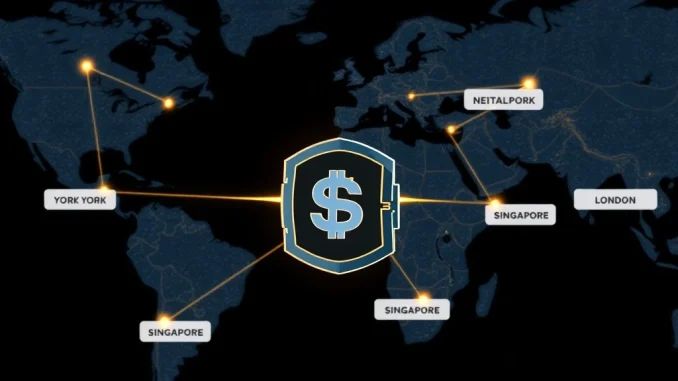
The proposed system hinges on a simple yet powerful mechanism. Licensed financial institutions, such as money service businesses, remittance processors, or even traditional banks, would onboard onto the t-0 Network. When a cross-border payment is initiated, the sending institution converts fiat currency into USD₮. This USD₮ is then transferred across the blockchain to the receiving institution’s digital wallet on the t-0 Network in a matter of seconds. The receiving institution can then redeem the USD₮ for local fiat currency. The entire process, termed T-0 or “trade date zero” settlement, achieves finality almost instantly. Key advantages of this model include:
- Speed: Settlement in seconds versus 2-5 business days.
- Cost Reduction: Elimination of multiple correspondent bank fees.
- Transparency: Real-time tracking of transaction status on the blockchain.
- 24/7 Availability: Operations are not constrained by banking holidays or time zones.
This approach uses the stability of the U.S. dollar, digitized through USD₮, as a neutral settlement asset, reducing foreign exchange volatility risk during the transaction window.
Context and Regulatory Landscape
Tether’s push into institutional payments arrives amid a global regulatory shift. Jurisdictions like the European Union with its MiCA (Markets in Crypto-Assets) framework, the UK, and Singapore are establishing clearer rules for stablecoin issuers and their use in payments. By targeting “licensed financial institutions” as its initial user base, Tether and the t-0 Network are strategically positioning themselves within existing regulatory perimeters. These institutions are already subject to anti-money laundering (AML) and know-your-customer (KYC) regulations, which can be extended to their use of the stablecoin network. This contrasts with a direct-to-consumer model, which faces higher regulatory hurdles. The success of this initiative will heavily depend on its ability to demonstrate robust compliance controls, a point Tether has emphasized in recent years through increased transparency reports and collaboration with regulators.
Historical Precedents and Market Implications
Tether’s investment follows a broader trend of traditional finance exploring blockchain for settlement. Major banks have experimented with private permissioned ledgers for years, such as JPMorgan’s JPM Coin. However, Tether’s approach utilizes a public blockchain ecosystem (primarily Ethereum and Tron), offering potentially greater interoperability. The move also places Tether in indirect competition with other projects aiming to revolutionize cross-border payments, including Ripple (XRP) and Circle’s USDC, which has also pursued institutional partnerships. The implications for the cryptocurrency market are substantial. If successful, this could drive massive new demand for USD₮ not as a trading vehicle, but as a functional working capital tool for businesses, potentially increasing its circulating supply and deepening its liquidity. Furthermore, it validates the use case of public blockchains for regulated, high-value financial transactions.
Conclusion
Tether’s strategic investment in the t-0 Network marks a pivotal moment in the convergence of digital assets and traditional finance. By focusing on USD₮-powered, near-instant cross-border payments for licensed institutions, Tether is addressing a multi-trillion-dollar market inefficiency with a blockchain-native solution. This institutional push extends the utility of the USD₮ stablecoin far beyond crypto exchanges, positioning it as potential core infrastructure for the future of global finance. The initiative’s success will hinge on technological execution, regulatory acceptance, and adoption by financial institutions seeking a competitive edge through faster, cheaper, and more transparent settlement. This development underscores the evolving narrative of stablecoins from speculative instruments to foundational pillars of a modernized financial system.
FAQs
Q1: What is the t-0 Network?
The t-0 Network is a blockchain-based settlement platform designed for financial institutions. It aims to enable instant (T-0) final settlement of transactions, such as cross-border payments, using digital assets like stablecoins as the settlement layer.
Q2: How does Tether’s USD₮ stablecoin work in this system?
USD₮ acts as the digital dollar used for settlement. A sending institution converts funds to USD₮, sends it over the network, and the receiving institution redeems it for local currency. This provides a stable, liquid asset that settles on a blockchain in seconds.
Q3: Who can use the USD₮-powered t-0 Network?
Initially, the platform is targeting licensed financial institutions worldwide, such as money transmitters, payment processors, and potentially traditional banks. It is not a direct-to-consumer product.
Q4: How is this different from using traditional systems like SWIFT?
Traditional systems often involve multiple intermediary banks, leading to delays of several days, higher costs, and less transparency. The t-0 Network aims for settlement in seconds with lower fees and real-time transaction tracking on a blockchain.
Q5: What are the main challenges for Tether’s new institutional push?
The primary challenges include navigating diverse global regulatory frameworks for stablecoins, ensuring seamless integration with legacy banking systems, and building trust among risk-averse institutional clients regarding security and compliance.
Updated insights and analysis added for better clarity.
This article was produced with AI assistance and reviewed by our editorial team for accuracy and quality.