NEW YORK, March 15, 2026 — In a landmark move that signals a new convergence of digital assets and human wellness, Tether Investments has made a major strategic investment in Eight Sleep, valuing the AI-driven sleep technology company at $1.5 billion. The deal, finalized this week, represents one of the largest single investments by a cryptocurrency entity into the consumer health technology sector. This investment provides Eight Sleep with significant capital to accelerate its research into AI-driven health intelligence, specifically expanding its biometric sleep tracking and climate control systems. Consequently, the partnership aims to position the combined entities at the forefront of the rapidly evolving quantified-self and preventative health markets.
Tether’s Strategic Pivot into AI Health Intelligence
The investment marks a deliberate strategic expansion for Tether, the company best known for issuing the world’s largest stablecoin, USDT. Paolo Ardoino, CEO of Tether, framed the move as part of a broader vision. “Our investment in Eight Sleep is a direct commitment to technologies that enhance human performance and longevity,” Ardoino stated in an official release. “We see a fundamental alignment between the precision of blockchain systems and the data-driven, personalized insights that advanced health intelligence provides.” This pivot follows Tether’s growing portfolio of investments beyond finance, including earlier stakes in renewable energy and Bitcoin mining infrastructure. Analysts at PitchBook Data note that Tether’s venture arm has deployed over $3.2 billion into non-crypto sectors since 2023, with health tech becoming an increasing priority.
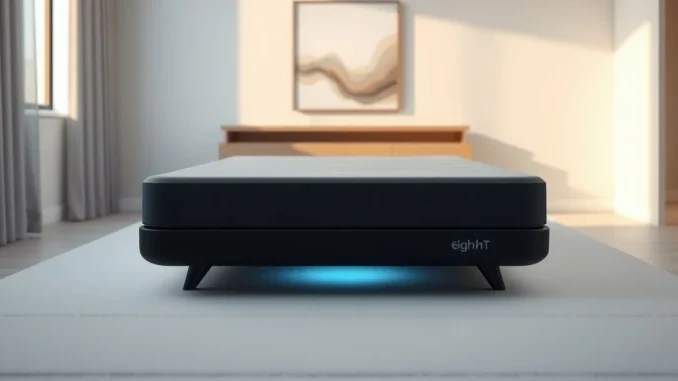
For Eight Sleep, founded in 2014 by Matteo Franceschetti and Alexandra Zatarain, the capital infusion arrives at a critical juncture. The company’s flagship product, the Pod, uses a grid of sensors and a water-based thermal layer to track sleep stages, heart rate, and respiratory rate, then automatically adjusts bed temperature for optimal rest. The new funding will specifically target the development of its proprietary AI engine, SleepOS. According to a company roadmap, the goal is to evolve the system from reactive temperature adjustment to a proactive health advisor capable of identifying early indicators of potential health issues based on nocturnal biometric data.
Impact on the Competitive Sleep Technology Landscape
This investment immediately reshapes the competitive dynamics of the sleep technology market, which Grand View Research valued at $15.6 billion globally in 2025. Eight Sleep now commands a war chest that dwarfs many traditional competitors. The capital will fund aggressive R&D, potential acquisitions, and a faster global retail rollout. Industry experts predict three immediate impacts. First, the pace of innovation in at-home health diagnostics will accelerate. Second, it validates the premium segment of the market, where Eight Sleep’s Pods can cost over $3,000. Third, it pressures legacy mattress companies and tech giants like Apple and Google, which have their own health-tracking ambitions, to respond.
- Accelerated R&D: Eight Sleep plans to double its AI research team by the end of 2026, focusing on predictive health algorithms.
- Market Validation: The $1.5B valuation sets a new high-water mark for direct-to-consumer health hardware companies.
- Competitive Pressure: Rivals like Sleep Number, Withings, and Oura must now contend with a competitor backed by deep, non-dilutive capital from Tether’s substantial reserves.
Expert Analysis on the Data Privacy Frontier
The deal raises significant questions about data privacy and security, given the sensitivity of health data and Tether’s origins in the often-unregulated crypto sphere. Dr. Evelyn Chen, a bioethics researcher at Stanford University’s Center for Biomedical Ethics, provided critical context. “The integration of deep financial technology with intimate health data creates a novel ethical and security paradigm,” Dr. Chen explained. “Eight Sleep collects highly personal biometric data. The stewardship of that data under a new corporate structure with ties to cryptocurrency requires transparent and robust governance. Consumers will rightly demand clarity on how their sleep data is protected, used, and whether it could ever be monetized.” In response to such concerns, Eight Sleep’s CEO, Matteo Franceschetti, emphasized in a statement that all health data would remain siloed and governed by strict HIPAA-compliant protocols, independent of Tether’s financial operations.
Broader Context: Crypto Capital Meets Real-World Tech
Tether’s investment is part of a larger, ongoing trend of cryptocurrency-native capital seeking tangible, real-world applications with high growth potential. Following the stabilization of crypto markets after the volatility of the early 2020s, entities like Tether, Coinbase Ventures, and Andreessen Horowitz’s crypto fund have increasingly targeted sectors like artificial intelligence, robotics, and biotechnology. This move represents a maturation of the industry, shifting from speculative trading to infrastructure and application investing. The table below illustrates how Tether’s investment compares to other major crypto-led investments in adjacent technology sectors over the past two years.
| Investing Entity | Target Company | Sector | Valuation |
|---|---|---|---|
| Tether Investments | Eight Sleep | Health Tech / AI | $1.5 Billion |
| Coinbase Ventures | Molecule (Biotech DAO) | Biotechnology | $850 Million |
| Andreessen Horowitz (a16z Crypto) | Physical AI (Robotics) | Robotics & AI | $2.1 Billion |
| Binance Labs | Ultiverse (AI-Gaming) | Gaming & Metaverse | $700 Million |
The Road Ahead: Integration and Expansion Plans
Looking forward, the partnership’s success hinges on execution. Eight Sleep’s leadership has outlined a clear 24-month plan. The first phase involves scaling manufacturing for its next-generation Pod, codenamed “Horizon,” which promises more advanced sensors for blood oxygen and stress-level monitoring. The second phase focuses on software, with plans to open its SleepOS API to select third-party health and fitness applications by late 2027, creating an ecosystem around its data. Notably, there are no announced plans to integrate cryptocurrency payments or blockchain technology directly into Eight Sleep products, suggesting the relationship is purely financial and strategic at this stage. Market expansion into Asia-Pacific and Europe is also slated to begin in Q4 2026.
Stakeholder Reactions and Market Response
Initial reactions from the market and community have been mixed but largely positive. Existing Eight Sleep users in online forums have expressed cautious optimism, hopeful for more rapid feature updates but concerned about potential subscription price increases. Industry analysts, like James Lee of Mizuho Securities, reacted favorably. “This gives Eight Sleep a decade’s worth of runway in a competitive market,” Lee noted. “It allows them to ignore short-term profitability pressures and focus entirely on building a defensible AI health platform. The risk for Tether is execution, but the potential payoff in owning a foundational health data layer is enormous.” Early trading in secondary markets suggests private shares of Eight Sleep have appreciated following the news.
Conclusion
The $1.5 billion investment by Tether into Eight Sleep is more than a simple funding round. It is a strategic bet on the future of personalized, AI-driven health intelligence, funded by the reserves of the world’s dominant stablecoin. The deal accelerates innovation in the sleep technology sector, provides Eight Sleep with unparalleled resources for expansion, and marks a significant step in the maturation of cryptocurrency capital into mainstream technology investing. The key takeaways are the validation of health biometrics as a critical data frontier, the emergence of new competitive dynamics, and the pressing need for clear data governance. Observers should watch for Eight Sleep’s next product launch and any moves by competitors like Apple, which continues to deepen the health features of its Watch, in response to this newly fortified challenger.
Frequently Asked Questions
Q1: How much did Tether invest in Eight Sleep?
Tether Investments participated in a funding round that valued Eight Sleep at $1.5 billion. The exact amount of Tether’s contribution has not been publicly disclosed, but it is described as a “major strategic investment” that provides significant capital for growth.
Q2: What will Eight Sleep use the new funding for?
The primary use of funds is to accelerate research and development of its AI health intelligence platform, SleepOS. This includes expanding its sensor technology, hiring more AI researchers, and funding global market expansion for its Pod smart mattresses.
Q3: Does this mean Eight Sleep will start accepting cryptocurrency?
No official plans have been announced to integrate cryptocurrency payments or blockchain technology into Eight Sleep products. The investment is currently framed as financial and strategic, with Tether seeking exposure to the high-growth health tech sector.
Q4: Is my Eight Sleep health data safe with Tether involved?
Eight Sleep CEO Matteo Franceschetti states that all user health data remains governed by strict, HIPAA-compliant protocols separate from Tether’s operations. The company asserts that data privacy and security architecture will not change due to the investment.
Q5: How does this affect the broader health technology industry?
The investment raises the competitive bar, providing Eight Sleep with deep capital to innovate rapidly. It pressures other sleep and health tech companies to accelerate their own R&D and may lead to increased merger and acquisition activity in the sector.
Q6: What should current Eight Sleep customers expect?
Customers can expect a faster rollout of new software features and AI-driven insights through the Eight Sleep app. The company has stated that existing subscriptions and data policies will remain unchanged in the immediate term.
Updated insights and analysis added for better clarity.
This article was produced with AI assistance and reviewed by our editorial team for accuracy and quality.