Global, February 2026: The cryptocurrency landscape this month is defined by a significant institutional maneuver and evolving presale dynamics. Tether Operations Limited, the issuer of the world’s largest stablecoin, USDT, confirmed a $100 million equity investment in Anchorage Digital Bank National Association, a federally chartered digital asset bank. Concurrently, the presale market shows selective momentum, with projects like DeepSnitch AI reporting substantial gains for early participants, while others such as OneXfer and Zaddy Coin position within a cautious yet active fundraising environment. This activity occurs against a backdrop of ongoing regulatory clarification and institutional adoption narratives.
Tether’s Strategic Investment in Anchorage Digital Bank
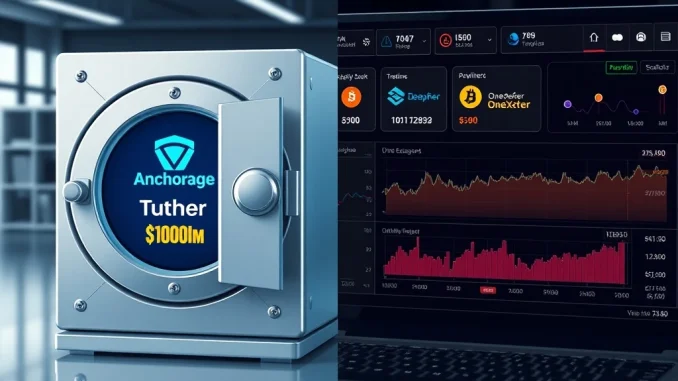
Tether’s capital injection into Anchorage represents one of the most substantial direct investments by a stablecoin issuer into a regulated banking partner. Anchorage Digital, which received a national trust charter from the Office of the Comptroller of the Currency (OCC) in 2021, provides custody, trading, and financing services exclusively for digital assets. The $100 million investment is not a simple deposit but an equity stake, deepening the strategic and financial ties between the entities.
Industry analysts interpret this move through several lenses. Primarily, it underscores a continued push for legitimacy and integration within the traditional financial system. By strengthening a regulated bank that specializes in digital assets, Tether potentially enhances the security and operational framework supporting its stablecoin reserves. This action follows a multi-year trend of Tether increasing transparency about its reserves, including publishing quarterly attestations.
“This is a classic ‘infrastructure buy,'” noted a financial technology analyst who requested anonymity due to firm policy. “Tether isn’t just parking cash; it’s investing in the regulated plumbing of the digital asset economy. It secures a key partnership, potentially improves reserve management options, and signals to the market that major players are building for the long term within compliance frameworks.” The investment is also seen as a vote of confidence in the U.S. regulatory pathway for digital asset banks, even amid a complex legislative environment.
The Presale Market in Early 2026: Selectivity and Utility Focus
The cryptocurrency presale market, a phase where projects raise capital by selling tokens before they are listed on public exchanges, has matured significantly since the initial coin offering (ICO) boom of 2017-2018. The current environment, as observed in February 2026, is characterized by increased investor scrutiny, a stronger emphasis on tangible product development, and regulatory awareness.
Projects that gain traction often demonstrate a working prototype, a clear utility for their token, and a credible team with relevant experience. The speculative frenzy around mere whitepapers has largely subsided, replaced by a more measured evaluation of technology and market fit. This shift aligns with broader trends in venture capital, where later-stage funding has tightened, placing more importance on early-stage milestones and proof of concept.
DeepSnitch AI: Demonstrating Live Tooling
Among presale projects attracting attention, DeepSnitch AI has reported significant paper gains for its earliest backers. The project focuses on applying artificial intelligence to on-chain analytics and security monitoring. Its reported 150% gain for early presale participants is based on the valuation set during its initial fundraising rounds compared to the price in its ongoing, later-stage presale or private transactions.
A key differentiator highlighted in its communications is the availability of live tools during the presale phase. Unlike projects that promise future development, DeepSnitch AI has provided limited access to its AI-driven smart contract audit scanner and wallet behavior profiling dashboard to its community and early investors. This “build-in-public” approach aims to demonstrate progress and utility before a public token launch.
“The presence of a functional product, even in beta, changes the risk profile,” explained Maya Chen, a researcher at a blockchain analytics firm. “It moves the conversation from ‘can they build it?’ to ‘how good is it, and will people use it?’ For AI-centric crypto projects, demonstrating technical capability early is becoming a near-requirement to stand out.” The project’s token is designed to grant access to premium features, stake for rewards within the ecosystem, and govern protocol upgrades.
Positioning of OneXfer and Zaddy Coin
Other projects like OneXfer and Zaddy Coin are also navigating the February presale landscape, though with different positioning. OneXfer presents itself as a cross-border payment and remittance solution leveraging blockchain for faster settlement and lower fees compared to traditional corridors. Its presale narrative ties into the growing discussion around central bank digital currencies (CBDCs) and the need for efficient interoperability between different digital money systems.
Zaddy Coin, according to its available documentation, adopts a more community and culture-driven approach, integrating with content creation and social media platforms. Its strategy involves building a dedicated user base through online engagement prior to focusing on broader exchange listings. Both projects exemplify the diversity of use cases still explored within the presale market, from hard infrastructure like payments to softer, community-oriented models.
It is critical to note that presale participation carries high risk. These projects are typically in early development stages, their tokens are illiquid, and regulatory treatment remains uncertain in many jurisdictions. Reported gains are often not realizable until tokens are listed on secondary markets, and such listings are never guaranteed. The market has seen numerous projects fail between presale and launch.
Institutional Behavior and Market Sentiment
Tether’s investment in Anchorage provides a contrasting narrative to the retail-focused presale market. Institutional activity in the digital asset space has increasingly bifurcated into two streams: investments in regulated infrastructure (like banks, custodians, and compliance tech) and highly selective allocations to the technology layer (like venture capital in blockchain protocols).
The $100 million move is seen as part of the former stream—a strengthening of the foundational services that allow both institutions and, indirectly, larger retail markets to operate. This type of investment often occurs independently of short-term cryptocurrency price volatility. It is a long-term strategic bet on the persistence and growth of the digital asset class as a whole, rather than a speculative bet on any single token’s price appreciation.
This institutional behavior can influence broader market sentiment. A stablecoin issuer reinforcing its regulated banking relationships may be interpreted as a stabilizing signal for the ecosystem, potentially creating a more favorable, or at least less uncertain, environment for all projects attempting to build and raise funds.
Conclusion
The cryptocurrency sector in February 2026 presents a multifaceted picture. Tether’s substantial equity investment in Anchorage Digital Bank underscores a continued institutional push towards regulated, secure infrastructure, moving beyond speculative trading into the architecture of finance itself. Simultaneously, the crypto presale market continues to evolve, with projects like DeepSnitch AI attempting to differentiate themselves through demonstrated product development and live utility, while others like OneXfer and Zaddy Coin test varied market niches. Together, these developments highlight a maturing industry where capital deployment is becoming more strategic at the institutional level and more discerning at the project level, even as innovation and high-risk fundraising persist.
FAQs
Q1: What does Tether’s $100M investment in Anchorage Bank mean?
Tether’s investment represents a strategic equity stake in a federally chartered digital asset bank. It signals a focus on strengthening regulated infrastructure, potentially enhancing the security and operational framework for managing its stablecoin reserves, and reflects confidence in the U.S. digital asset banking system.
Q2: Are gains from a crypto presale like DeepSnitch AI’s 150% real?
Reported presale gains are typically paper gains based on the increase in the token’s price between early and later funding rounds. These gains are not realizable as cash until the token is listed on a public exchange and can be sold, which is not guaranteed. They represent a change in valuation, not liquid profit.
Q3: What is a crypto presale?
A crypto presale is an early fundraising stage where a project sells its tokens to investors before a public listing on exchanges. It is typically riskier than buying listed tokens, as the project is often in development, liquidity is zero, and regulatory status may be unclear.
Q4: Why is having a “live tool” important for a presale project?
Demonstrating a working product, or live tool, during a presale helps reduce execution risk. It moves the project from a concept to a tangible proof-of-concept, allowing potential investors to evaluate its technology, utility, and team capability more concretely than a whitepaper alone.
Q5: How does institutional investment differ from presale activity?
Institutional investment in crypto, like Tether’s bank investment, often targets regulated infrastructure, services, or mature protocols. It is typically strategic and long-term. Presale activity is usually early-stage, high-risk funding for unproven projects, appealing to different investors with a higher risk tolerance seeking earlier-stage potential returns.
Updated insights and analysis added for better clarity.
This article was produced with AI assistance and reviewed by our editorial team for accuracy and quality.