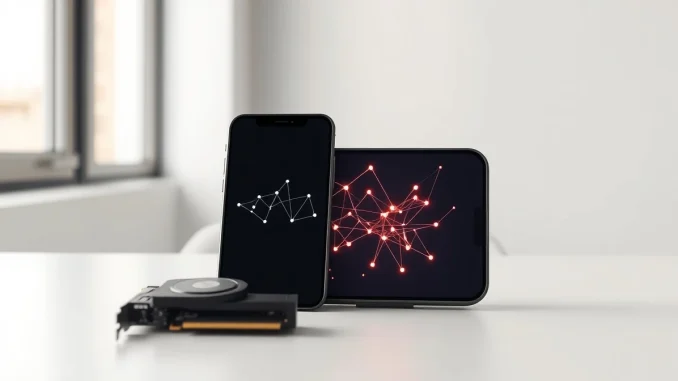
In a significant move that could democratize access to advanced artificial intelligence development, Tether Operations Limited, the issuer of the USDT stablecoin, has launched a groundbreaking AI training framework designed for consumer-grade hardware. Announced on March 17, 2026, this new system allows for the fine-tuning of large language models directly on smartphones and non-Nvidia GPUs, potentially reshaping the computational landscape for machine learning.
Tether’s AI Framework Breaks Nvidia’s Training Monopoly
Traditionally, training and fine-tuning sophisticated AI models require immense computational power, typically supplied by high-end Nvidia data center GPUs like the H100. This creates a significant cost and accessibility barrier. However, Tether’s new framework, developed as part of its broader QVAC platform, directly challenges this paradigm. By leveraging Microsoft’s innovative BitNet architecture and Low-Rank Adaptation (LoRA) techniques, the system drastically reduces memory and processing requirements.
Consequently, the framework expands support to a wide array of consumer chipsets. This includes processors from AMD and Intel, Apple’s Silicon for Macs, and mobile GPUs from Qualcomm and Apple. The company reports its engineers successfully fine-tuned models with up to 1 billion parameters on a smartphone in under two hours. Smaller models completed the process in mere minutes. Furthermore, support extends to models as large as 13 billion parameters on mobile devices, a feat previously confined to powerful servers.
The Technical Leap: BitNet and LoRA
The core innovation lies in the use of the 1-bit BitNet architecture. Compared to standard 16-bit models, BitNet can reduce Video RAM (VRAM) requirements by up to 77.8%, according to Tether’s technical data. This massive efficiency gain is what allows larger models to operate on hardware with limited memory. Simultaneously, the integration of LoRA techniques enables efficient fine-tuning. LoRA works by injecting trainable rank decomposition matrices into a pre-trained model, updating only these small matrices during training instead of all the model’s parameters. This method slashes the computational load and storage needs.
- BitNet Architecture: Uses 1-bit weights, dramatically cutting memory use and power consumption.
- LoRA Fine-Tuning: Updates only a small subset of parameters, making training feasible on weaker hardware.
- Cross-Platform Support: Enables training and inference across AMD, Intel, Apple, and Qualcomm chips.
Real-World Impacts and Use Cases
The implications of this technology extend far beyond technical specifications. Primarily, it lowers the economic barrier to entry for AI research and application development. Individuals and smaller organizations can now experiment with model customization without accessing cloud credits or expensive hardware. Additionally, the performance gains significantly benefit inference—the process of running a trained model to make predictions. Tether states mobile GPUs can run BitNet models several times faster than CPUs, enabling more responsive on-device AI applications.
Moreover, the framework unlocks powerful privacy-preserving techniques like federated learning. In this setup, a global AI model can be improved by learning from data distributed across millions of devices (like smartphones) without that raw data ever leaving the device. This method reduces reliance on centralized cloud infrastructure and mitigates data privacy concerns. On-device training also allows for highly personalized AI experiences that adapt to a user’s behavior without compromising their data to a central server.
The Crypto Sector’s Strategic Pivot to AI
Tether’s foray into AI infrastructure is not an isolated event. It reflects a broader strategic pivot within the cryptocurrency and blockchain sector towards high-performance compute and machine learning. This trend has accelerated over the past two years, driven by the convergence of cryptographic security, decentralized networks, and AI’s computational demands.
| Company | Date | AI/Compute Initiative |
|---|---|---|
| Sep 2025 | Acquired a 5.4% stake in Cipher Mining as part of a $3B AI data center deal. | |
| IREN | Dec 2025 | Bitcoin miner announced plans to raise ~$3.6B for AI infrastructure. |
| HIVE Digital | Feb 2026 | Reported record revenue fueled by AI and HPC operations growth. |
| Core Scientific | Mar 2026 | Secured a $500M loan facility from Morgan Stanley for expansion. |
Parallel to infrastructure development, the rise of autonomous AI agents within crypto is creating new demand for efficient, decentralized computation. For instance, in October 2025, Coinbase introduced wallet infrastructure enabling AI agents to conduct on-chain transactions. In February 2026, Alchemy launched a system allowing agents to access blockchain data services. These developments create a synergistic ecosystem where Tether’s efficient training framework could play a crucial role in developing and deploying the next generation of decentralized AI applications.
Conclusion
Tether’s launch of a consumer-hardware AI training framework represents a pivotal step toward democratizing machine learning. By leveraging BitNet and LoRA to break free from dependency on specialized Nvidia hardware, the technology promises to lower costs, enhance privacy through on-device processing, and fuel innovation at the edge of the network. As the cryptocurrency and AI sectors continue to converge, tools like this framework will be critical in shaping a more accessible and decentralized future for artificial intelligence. The move underscores a strategic expansion for Tether beyond stablecoins, positioning the company at the intersection of two of the most transformative technologies of the decade.
FAQs
Q1: What is the key innovation in Tether’s new AI framework?
The key innovation is its use of Microsoft’s 1-bit BitNet architecture combined with LoRA fine-tuning techniques. This combination drastically reduces memory and compute requirements, allowing large language models to be trained on consumer smartphones and non-Nvidia GPUs for the first time.
Q2: Which hardware platforms does the Tether AI framework support?
The framework supports a wide range of consumer and mobile chipsets, including AMD GPUs, Intel processors, Apple Silicon (M-series), and mobile GPUs from Qualcomm and Apple. This breaks the traditional reliance on high-end Nvidia data center GPUs for AI training.
Q3: How does this technology benefit user privacy?
It enables on-device training and federated learning. This means AI models can be personalized and improved using the data on a user’s own device without that sensitive data ever being sent to a central cloud server, offering a stronger privacy-preserving approach.
Q4: Why are cryptocurrency companies like Tether expanding into AI?
There is a significant convergence between the computational needs of AI, especially for training, and the infrastructure and decentralized ethos of the crypto sector. Many crypto mining companies are repurposing hardware for AI compute, and there is growing demand for AI agents that can operate on blockchain networks.
Q5: What are the practical limits of this framework?
While revolutionary for accessibility, the framework is optimized for fine-tuning pre-existing models, not for training massive foundation models from scratch. The current support extends to models up to 13 billion parameters on mobile devices, which, while impressive, is still below the scale of the largest frontier models requiring data-center-scale resources.
Updated insights and analysis added for better clarity.
This article was produced with AI assistance and reviewed by our editorial team for accuracy and quality.