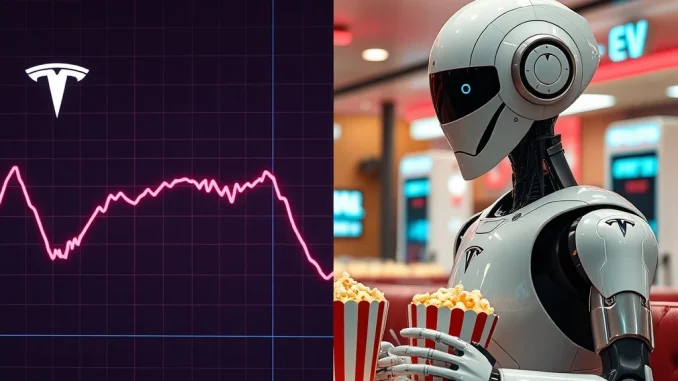
The financial world, including cryptocurrency enthusiasts, often keeps a keen eye on tech giants like Tesla, whose market movements can ripple across various sectors. When Tesla, a company synonymous with innovation and often linked to the digital asset space through its Bitcoin holdings, reports a significant earnings miss, it sends a powerful signal. Tesla’s latest Q2 2025 earnings call has done just that, revealing a challenging quarter that saw its shares plummet by nearly 5% in after-hours trading. This isn’t just a blip for the electric vehicle (EV) titan; it’s a moment that raises crucial questions about its core business, its ambitious ventures into AI, and the volatile role of its digital assets in its financial health.
Tesla Earnings Shockwave: A Deeper Dive into Q2’s Decline
Tesla’s Q2 2025 earnings report painted a sobering picture for investors. The company announced a 12% year-on-year decline in total revenue, falling to $22.5 billion and significantly missing Wall Street’s expectations. This downturn was largely attributed to a steep 16% drop in automotive revenue, which remains the company’s primary income stream. Several factors contributed to this slump:
- Weakened Demand: Key global markets experienced a noticeable slowdown in electric vehicle demand, impacting Tesla’s sales volume.
- Production Bottlenecks: Persistent supply chain issues and manufacturing hurdles continued to affect production efficiency and delivery timelines.
- Increased Competition: The electric vehicle market is becoming increasingly crowded, with traditional automakers and new EV startups intensifying the competitive landscape.
This financial shortfall has naturally sparked concerns among analysts and investors alike, prompting a re-evaluation of Tesla’s immediate growth trajectory and market position. The core business, once a relentless growth engine, now faces headwinds that demand strategic adjustments.
Elon Musk AI Vision: Shifting Gears from EVs to Robots?
In a move that surprised many during the earnings call, CEO Elon Musk notably pivoted the discussion away from the disappointing financial figures to highlight Tesla’s burgeoning ventures into robotics and artificial intelligence. This strategic deflection underscored Musk’s long-term vision, even as the company grappled with short-term financial pressures. The spotlight was firmly placed on the humanoid “Optimus” robots, unveiled in a rather theatrical manner at a retro-themed diner in West Hollywood. Dressed in “cute outfits” and serving popcorn and tacos, these robots generated significant viral attention, but also raised eyebrows about the company’s immediate strategic priorities.
Musk framed the Optimus project as a significant step towards a future where robots are “so common you don’t even look up.” This aligns with Tesla’s broader AI ambitions, which also include a recently launched robotaxi service in Austin. While these projects showcase Musk’s visionary leadership and potential future revenue streams, their current commercial viability and direct contribution to profitability remain unproven. Critics wonder if these ambitious AI pursuits are a necessary diversification or a costly distraction from the company’s immediate challenges in the automotive sector.
The Rise of Optimus Robots: A Glimpse into Tesla’s Futuristic Ambitions
The unveiling of the Optimus robots wasn’t just a PR stunt; it was a clear signal of Tesla’s commitment to becoming a leader in general-purpose AI and robotics. The Tesla Diner itself, a 24/7 establishment featuring 80 EV charging outlets, roller skates for patrons, and robot servers, served as a tangible, albeit unconventional, demonstration of this future. While the diner drew long lines and considerable media buzz, its commercial aspects also faced scrutiny.
For instance, the “Tesla burger” priced at $13.50, a 33% markup over industry averages, highlighted a strategy that seems to prioritize brand storytelling and experiential marketing over immediate revenue generation. The Optimus project, while captivating, currently represents a significant research and development investment with a distant return on investment. The question for investors is whether these cutting-edge robotics endeavors will eventually bolster Tesla’s differentiation in a crowded market or continue to divert crucial resources from its core electric vehicle operations. This bold move into advanced robotics positions Tesla not just as an automaker, but as a multifaceted technology company with far-reaching ambitions in the AI space.
Navigating the Electric Vehicle Market: Tesla’s Competitive Landscape
The electric vehicle market, once largely dominated by Tesla, is now experiencing intense competition. The Q2 earnings report underscored the increasing pressure from rivals globally. Companies like Rivian, known for its electric trucks and SUVs, and BYD, a Chinese automotive giant rapidly expanding its EV production, are gaining significant ground. This heightened competition is contributing to the “weaker demand” Tesla cited in its earnings report, as consumers now have a wider array of compelling EV options.
Tesla’s ability to maintain its lead in this evolving landscape is now under greater scrutiny. The company needs to innovate not just in futuristic technologies like Optimus, but also in its core EV offerings – improving production efficiency, expanding charging infrastructure, and developing new models that can effectively compete on price, range, and features. The success of its long-term bets on robotics and AI could either provide a unique competitive edge or risk diluting its focus from the primary battleground of EV sales.
Tesla Stock Volatility: What’s Next for Investors?
Following the Q2 earnings report, Tesla stock closed at $317.80, reflecting significant investor concerns. The 5% drop in after-hours trading highlighted a clear apprehension regarding the company’s immediate financial outlook. CFO Vaibhav Taneja candidly acknowledged that “rough” quarters lie ahead, signaling continued volatility and uncertainty.
A notable factor contributing to this uncertainty is the company’s Bitcoin holdings, valued at $1.23 billion. While previous Bitcoin gains had offset earlier losses, Taneja warned that “further price swings could impact earnings.” This statement underscores the dual-edged sword of holding significant cryptocurrency assets for a publicly traded company. While they offer potential for gains, their inherent volatility introduces an unpredictable element into quarterly financial reports, making Tesla stock more susceptible to broader market fluctuations in the crypto space.
For investors, the contrast between Tesla’s whimsical robot displays and its challenging earnings performance is stark. The company’s dual approach—balancing radical innovation with financial stability—is being tested. Will Musk’s theatrical gestures and long-term AI bets translate into sustainable growth, or will they be perceived as a distraction from fundamental operational rigor? The coming quarters will be crucial in determining whether Tesla can regain its momentum in the EV market while successfully laying the groundwork for its ambitious AI and robotics future.
Summary: Balancing Vision with Reality
Tesla’s Q2 2025 earnings report serves as a powerful reminder that even the most innovative companies face market realities. While Elon Musk’s captivating vision for AI and robotics, exemplified by the Optimus robots and the Tesla Diner, continues to capture public imagination, the immediate financial performance tells a different story. A significant revenue drop, an automotive decline, and the unpredictable influence of its Bitcoin holdings present formidable challenges. As the electric vehicle market intensifies, Tesla’s ability to navigate production hurdles, fend off competitors, and translate its futuristic projects into tangible profitability will be under intense scrutiny. Investors will be watching closely to see if the company can strike the right balance between audacious innovation and robust financial health, ensuring that its groundbreaking ventures ultimately bolster, rather than detract from, its core business.
Frequently Asked Questions (FAQs)
Q1: Why did Tesla’s revenue drop in Q2 2025?
A1: Tesla’s total revenue dropped by 12% year-on-year, primarily due to a 16% decline in automotive revenue. This was attributed to weaker demand in key markets and ongoing production bottlenecks.
Q2: How did Elon Musk respond to the earnings miss?
A2: Instead of focusing on the financial shortfall, CEO Elon Musk shifted the earnings call’s emphasis to Tesla’s advancements in robotics and AI, including the unveiling of humanoid “Optimus” robots and the launch of a robotaxi service.
Q3: What role do Tesla’s Bitcoin holdings play in its financial performance?
A3: Tesla holds Bitcoin valued at $1.23 billion. While previous gains from these holdings had offset losses, CFO Vaibhav Taneja warned that future price swings in Bitcoin could impact the company’s earnings, adding an element of volatility to its financial reports.
Q4: What are the “Optimus” robots and the Tesla Diner?
A4: Optimus are humanoid robots developed by Tesla as part of its broader AI ambitions. The Tesla Diner is a retro-themed establishment in West Hollywood where these robots serve patrons, featuring EV charging outlets and aiming to showcase Tesla’s futuristic vision and brand storytelling.
Q5: How is competition impacting Tesla in the electric vehicle market?
A5: The electric vehicle market is becoming increasingly competitive, with rivals like Rivian and BYD gaining significant market share. This increased competition is contributing to weaker demand for Tesla’s vehicles and is a key factor in its automotive revenue decline.
Q6: What are investors’ main concerns regarding Tesla’s future?
A6: Investors are concerned about Tesla’s ability to maintain its lead in the EV market amidst rising competition and production challenges. They are also scrutinizing whether the company’s significant investments in futuristic projects like robotics and AI will translate into sustainable profitability or divert resources from core operations, especially given the ongoing volatility of Tesla stock and its Bitcoin holdings.