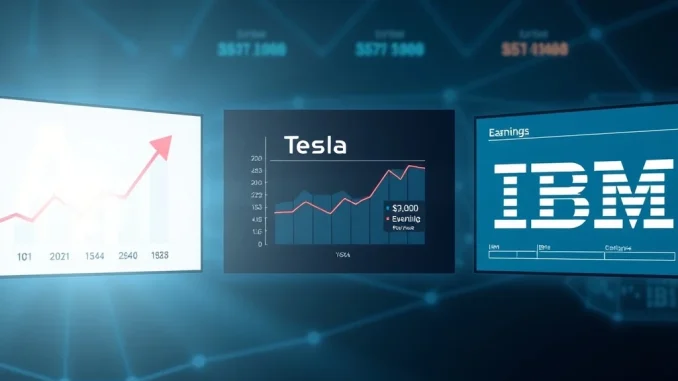
The U.S. tech earnings season has kicked off, delivering a fascinating and mixed bag of results that offer crucial insights for investors across all sectors, including the crypto market. As major players like Alphabet, Tesla, and IBM reveal their latest financial health, understanding these shifts is key to anticipating broader economic trends that often ripple into digital assets. This initial wave of **Tech Earnings** provides a snapshot of growth, resilience, and emerging challenges within the industry’s giants.
Alphabet’s Bold Bet: Skyrocketing AI Spending
Alphabet emerged as a clear standout, not only surpassing its revenue and earnings forecasts but also making a significant commitment to its future. The company’s second-quarter revenue hit an impressive $96.43 billion, exceeding the $94 billion projection. This strong performance was fueled by robust growth across its core businesses, particularly in Google Cloud, which saw revenue reach $13.62 billion, outpacing estimates. Ad revenue also climbed, growing 10.4% year-over-year to $71.34 billion.
The most compelling news, however, was Alphabet’s intensified **AI Spending** pledge. The company announced it would boost its 2025 capital spending target from $75 billion to a staggering $85 billion. This reflects immense confidence in the future of cloud and search services, driven heavily by artificial intelligence. This aggressive investment aligns with broader industry trends, as tech titans like Microsoft and Amazon also scale their bets on AI, signaling a new era of innovation.
Tesla’s Bumpy Road: Navigating Revenue Hurdles
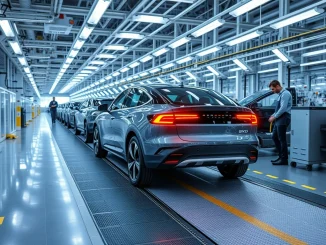
In contrast to Alphabet’s ascent, Tesla faced considerable challenges, failing to meet market expectations. The electric vehicle (EV) giant reported adjusted earnings per share of $0.40, falling short of the $0.42 forecast. Total revenue also missed the mark, coming in at $22.5 billion against an estimated $22.74 billion.
Key areas of concern for Tesla included:
- Automotive Revenue Drop: A significant 16% year-over-year decline to $16.7 billion.
- Plummeting Regulatory Credits: Sales of regulatory credits, a notable revenue stream, sharply fell from $890 million to $439 million.
- Production Challenges: The company cited production hurdles and a strategic shift towards lower-cost models as contributing factors.
- CEO Controversies: Political controversies surrounding CEO Elon Musk, including high-profile endorsements and policy changes at his DOGE initiative, were noted to have compounded consumer sentiment risks.
Despite these setbacks, Tesla outlined plans to launch a cheaper EV in 2025, aiming for future volume growth. Investors, however, remain cautious about the path to sustained profitability.
IBM’s Quiet Comeback: A Strong 8% Earnings Jump
IBM delivered a surprisingly robust performance, reporting a strong turnaround with revenue rising 8% year-over-year to $16.98 billion, surpassing the $16.59 billion forecast. Adjusted earnings per share reached $2.80, comfortably above the $2.64 estimate. This impressive growth was primarily driven by its software division, which reported $7.39 billion in revenue, and its hybrid cloud services, which grew by 16%.
Despite beating expectations, IBM shares experienced a 5% decline in after-hours trading. However, it’s crucial to note that the stock remained up 28% year-to-date, significantly outperforming the S&P 500’s 8% gain. IBM reaffirmed its $13.5 billion free cash flow target for 2025 and highlighted strategic moves such as the z17 mainframe launch and the Hakkoda acquisition, underscoring its focus on enterprise AI integration and strategic growth.
Divergent Strategies, Unified Impact: What These Tech Earnings Tell Us
The opening of the tech earnings season clearly highlighted divergent strategies within the sector. Alphabet’s aggressive **Alphabet AI** push and IBM’s cloud-focused growth signal strong confidence in long-term innovation and enterprise solutions. Meanwhile, Tesla’s struggles underscore near-term volatility in the EV markets and the challenges of scaling production amid intense competition and external factors.
Analysts observed that Alphabet’s results demonstrated its remarkable ability to monetize AI-driven services, particularly within its dominant search and expanding cloud computing segments. For Tesla, the company’s guidance on cost reductions and plans for a more affordable EV model offer a potential path to volume growth, though profitability remains a key concern for investors. IBM’s performance, on the other hand, reflected the tangible value of strategic acquisitions and its successful integration of enterprise AI solutions, positioning it strongly in the hybrid cloud market.
Here’s a quick comparison of the key metrics:
| Company | Q2 Revenue (Actual vs. Forecast) | Q2 EPS (Actual vs. Forecast) | Key Highlight | Stock Movement Post-Earnings |
|---|---|---|---|---|
| Alphabet | $96.43B vs. $94B (Beat) | Beat Forecast | Boosted AI Spending to $85B by 2025, Cloud Growth | Positive |
| Tesla | $22.5B vs. $22.74B (Miss) | $0.40 vs. $0.42 (Miss) | 16% Automotive Revenue Drop, Production Hurdles | Negative |
| IBM | $16.98B vs. $16.59B (Beat) | $2.80 vs. $2.64 (Beat) | 8% Revenue Growth, Strong Software/Hybrid Cloud | Down 5% (Despite YTD +28%) |
Market Concentration & Future Outlook
The collective weight of these tech giants on the broader market remains significant, with Alphabet, Tesla, and IBM together accounting for over 5% of the S&P 500’s weight. The opening day of the earnings season left investors balancing optimism for AI-driven growth with caution over sector-specific challenges. As the tech-heavy index shows mixed momentum, attention now shifts to subsequent reports from other ‘Magnificent Seven’ firms. These upcoming disclosures will be crucial in gauging whether the trends observed in this initial trio persist, shaping the investment landscape for the remainder of the year and potentially influencing the crypto market’s sentiment as well.
Summary: A Glimpse into Tech’s Diverse Future
The initial wave of Q2 2025 **Tech Earnings** has painted a vivid picture of a dynamic and sometimes unpredictable industry. Alphabet’s aggressive **AI Spending** strategy positions it as a leader in the AI race, promising future innovations. Tesla’s recent **Tesla Revenue** miss highlights the intense competition and evolving landscape of the EV market, pushing the company to innovate with more affordable models. Meanwhile, IBM’s robust **IBM Earnings** demonstrate the enduring power of strategic enterprise solutions and hybrid cloud adoption. As these tech titans navigate their unique challenges and opportunities, their performances will continue to ripple through global markets, influencing everything from traditional stocks to the volatile world of cryptocurrencies.
Frequently Asked Questions (FAQs)
1. What were the main takeaways from the Q2 2025 tech earnings reports?
The main takeaways included Alphabet’s strong performance driven by increased AI spending, Tesla’s revenue miss due to production challenges and market shifts, and IBM’s robust 8% revenue growth, primarily from its software and hybrid cloud segments, despite a post-earnings stock dip.
2. How is Alphabet increasing its focus on AI?
Alphabet is significantly boosting its AI investment, increasing its 2025 capital spending target from $75 billion to $85 billion. This substantial commitment reflects its confidence in leveraging AI to enhance its core cloud and search services.
3. Why did Tesla’s revenue fall short of expectations?
Tesla’s revenue fell short due to a 16% year-over-year drop in automotive revenue, plummeting regulatory credit sales, and production challenges. Political controversies surrounding CEO Elon Musk were also cited as a factor impacting consumer sentiment.
4. What contributed to IBM’s strong performance?
IBM’s strong performance was driven by an 8% year-over-year revenue increase, with significant contributions from its software division and 16% growth in hybrid cloud services. Strategic acquisitions and a focus on enterprise AI integration also played a key role.
5. What are the broader implications of these earnings for the tech sector?
These earnings highlight divergent strategies within the tech sector: aggressive AI investment (Alphabet), navigating EV market volatility (Tesla), and successful enterprise cloud/AI integration (IBM). They underscore the ongoing importance of innovation, market adaptation, and the significant impact of tech giants on the overall S&P 500.
6. How do these results impact market concentration risks?
With Alphabet, Tesla, and IBM collectively accounting for over 5% of the S&P 500, their mixed earnings reports emphasize the elevated market concentration risks. The initial results set the tone for how the broader market, and potentially interconnected sectors like cryptocurrency, will react to future reports from other major tech firms.