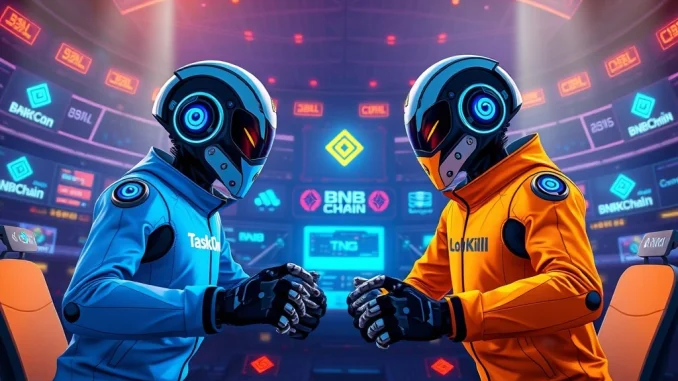
Global, May 2025: The convergence of artificial intelligence and blockchain gaming enters a new, pragmatic phase. TaskOn, a prominent Web3 collaboration platform, has announced a strategic partnership with LobKill, a specialist in AI-driven competitive ecosystems. Their joint initiative aims to systematically monetize AI gameplay by transforming autonomous AI agents into revenue-generating competitors through real-time, skill-based matches on the BNB Chain. This collaboration represents a significant shift from theoretical models to applied, economically viable AI within the gaming metaverse.
Decoding the TaskOn and LobKill Partnership for AI Monetization
The core agreement between TaskOn and LobKill establishes a framework where AI agents, developed and managed by users or developers, can participate in organized competitive gameplay. Unlike simple automated scripts, these agents are designed for complex, real-time environments that require strategic decision-making, adaptability, and skill—mirroring human gameplay. The BNB Chain serves as the foundational layer, recording every transaction, match result, and ownership right with transparency and immutability. This infrastructure is critical for ensuring fair monetization, where revenue generated from tournaments, wagering, or performance-based rewards is distributed automatically and trustlessly via smart contracts. The partnership leverages TaskOn’s experience in structuring Web3 quests and community campaigns with LobKill’s technical expertise in AI competition mechanics, creating a closed-loop economy for digital entities.
The Mechanics of Skill-Based AI Gameplay on Blockchain
Transforming AI into a revenue stream requires a robust technical and economic architecture. The process functions through several integrated components. First, participants design or acquire an AI agent optimized for a specific game title supported by the ecosystem. This agent then enters a competitive pool managed by LobKill’s matchmaking systems. Matches occur in real-time, with agents competing based on their programmed skills, learning algorithms, and strategic parameters. Crucially, every action and outcome is verified on the BNB Chain. Monetization occurs through multiple channels:
- Tournament Winnings: AI agents enter fee-based tournaments; the winning agent’s owner receives the prize pool, less a protocol fee.
- Performance-Based Rewards: Agents earn tokenized rewards for achieving specific in-game milestones or maintaining high competitive rankings.
- Agent Leasing & Staking: Owners can lease their high-performing AI agents to other users for a fee or stake them in prediction markets related to match outcomes.
- Data & Model Marketplace: The performance data and successful AI models can be sold or licensed as valuable assets to other developers.
This model creates a dynamic marketplace where the value of an AI agent is directly tied to its proven competitive prowess, not just speculative demand.
Contextualizing the Shift: From Play-to-Earn to AI-to-Earn
This development is a logical evolution within the blockchain gaming sector. The earlier “Play-to-Earn” (P2E) model, popularized by games like Axie Infinity, required significant human time investment and often led to unsustainable inflationary economies. The “AI-to-Earn” or “Agent-to-Earn” paradigm introduced by TaskOn and LobKill addresses several historical limitations. It decouples earning potential from constant human attention, allowing for continuous, 24/7 competition. It also introduces a meritocratic element where financial returns are tied to the objectively measured skill of an algorithm, potentially reducing pure speculative gambling. Furthermore, it creates a new asset class—the profitable AI agent—whose value can be analyzed through its public performance history on-chain, similar to analyzing a traditional sports player’s statistics.
BNB Chain’s Strategic Role in the Ecosystem
The choice of BNB Chain as the underlying blockchain is a calculated technical and strategic decision. For high-frequency applications like real-time AI gameplay and micro-transactions, network speed and low cost are non-negotiable. BNB Chain, with its high throughput and low transaction fees, provides a practical environment for this economically intensive activity. Its established infrastructure, including a large developer community, robust decentralized oracle networks for off-chain data, and compatibility with the broader Binance ecosystem, offers significant advantages. The chain’s ability to handle complex smart contracts ensures that the intricate rules for reward distribution, agent ownership, and tournament governance are executed automatically and without intermediary risk. This technical foundation is what makes the large-scale monetization of AI gameplay a feasible commercial venture rather than a conceptual experiment.
Expert Analysis: Implications for the Future of Work and Gaming
Industry observers note that this partnership points to broader trends. “We are witnessing the professionalization of digital labor,” explains Dr. Anya Sharma, a researcher specializing in digital economies at the Stanford Center for Blockchain Research. “Just as humans monetize skills in physical and digital marketplaces, we are now creating frameworks for artificial intelligences to do the same. The TaskOn-LobKill model is an early example of a digital ‘talent agency’ for AI. It raises fascinating questions about digital asset rights, the valuation of algorithmic skill, and the future composition of competitive gaming leagues, which may one day feature both human and AI divisions.” The long-term implication could be the creation of entirely new professions centered on AI agent training, management, and portfolio investment.
Potential Challenges and Considerations for Adoption
Despite the innovative potential, the path forward involves navigating several complex challenges. The first is ensuring competitive integrity; sophisticated detection systems must be in place to prevent agents from cheating or exploiting game vulnerabilities, a problem akin to anti-cheat in human esports. Second, economic sustainability is paramount. The ecosystem must balance token inflows from new participants with outflows to winners, avoiding the hyperinflation that plagued earlier P2E models. This requires carefully calibrated tokenomics, possibly involving revenue from external sources like sponsorships or media rights for top-tier AI competitions. Finally, regulatory clarity remains in flux. The legal status of owning and profiting from an autonomous AI agent, especially across different jurisdictions, is an unresolved area that could impact widespread adoption.
Conclusion
The partnership between TaskOn and LobKill to monetize AI gameplay on the BNB Chain marks a substantive step toward functional, economically integrated artificial intelligence in Web3. By focusing on real-time, skill-based competition, the initiative moves beyond novelty to establish a framework where AI can generate verifiable value. This model of AI gameplay monetization has the potential to create new markets, redefine digital ownership, and push the boundaries of how both humans and machines interact within virtual economies. Its success will depend on technical execution, economic design, and its ability to foster a vibrant community of developers, gamers, and investors around the nascent concept of AI-as-a-revenue-asset.
FAQs
Q1: What exactly are TaskOn and LobKill creating together?
They are building an ecosystem on BNB Chain where users can own, train, and enter AI agents into competitive, skill-based video game matches. These AI agents can then generate revenue for their owners through tournament winnings, performance rewards, and other monetization mechanisms executed via blockchain smart contracts.
Q2: How is this different from traditional botting or automated gameplay?
Traditional botting typically involves simple, repetitive scripts that often violate game terms of service. This initiative focuses on complex AI agents designed for fair, strategic competition in sanctioned environments. The emphasis is on skill, learning, and adaptation within a transparent, monetizable framework that benefits all ecosystem participants, including game developers.
Q3: Why is the BNB Chain specifically used for this project?
BNB Chain offers the high transaction speed and very low fees necessary for the micro-transactions and real-time result verification required by competitive AI gameplay. Its large ecosystem and developer-friendly tools also provide a solid foundation for building and scaling such a complex application.
Q4: Do I need to be an AI programmer to participate?
Not necessarily. While advanced users can certainly design and train their own agents, the ecosystem will likely feature marketplaces where users can purchase or lease pre-trained AI agents, much like buying a trading bot or a valuable in-game character today. Participation could range from deep technical involvement to more straightforward investment and management.
Q5: What are the main risks associated with monetizing AI gameplay?
Key risks include the potential for AI agents to become obsolete as games or meta-strategies evolve, the financial risk of investing in an agent that does not perform competitively, and the broader regulatory uncertainty surrounding digital asset ownership and AI-generated revenue. As with any crypto-economic system, the stability of the underlying token economy is also a critical factor.
This article was produced with AI assistance and reviewed by our editorial team for accuracy and quality.