
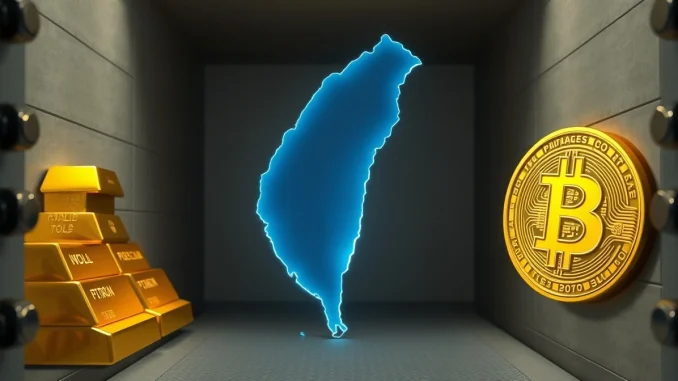
Taipei, Taiwan – A prominent policy institute is urging Taiwan’s central bank to reconsider holding Bitcoin as part of its national reserves. The recommendation, detailed in a recent report, frames the digital asset as a unique tool for geopolitical insurance and a hedge against the devaluation of the US dollar. This call comes despite the Central Bank of the Republic of China (CBC) ruling out such a move just months ago.
The Geopolitical Case for a Taiwan Bitcoin Reserve
According to a report from the Bitcoin Policy Institute, Taiwan faces distinct financial vulnerabilities. Research fellow Jacob Langenkamp authored the analysis. He argues that in a scenario involving military conflict or a blockade, traditional reserve assets like gold or foreign currency could become inaccessible or frozen. “Uniquely for Taiwan, Bitcoin provides geopolitical resilience,” Langenkamp wrote. “In a PRC blockade or invasion, gold is stranded or seized and USD reserves face potential restrictions, but Bitcoin remains fully accessible without physical transport.”
Also read: Bitcoin's Stagnant Price Action Sparks Intense Debate: Is a Massive Breakout Looming?
This perspective highlights a growing discussion about digital sovereignty. For a nation in Taiwan’s position, the ability to move value across borders without intermediary banking systems presents a potential strategic advantage. The think tank’s report suggests Bitcoin could act as an “insurance” policy for extreme scenarios.
Central Bank Resistance and Existing Holdings
The CBC has previously explored the idea. Last year, the bank investigated establishing a national Bitcoin reserve. By December, however, it decided against the move. Officials cited concerns over Bitcoin’s price volatility, market liquidity, and the challenges of secure custody for a nation-state. Instead, the bank reaffirmed its view of the US dollar as a safer alternative for reserves.
Also read: Bitcoin ETFs Predicted to Eclipse Gold ETFs as Investor Use Cases Expand
Despite this policy stance, Taiwan already holds Bitcoin. Taiwanese lawmaker Ko Ju-Chun revealed on social media platform X last year that the country’s Ministry of Justice holds 210 BTC. These were confiscated during criminal investigations and were worth approximately $14 million at the time of disclosure. The CBC has committed to further testing digital asset technology using these existing holdings in a regulatory sandbox environment.
Analyzing the Dollar Debasement Argument
Beyond conflict, the report identifies another key risk: reliance on the US dollar. Langenkamp notes that Taiwan’s central bank reserves are at least 80% held in USD-denominated assets. Most of its trade is also conducted in dollars. This creates significant exposure if the dollar’s value erodes over time. The report points to growing US national debt, Federal Reserve monetary policies, and potential shifts in key industries like semiconductors and AI as factors that could accelerate dollar debasement.
“Bitcoin can couple with gold to offer that hedge against USD debasement,” Langenkamp added. He contends that early adoption could benefit Taiwan if the asset’s value appreciates as more nations consider it. Industry watchers note that this argument is gaining traction in various financial circles, though it remains contentious among traditional economists.
How Other Nations Are Approaching Bitcoin Reserves
Taiwan is not alone in this debate. The most notable example is El Salvador, which adopted Bitcoin as legal tender in 2021 and has been accumulating it for its national treasury. According to public data tracked by various analysts, El Salvador’s holdings would place it ahead of Taiwan’s disclosed 210 BTC. Other countries, including Finland, also hold Bitcoin seized from criminal activities.
This suggests a gradual, if cautious, exploration of digital assets at the sovereign level. The implication is that early movers might gain a strategic or financial advantage. However, the volatility concern remains a major barrier. Langenkamp acknowledges the CBC’s worries are valid but argues they “will diminish as the asset matures and gains adoption among nations.” He suggests institutional expertise can address custody and liquidity issues.
Practical Challenges and Market Realities
Adopting Bitcoin as a reserve asset is not a simple switch. Central banks prioritize stability, capital preservation, and liquidity above all else. Bitcoin’s price history shows dramatic swings, which could jeopardize a portion of national savings. Furthermore, the market depth for converting billions of dollars worth of Bitcoin into other currencies without moving the market is untested at the scale of central bank reserves.
Security presents another monumental challenge. Safeguarding the private keys to a multi-billion dollar Bitcoin reserve would require military-grade, redundant security protocols far beyond typical financial infrastructure. A single breach could be catastrophic. These practical hurdles explain the CBC’s current reluctance. What this means for investors is that while sovereign interest is a bullish long-term signal, immediate, large-scale adoption is unlikely.
Conclusion
The debate over a Taiwan Bitcoin reserve underscores a broader shift in how nations view monetary resilience. The proposal from the Bitcoin Policy Institute frames the digital asset as a tool for specific geopolitical and financial risks unique to Taiwan’s situation. While the central bank currently views the risks as too great, the conversation itself is significant. It reflects serious consideration of digital assets in national strategy. The path forward likely involves continued research, sandbox testing, and observation of other nations’ experiments. For Taiwan, the core question remains: is the potential insurance against extreme scenarios worth the undeniable volatility and operational risks today?
FAQs
Q1: Why is a think tank suggesting Taiwan hold Bitcoin?
The Bitcoin Policy Institute argues Bitcoin could remain accessible if traditional financial systems are disrupted by conflict. It also sees Bitcoin as a potential hedge against the US dollar losing value over time.
Q2: What did Taiwan’s central bank already decide about Bitcoin?
In December, the Central Bank of the Republic of China (CBC) ruled out creating a national Bitcoin reserve. It cited concerns about price volatility, market liquidity, and security challenges.
Q3: Does Taiwan own any Bitcoin already?
Yes. A Taiwanese lawmaker disclosed in 2025 that the Ministry of Justice holds 210 Bitcoin, worth about $14 million at the time. These were seized from criminal cases.
Q4: What are the biggest arguments against a national Bitcoin reserve?
The primary arguments are Bitcoin’s price volatility, which is unsuitable for stable national reserves, and the immense security challenge of protecting the digital keys. The market’s ability to handle large central bank transactions is also unproven.
Q5: Are other countries holding Bitcoin in their reserves?
El Salvador is the most prominent example, having adopted it as legal tender and buying it for its national treasury. Other countries, like Finland, hold smaller amounts seized from criminal activities.

This article was produced with AI assistance and reviewed by our editorial team for accuracy and quality.




Be the first to comment