In a landmark development for blockchain finance, infrastructure asset manager Superstate has successfully secured $82.5 million in a pivotal Series B funding round. This substantial capital injection, led by prominent investment firms, signals a major acceleration in the firm’s mission to bridge traditional securities with decentralized networks. Consequently, the financial technology sector now watches closely as Superstate prepares to deploy these resources. The company aims to expand its regulatory-compliant tokenization framework significantly. Ultimately, this funding round elevates the firm’s total capital raised beyond the $100 million threshold, marking a new chapter for asset tokenization.
Superstate Series B Funding: A Deep Dive into the $82.5M Round
Bain Capital and Distributed Global jointly led the recent Series B financing for Superstate. The investment round also attracted participation from several other notable firms. Hohn Ventures, Galaxy Digital, and Bullish all contributed to the final $82.5 million figure. This collective backing from both traditional finance and crypto-native investors demonstrates strong market confidence. The funding will primarily fuel an ambitious expansion of Superstate’s technological infrastructure. Previously, the company focused on tokenized treasury products like short-term government bonds. Now, it plans to develop a full-scale platform for registering traditional equities on blockchain networks. This strategic pivot addresses a growing demand for on-chain capital markets.
Robert Leshner, founder of Compound and a key figure in decentralized finance, originally conceived Superstate. The firm operates as a registered investment adviser under U.S. regulatory frameworks. Its initial product suite allowed users to gain exposure to U.S. Treasury bills through blockchain-based tokens. These tokens represent ownership in a fund holding the underlying assets. The new funding will help the company navigate the complex regulatory landscape for broader asset classes. Specifically, Superstate intends to register stocks with the Securities and Exchange Commission (SEC). These registered securities would then exist as tokens on public blockchains.
The Investor Landscape and Strategic Implications
The involvement of Bain Capital, a giant in private equity, provides more than just capital. It lends considerable institutional credibility and operational expertise to Superstate’s endeavors. Similarly, Distributed Global brings deep specialization in crypto venture capital. Their participation underscores a belief in the tokenization thesis. Galaxy Digital, founded by Mike Novogratz, adds its extensive network in both Wall Street and digital assets. This consortium of investors creates a powerful alliance for Superstate. The firm must now execute its roadmap under heightened expectations. The market will scrutinize its progress in obtaining necessary regulatory approvals.
Tokenization Infrastructure: Building the Next Generation of On-Chain Assets
Tokenization refers to the process of converting rights to a real-world asset into a digital token on a blockchain. This technology promises several transformative benefits for financial markets. Increased liquidity, fractional ownership, and 24/7 settlement are among the most cited advantages. Superstate’s infrastructure aims to serve as the compliant bridge between issuers and these new capabilities. The company’s existing tokenized treasury funds, such as the Superstate Short-Term Government Bond Fund, already demonstrate the model. Investors purchase tokens that represent shares in a regulated fund. That fund, in turn, holds high-quality, short-duration U.S. government debt.
The technical architecture for such a system is complex. It requires robust smart contracts, secure custody solutions, and reliable oracle networks for price feeds. Furthermore, the infrastructure must ensure full compliance with securities laws at every step. Superstate’s proposed expansion into equities represents a more significant challenge than treasury products. Equities involve corporate actions like dividends, voting rights, and stock splits. Tokenizing these features programmatically requires sophisticated engineering and legal structuring. The $82.5 million in new capital will fund the research, development, and legal work needed to solve these problems.
- Regulatory Compliance: Navigating SEC registration for each tokenized stock.
- Technical Scalability: Building systems that can handle high transaction volumes on Ethereum and Solana.
- Interoperability: Ensuring tokens can move seamlessly across different wallets and exchanges.
- Investor Protection: Implementing know-your-customer (KYC) and anti-money laundering (AML) checks on-chain.
Comparing Blockchain Platforms: Ethereum and Solana
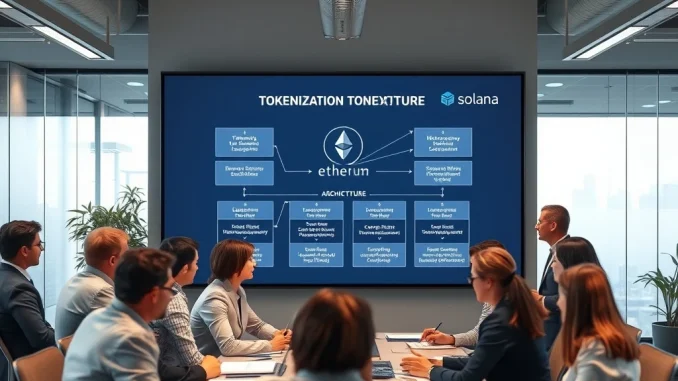
Superstate’s decision to build on both Ethereum and Solana is strategically significant. Each network offers distinct advantages for tokenization. Ethereum provides unparalleled security, decentralization, and a vast ecosystem of developers and applications. Its established reputation is crucial for institutional adoption. However, Ethereum can suffer from high transaction fees during periods of network congestion. Solana, conversely, offers extremely high throughput and low transaction costs. This makes it suitable for applications requiring frequent, small-value transactions. By supporting both, Superstate can cater to different use cases and investor preferences. This multi-chain approach mitigates platform risk and maximizes potential user reach.
| Feature | Ethereum | Solana |
|---|---|---|
| Transactions Per Second | ~15-30 (post-merge) | ~2,000-65,000 |
| Average Transaction Fee | Variable, can be high | Typically very low ($0.00025) |
| Consensus Mechanism | Proof-of-Stake | Proof-of-History / Proof-of-Stake |
| Developer Ecosystem | Extremely large and mature | Growing rapidly |
| Primary Advantage for Superstate | Security, institutional trust | Speed, low cost for fractional trading |
The Regulatory Pathway: SEC-Registered Stocks on Blockchain
The most ambitious aspect of Superstate’s plan involves issuing SEC-registered stocks on-chain. This endeavor sits at the complex intersection of securities law and blockchain technology. A traditional initial public offering (IPO) creates shares recorded in a central ledger maintained by transfer agents like Computershare. Superstate’s model would create a digital twin of these shares on a blockchain. The legal ownership would still reside with the SEC-registered entity, but the beneficial ownership and transfer mechanism would be tokenized. This approach requires explicit approval from the SEC, which has historically been cautious about crypto-assets.
Recent developments, however, suggest a shifting landscape. The approval of Bitcoin spot ETFs in early 2024 demonstrated the SEC’s capacity to engage with crypto-related products under existing frameworks. Furthermore, other firms have made progress with tokenized versions of funds and money market instruments. Superstate’s strategy likely involves working within the existing Investment Company Act of 1940 framework. The firm would create a registered fund that holds the underlying stocks. Then, it would issue tokens representing shares in that fund. This two-layer structure provides a clear regulatory anchor while enabling blockchain-based transfer and trading.
The potential impact of successful execution is profound. It could unlock global, 24/7 trading for U.S. equities. It could also enable new forms of corporate finance and shareholder engagement. For instance, companies could program dividend distributions to occur automatically via smart contracts. Shareholder voting could become more transparent and accessible. Nevertheless, significant hurdles remain. The SEC must be convinced that blockchain settlement is as secure and fraud-resistant as the current system. Superstate’s $82.5 million war chest will be essential for funding the lengthy and expensive regulatory dialogue required.
Expert Perspectives on the Tokenization Movement
Industry analysts view Superstate’s funding as part of a broader trend. “The tokenization of real-world assets (RWA) is arguably the most tangible use case for blockchain in traditional finance,” noted a report from Bernstein published in late 2024. The report projected the tokenized asset market could grow into a multi-trillion-dollar opportunity within five years. Other experts emphasize the importance of regulatory-first approaches. “Firms that prioritize compliance from day one, like Superstate, are best positioned to scale,” commented a fintech partner at a major consulting firm. This sentiment echoes the investor confidence shown by Bain Capital and others. The funding validates a patient, institutional-grade approach to blockchain innovation.
Market Context and Competitive Landscape
Superstate does not operate in a vacuum. Several other projects and companies are exploring similar territory. Franklin Templeton and WisdomTree, for example, have launched tokenized money market funds on blockchain networks. Ondo Finance is another significant player in the tokenized treasury space. However, Superstate’s explicit focus on SEC-registered equities sets it apart. This focus places it in direct competition with traditional market infrastructure providers. It also aligns with initiatives from large financial institutions like JPMorgan, which has experimented with tokenized collateral. The $82.5 million funding round provides Superstate with the resources to compete effectively. It can now attract top legal, technical, and financial talent to advance its platform.
The timing of this capital raise is also noteworthy. It follows a period of renewed institutional interest in blockchain technology, often called “Blockchain 2.0” or “Institutional DeFi.” After the speculative excesses of 2021-2022, the industry has shifted toward building practical, regulated applications. Superstate’s model epitomizes this shift. It uses blockchain as a settlement and transfer layer rather than as a tool for creating entirely new, unregulated assets. This pragmatic approach resonates with institutional investors who are risk-averse but innovation-curious. The participation of Galaxy Digital and Bullish, both deeply embedded in the crypto ecosystem, provides a bridge to that community as well.
Conclusion
Superstate’s $82.5 million Series B funding round represents a major milestone for the asset tokenization sector. The investment, led by Bain Capital and Distributed Global, provides the firm with substantial capital to execute its ambitious roadmap. Superstate now plans to expand beyond tokenized treasury products to build infrastructure for SEC-registered stocks on the Ethereum and Solana blockchains. This endeavor sits at the forefront of merging traditional finance with decentralized technology. Success depends on navigating a complex regulatory environment, building scalable technical systems, and fostering market adoption. If successful, Superstate could help redefine how equities are issued, traded, and managed globally. The firm’s progress will be a key indicator of how quickly the multi-trillion-dollar vision for tokenized real-world assets becomes a reality.
FAQs
Q1: What is Superstate and what does it do?
Superstate is a regulated investment adviser and asset manager specializing in tokenization infrastructure. It creates blockchain-based tokens that represent ownership in traditional financial assets, starting with U.S. Treasury bills and aiming to expand to SEC-registered stocks.
Q2: Who led the $82.5 million Series B funding round for Superstate?
The round was co-led by Bain Capital, a major global private investment firm, and Distributed Global, a crypto-focused venture capital fund. Other participants included Hohn Ventures, Galaxy Digital, and Bullish.
Q3: What will Superstate use the new funding for?
The capital will fund the expansion of its tokenization infrastructure. The primary goal is to develop the capability to issue tokens representing U.S. Securities and Exchange Commission (SEC)-registered stocks on the Ethereum and Solana blockchain networks.
Q4: What are the benefits of tokenizing stocks on a blockchain?
Potential benefits include increased market liquidity, enabling fractional ownership of high-value stocks, allowing for 24/7 trading, reducing settlement times from days to minutes, and enabling programmable features like automated dividend distributions.
Q5: What are the biggest challenges Superstate faces?
The main challenges are regulatory approval from the SEC, building technically robust and secure infrastructure on two different blockchains, ensuring full compliance with securities laws (like KYC/AML), and achieving widespread adoption from both issuers and investors.
Q6: How does tokenization differ from cryptocurrency trading?
Tokenization involves creating a digital representation of an existing, regulated real-world asset (like a stock or bond). Cryptocurrencies like Bitcoin are typically native digital assets without a traditional underlying claim. Tokenization focuses on improving the efficiency of existing markets, not creating new, speculative assets.
Updated insights and analysis added for better clarity.
This article was produced with AI assistance and reviewed by our editorial team for accuracy and quality.