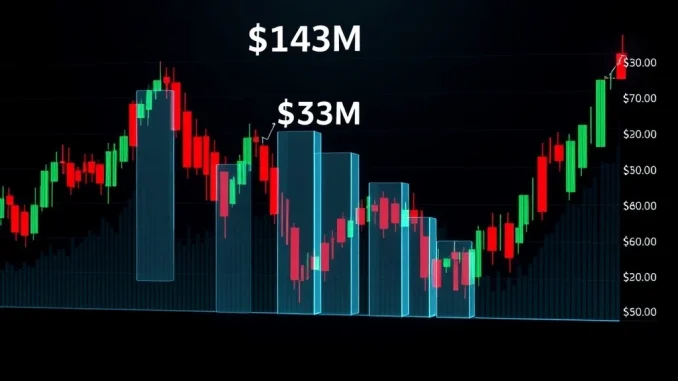
Global Cryptocurrency Markets, May 2025: The SUI blockchain’s native token finds itself at a critical technical and financial juncture. Data from major derivatives exchanges reveals a precarious buildup of over $143 million in short positions positioned just above the current trading range. This concentration of leveraged bets against the token’s price creates a volatile scenario familiar to seasoned crypto traders, where a modest price increase could trigger a cascade of forced buying. The resulting dynamic places significant upside pressure on SUI, presenting a complex risk-reward landscape that demands a clear understanding of market mechanics.
Understanding the $143M SUI Short Liquidation Stack
In cryptocurrency derivatives trading, a “short” position is a bet that an asset’s price will decrease. Traders borrow an asset to sell it, hoping to buy it back later at a lower price to return the loan and pocket the difference. These positions are often taken with leverage, meaning traders use borrowed capital to amplify their potential gains—and losses. A “liquidation” occurs when the price moves against a leveraged position so severely that the trader’s initial collateral is exhausted, prompting the exchange to automatically close the position to prevent further loss.
The current situation with SUI is defined by a high density of these leveraged short positions clustered within a specific price band above the current level. Analysis from platforms like Binance, Bybit, and OKX shows a significant wall of liquidations, with a notable $16 million cluster noted near the $1.25 mark. When the market price approaches these levels, it creates a self-reinforcing feedback loop. As the price rises and begins to liquidate the first batch of shorts, the exchanges’ automated systems are forced to buy SUI tokens in the open market to close those positions. This buying activity can push the price higher, potentially liquidating the next batch of shorts, leading to a rapid, explosive upward move known as a “short squeeze.”
Technical Structure and Market Sentiment for SUI
This liquidation overhang is not occurring in a vacuum. Technically, SUI has been consolidating around a multi-month support level, a zone where buying interest has historically emerged. This creates a foundational floor, making a sudden, deep collapse less probable in the immediate term and increasing the relative risk for those holding short positions. The market structure reveals a notable skew: while short exposure is thick and concentrated, data suggests long exposure—bets on the price rising—remains comparatively thinner and more dispersed.
This imbalance is critical. It means the market lacks a similarly large wall of long liquidations below the price that could fuel a rapid downdraft. Instead, the predominant liquidation risk sits above, acting as a potential accelerant for any bullish momentum. The following table summarizes the key pressure points identified from aggregated exchange data:
| Price Zone (Approx. USD) | Estimated Short Liquidation Value | Potential Market Impact |
|---|---|---|
| $1.20 – $1.30 | ~$40 Million | Initial trigger zone; could fuel momentum |
| $1.30 – $1.45 | ~$65 Million | Major acceleration zone; high volatility likely |
| $1.45+ | ~$38 Million | Continuation zone; would indicate a strong bullish breakout |
This setup does not guarantee a price increase, but it fundamentally alters the risk profile. It increases the asymmetric risk for short sellers, as a small upward move has a higher probability of causing a disproportionate, volatile reaction compared to a similar downward move.
The Mechanics of a Leverage-Induced Volatility Expansion
To understand what happens next, one must consider the engine of modern crypto markets: leverage. High leverage allows for large positions with relatively little capital. When many traders collectively lean in one direction with high leverage—as seen with the stacked SUI shorts—the market becomes structurally unstable. It is akin to storing potential energy. The catalyst to release this energy can be a positive news event related to the Sui blockchain’s ecosystem, a broader market rally, or simply a period of sustained buying pressure that exhausts immediate sell orders.
Historical precedents in crypto are abundant. Tokens like Solana (SOL), Dogecoin (DOGE), and numerous others have experienced historic short squeezes where liquidation cascades drove prices up 50%, 100%, or more within days or even hours. These events are not mere speculation; they are a direct, mechanical result of market structure. The key variable is whether underlying spot market demand—real buying from users and investors—can sustain the price after the leveraged frenzy subsides, or if the price will recede once the forced buying is complete.
Broader Context: The Sui Blockchain’s Position
The Sui blockchain itself, a Layer-1 platform designed for high-speed asset ownership and smart contracts, provides the fundamental backdrop. Market sentiment for a token is inevitably tied to the health and growth of its underlying network. Developments such as increasing Total Value Locked (TVL) in its DeFi ecosystem, growth in unique active addresses, or major partnerships can provide the fundamental spark that ignites the leveraged powder keg described by the liquidation data. Conversely, network issues or negative ecosystem news could dampen buying interest, allowing shorts to remain safe or even press their advantage.
This interplay between on-chain fundamentals and off-chain derivatives markets is a defining feature of the current crypto landscape. Traders are not just betting on a technology’s success but also on the collective behavior and positioning of other market participants. The $143 million liquidation stack is, therefore, a real-time map of one side of that collective bet.
Conclusion: Navigating a High-Pressure Zone
The concentration of $143 million in SUI short liquidations above the current price creates a pronounced asymmetry in near-term market risk. The technical structure at multi-month support provides a base, while the mechanics of leveraged derivatives pose a clear and present danger to those betting on decline. While this setup favors potential bullish triggers and warns of possible volatility expansion, it is not a prediction of a guaranteed outcome. Market participants should prioritize risk management, understanding that such environments can produce rapid moves in either direction, though the liquidation data suggests the path of least resistance for a volatility spike may be upward. The coming days will reveal whether underlying demand can engage with this technical setup, making SUI a token to watch closely for its demonstration of pure market mechanics in action.
FAQs
Q1: What does “$143M in short liquidations” mean for SUI?
It means there are leveraged bets against SUI’s price worth $143 million that will be automatically closed by exchanges if the price rises to specific levels. This forced closing requires buying SUI, which can push the price higher in a feedback loop.
Q2: Does a high short liquidation level guarantee the price will go up?
No, it does not guarantee an increase. It indicates where forced buying will occur if the price *does* rise, making upward moves more volatile and punishing for short sellers. The price still needs a catalyst to start moving upward.
Q3: What is a “short squeeze”?
A short squeeze is a rapid price increase caused primarily by short sellers being forced to buy back the asset to close their losing positions. This buying pressure feeds on itself, squeezing out more shorts and accelerating the rally.
Q4: How does leverage amplify this situation?
Leverage allows traders to control large positions with little capital. When prices move against them, their collateral is quickly depleted, triggering automatic liquidations. High leverage across many traders turns a normal price move into a volatile cascade of forced trades.
Q5: Where does this liquidation data come from, and is it reliable?
The data is aggregated from public information provided by major cryptocurrency derivatives exchanges like Binance, Bybit, and OKX. These platforms publicly display estimated liquidation levels across price points, which analytics firms compile. While precise to the dollar, the aggregated figures are considered a highly reliable indicator of market pressure zones.