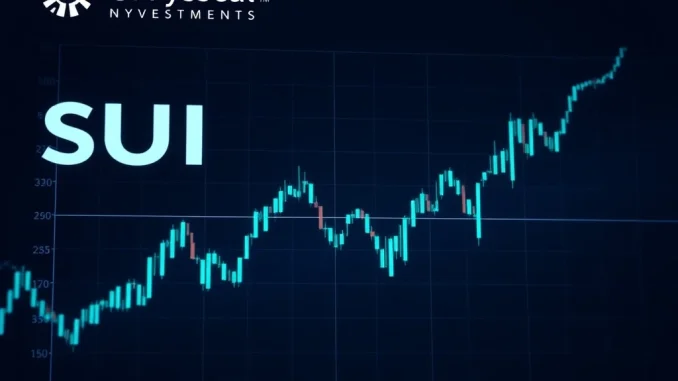
New York, April 2025: The SUI cryptocurrency faces a pivotal moment as its price consolidates near the crucial $0.97 resistance level. This technical tension arrives precisely as Grayscale Investments prepares to launch its groundbreaking Sui Staking ETF under the ticker GSUI on the NYSE Arca tomorrow. Market data reveals SUI has posted steady weekly gains of approximately 10%, accompanied by a notable rise in open interest across major derivatives exchanges. Traders and institutional investors now watch closely to determine whether this ETF introduction will serve as a catalyst for breakout momentum or trigger a classic “sell the news” reaction in volatile cryptocurrency markets.
SUI Price Technical Analysis and Market Context
The SUI token currently trades within a narrow band just below the psychologically significant $1.00 threshold. Technical analysts identify several converging factors at this juncture. The $0.97 level represents not only a recent high but also aligns with Fibonacci retracement levels from the token’s previous market cycle. Trading volume has increased by approximately 35% over the past five sessions, suggesting heightened institutional and retail interest ahead of the ETF debut. Open interest in SUI futures contracts across platforms like Binance and Bybit has surged to levels not seen since January, indicating substantial new capital positioning for potential volatility.
Historical cryptocurrency market behavior around major product launches provides important context. Previous ETF introductions for Bitcoin and Ethereum created both immediate price spikes and subsequent corrections as markets digested the new investment vehicle’s impact. The SUI ecosystem itself has demonstrated resilience through recent market fluctuations, with its total value locked (TVL) in decentralized applications growing steadily despite broader sector headwinds. This fundamental strength provides a foundation different from many purely speculative assets approaching similar product milestones.
Grayscale’s GSUI ETF Structure and Market Implications
Grayscale’s GSUI ETF represents a significant innovation in digital asset investment products. Unlike traditional cryptocurrency ETFs that simply hold the underlying asset, this fund incorporates staking mechanics inherent to the Sui blockchain. The ETF will stake a portion of its SUI holdings to generate yield, which may then be distributed to shareholders or reinvested. This structure addresses a longstanding challenge in cryptocurrency investment: providing exposure to proof-of-stake assets while capturing their native yield generation potential within regulated frameworks.
The regulatory pathway for this product involved extensive engagement with the Securities and Exchange Commission (SEC). Grayscale’s successful conversion of its Bitcoin Trust (GBTC) to an ETF in early 2024 established important precedents for product structure and regulatory compliance. The GSUI filing specifically addresses custody solutions, valuation methodologies for staking rewards, and shareholder disclosure requirements. Industry observers note this product could establish a template for future proof-of-stake cryptocurrency ETFs, potentially opening avenues for similar products featuring assets like Solana, Cardano, or Polkadot.
- Product Name: Grayscale Sui Staking ETF
- Ticker: GSUI
- Exchange: NYSE Arca
- Launch Date: April 2025
- Key Feature: Incorporates staking yield generation
- Custodian: Coinbase Custody Trust Company
The Evolving Landscape of Cryptocurrency Investment Products
The introduction of GSUI occurs within a rapidly maturing cryptocurrency investment ecosystem. Since the SEC approved spot Bitcoin ETFs in January 2024, approximately $55 billion has flowed into these products, demonstrating substantial institutional demand for regulated digital asset exposure. Ethereum ETFs followed in late 2024, though with more modest initial inflows. Grayscale’s decision to pursue a SUI-specific ETF rather than a broader “smart contract platform” product reflects both the Sui blockchain’s distinctive technical architecture and growing recognition of layer-1 blockchain differentiation among institutional investors.
Sui’s technical foundation, developed by former Meta engineers, emphasizes parallel transaction processing and object-centric programming. These features have attracted developer interest, with the network hosting over 200 decentralized applications spanning decentralized finance, gaming, and social platforms. The blockchain’s total value locked has grown approximately 400% year-over-year, though from a relatively small base compared to established networks like Ethereum. This growth trajectory likely influenced Grayscale’s product development decisions, as emerging but technically distinctive blockchains may offer different risk-return profiles than more mature networks.
Market Reactions and Trader Positioning
Options market data reveals sophisticated positioning around the ETF launch. The put-call ratio for SUI options has declined steadily over the past week, indicating reduced hedging activity or increased bullish sentiment. However, maximum pain price analysis—which identifies the strike price that would cause the greatest financial loss to options holders—suggests concentrated positions around the $0.90 level, slightly below current trading. This positioning creates potential for volatility in either direction as the product begins trading.
On-chain metrics provide additional context for retail and institutional behavior. Exchange net flows have turned negative over the past seven days, with more SUI leaving exchanges than entering them. This pattern typically suggests accumulation rather than distribution, as investors move tokens to private wallets or staking contracts rather than preparing for immediate sale. The percentage of SUI supply currently staked has increased from 52% to 58% over the past month, indicating growing network participation that may reduce immediately available selling pressure regardless of ETF-driven price movements.
| Metric | Current Value | 7-Day Change | 30-Day Change |
|---|---|---|---|
| Price | $0.97 | +10.2% | +18.7% |
| 24-Hour Volume | $412M | +35.4% | +22.1% |
| Open Interest (Futures) | $186M | +42.8% | +65.3% |
| Exchange Net Flow | -4.2M SUI | Negative | Negative |
| Staked Percentage | 58% | +2.1% | +6.4% |
Historical Precedents and Potential Outcomes
Financial markets often exhibit patterned behavior around similar events. The launch of Grayscale’s Bitcoin Trust conversion to an ETF in January 2024 provides the most relevant comparison. Bitcoin experienced approximately 15% appreciation in the week preceding that launch, followed by a 20% correction over the subsequent month as profit-taking emerged. However, six months later, Bitcoin established new all-time highs, suggesting that while short-term volatility followed the event, the structural change of ETF accessibility provided lasting bullish fundamentals.
The SUI situation differs in several important respects. First, SUI represents a smaller market capitalization asset with different liquidity dynamics. Second, the incorporation of staking mechanics creates additional yield considerations absent from Bitcoin products. Third, the cryptocurrency market structure has evolved significantly since early 2024, with increased institutional participation potentially dampening extreme volatility. These differences suggest that while historical patterns offer guidance, they cannot precisely predict GSUI’s impact on SUI price dynamics.
Regulatory Considerations and Future Developments
The SEC’s approval of GSUI followed months of review and represents a notable development in regulatory approach to proof-of-stake cryptocurrencies. Previous SEC guidance had expressed concerns about whether staking arrangements might constitute investment contracts subject to securities regulations. Grayscale’s product structure apparently addressed these concerns through specific mechanisms for staking reward distribution and disclosure. This resolution may establish important guidance for other proof-of-stake blockchain projects seeking regulated investment product exposure.
Looking forward, the success or challenges facing GSUI will likely influence regulatory consideration of similar products. SEC Commissioner Hester Peirce, often called “Crypto Mom” for her supportive stance on digital asset innovation, has previously advocated for a more structured approach to cryptocurrency investment products. The GSUI launch represents a practical test case for her proposed frameworks. Industry observers will monitor trading volumes, investor participation, and operational efficiency as indicators of whether this product category can achieve sustainable growth.
Conclusion
The SUI price approaches a definitive technical test as Grayscale’s innovative GSUI ETF prepares for its NYSE Arca debut. Current trading near the $0.97 resistance level, combined with rising open interest and steady weekly gains, creates conditions for significant price movement. The ETF itself represents a structural advancement for cryptocurrency investment products, incorporating staking yield generation within a regulated framework. While historical precedents suggest potential for both immediate volatility and longer-term accessibility benefits, SUI’s distinctive fundamentals and the product’s novel features may produce unique market dynamics. The coming sessions will reveal whether this milestone catalyzes SUI price breakout or triggers profit-taking consolidation, providing important data points for the evolving relationship between cryptocurrency networks and traditional financial markets.
FAQs
Q1: What is the GSUI ETF and how does it differ from other cryptocurrency ETFs?
The GSUI ETF is Grayscale’s Sui Staking Exchange-Traded Fund. Unlike standard cryptocurrency ETFs that simply hold the underlying asset, GSUI incorporates staking mechanics to generate yield from the proof-of-stake SUI tokens it holds, potentially distributing this yield to shareholders.
Q2: Why is the $0.97 price level significant for SUI?
The $0.97 level represents a key technical resistance point where previous price advances have stalled. It also approaches the psychologically important $1.00 threshold. Breaking through this resistance could signal stronger bullish momentum, while rejection might indicate continued range-bound trading.
Q3: How might the ETF launch affect ordinary SUI token holders?
Ordinary SUI holders may experience increased price volatility around the launch. Longer-term, successful ETF adoption could increase institutional demand and liquidity for SUI. The ETF does not directly impact token functionality or staking rewards for holders outside the fund.
Q4: What are the risks associated with the GSUI ETF launch?
Primary risks include regulatory challenges, potential underperformance versus holding SUI directly due to management fees, tracking error between the ETF price and underlying SUI value, and the possibility of “sell the news” price declines following initial enthusiasm.
Q5: How does SUI’s staking mechanism work within the ETF structure?
The ETF custodian will stake a portion of the fund’s SUI holdings through validated network nodes. Generated staking rewards may be reinvested to grow the fund’s asset base or distributed to shareholders as dividends, though specific distribution policies will be detailed in the fund’s prospectus.