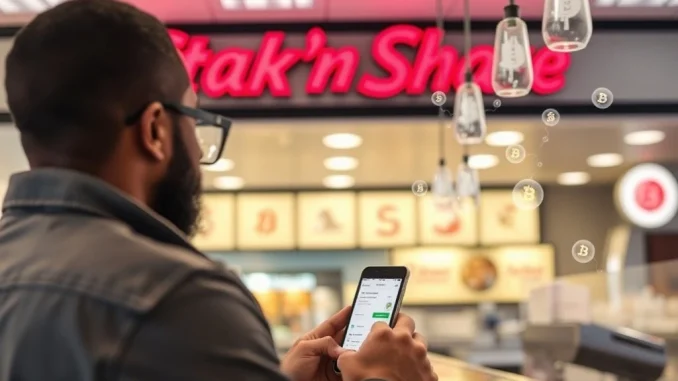
In a bold move reshaping traditional business models, Steak ‘n Shake has demonstrated how Bitcoin integration can drive tangible financial improvements. The fast-food chain’s 2025 global rollout of Bitcoin payments via the Lightning Network has yielded measurable benefits including significant sales growth and reduced transaction costs. This strategic adoption positions Bitcoin not merely as a payment method but as a core component of corporate treasury management and operational efficiency.
Bitcoin Payments Transform Fast-Food Economics
Steak ‘n Shake began accepting Bitcoin globally in May 2025, implementing the Lightning Network for transaction processing. Within weeks, the company documented transaction costs nearly 50% lower than traditional card payment systems. This reduction directly improved margins in an industry where profitability depends on managing operational expenses. The Lightning Network’s efficiency enabled faster settlement times while minimizing fees typically charged by payment processors.
Company executives reported that every Bitcoin payment received from customers flows directly into Steak ‘n Shake’s strategic Bitcoin reserve. This approach transforms routine customer transactions into a growing non-cash asset on the corporate balance sheet. The company’s Bitcoin holdings increased by $10 million in notional value during 2025, fueled by both customer payments and appreciation of the cryptocurrency’s market value.
Measurable Sales Growth and Competitive Advantage
Financial results from 2025 reveal substantial performance improvements following Bitcoin integration. Same-store sales increased 11% quarter-over-quarter in Q2 2025, accelerating to 15% growth in Q3 2025. These figures exceeded performance metrics from major competitors including McDonald’s, Domino’s, and Taco Bell during the same period. The sales surge coincided with the global Bitcoin payment rollout, suggesting correlation between cryptocurrency adoption and customer engagement.
Management attributes several operational benefits directly to Bitcoin strategy implementation:
- Reduced payment processing fees through Lightning Network efficiency
- Faster transaction settlement improving customer throughput
- Increased customer traffic from cryptocurrency users
- Enhanced same-store sales performance across locations
- Expansion of non-cash treasury reserves as a financial buffer
Strategic Context and Industry Implications
Steak ‘n Shake’s Bitcoin adoption occurs against a backdrop of industry challenges and corporate restructuring. The chain’s U.S. footprint peaked at 628 locations in 2018 but declined to 394 by 2026 following 230 store closures between 2018 and 2025. Current operations span hundreds of locations across the United States, France, Italy, Portugal, and Monaco. Bitcoin integration represents a strategic pivot toward technological innovation and financial resilience.
The company announced expansion plans into El Salvador later in 2025, targeting a market with established Bitcoin infrastructure and supportive regulatory frameworks. This international growth strategy leverages cryptocurrency adoption as both operational tool and market differentiator. Social media activity amplified the initiative’s visibility, with Bitcoin users widely sharing payment receipts from Steak ‘n Shake locations worldwide.
Bitcoin as Corporate Treasury Asset
Beyond payment processing, Steak ‘n Shake positions Bitcoin as a long-term treasury asset. This approach reflects growing corporate interest in cryptocurrency as an alternative reserve holding. Bitcoin investor and accountant Rajat Soni argues the strategy illustrates how cryptocurrency can function as a financial buffer for businesses. He maintains that Bitcoin reserves can extend corporate financial runways and improve resilience during economic downturns.
The corporate Bitcoin reserve accumulates through two primary mechanisms: direct customer payments and strategic acquisitions. This dual approach creates a self-reinforcing system where customer adoption simultaneously drives transaction volume and treasury growth. The reserve’s increasing value provides additional balance sheet strength while potentially offering appreciation benefits over traditional cash holdings.
| Metric | Pre-Implementation | Post-Implementation |
|---|---|---|
| Transaction Costs | Standard card processing fees | ~50% reduction via Lightning Network |
| Same-Store Sales Growth | Industry average rates | 11-15% quarterly increases |
| Bitcoin Treasury | Minimal or nonexistent | $10M notional value increase |
| Customer Engagement | Traditional marketing channels | Social media amplification by crypto users |
Technical Implementation and Infrastructure
Steak ‘n Shake selected the Lightning Network for Bitcoin transaction processing based on several technical advantages. This second-layer solution enables faster transactions with lower fees compared to base Bitcoin blockchain settlements. The network’s association with long-time Bitcoin advocate Jack Dorsey provided additional credibility during implementation. Technical integration required point-of-sale system updates and staff training across global locations.
The Lightning Network’s scalability proved particularly valuable for fast-food environments requiring rapid transaction processing. Traditional Bitcoin transactions might experience confirmation delays during network congestion, but Lightning Network channels maintain consistent speed regardless of mainnet activity. This reliability ensures customer satisfaction while maintaining the security and decentralization benefits of Bitcoin’s underlying blockchain.
Regulatory Considerations and Compliance
Global Bitcoin payment implementation necessitated careful attention to regional regulatory frameworks. Different jurisdictions maintain varying approaches to cryptocurrency taxation, reporting, and consumer protection. Steak ‘n Shake’s expansion into multiple countries required customized compliance strategies for each market. The company’s selection of El Salvador for international growth reflects strategic alignment with Bitcoin-friendly regulations.
Corporate treasury holdings of Bitcoin introduce additional accounting and reporting considerations. Financial statements must reflect cryptocurrency assets according to applicable accounting standards, with potential implications for tax treatment and balance sheet presentation. These complexities represent implementation challenges that businesses must navigate when adopting similar strategies.
Consumer Behavior and Market Response
Bitcoin payment adoption has attracted distinct customer segments to Steak ‘n Shake locations. Cryptocurrency enthusiasts frequently choose businesses supporting Bitcoin, creating a loyal customer base with shared technological interests. Social media sharing of payment experiences generates organic marketing exposure, particularly within cryptocurrency communities. This digital word-of-mouth amplifies traditional advertising efforts.
The company reports increased customer engagement metrics following Bitcoin implementation. While specific demographic data remains proprietary, anecdotal evidence suggests younger, technologically-oriented consumers represent a significant portion of Bitcoin-paying customers. This demographic alignment supports long-term brand positioning as innovative and forward-thinking within the competitive fast-food industry.
Conclusion
Steak ‘n Shake’s Bitcoin integration demonstrates how cryptocurrency adoption can deliver measurable business benefits beyond speculative investment. The combination of reduced transaction costs, increased sales, and treasury growth creates a compelling case for Bitcoin payments in traditional industries. As businesses increasingly explore cryptocurrency applications, this case study provides valuable insights into practical implementation and financial impact. The fast-food chain’s experience suggests Bitcoin can function effectively as both payment system and corporate asset when strategically implemented with appropriate technical infrastructure.
FAQs
Q1: How does Steak ‘n Shake process Bitcoin payments?
The company uses the Lightning Network, a second-layer solution built on Bitcoin’s blockchain that enables faster transactions with significantly lower fees than traditional payment methods.
Q2: What happens to Bitcoin received from customer payments?
All Bitcoin payments flow directly into Steak ‘n Shake’s corporate treasury reserve, where they function as a non-cash asset on the company’s balance sheet alongside traditional holdings.
Q3: How have Bitcoin payments affected Steak ‘n Shake’s financial performance?
The company reported same-store sales increases of 11-15% quarterly in 2025 alongside transaction cost reductions of approximately 50%, outperforming major competitors during the same period.
Q4: Why did Steak ‘n Shake choose the Lightning Network for Bitcoin transactions?
The Lightning Network provides the speed necessary for fast-food environments while maintaining Bitcoin’s security benefits and reducing fees compared to both traditional card payments and standard Bitcoin transactions.
Q5: Is Steak ‘n Shake expanding its Bitcoin strategy internationally?
Yes, the company announced plans to expand into El Salvador in 2025, targeting a market with established Bitcoin infrastructure and supportive regulatory frameworks for cryptocurrency adoption.
Updated insights and analysis added for better clarity.
This article was produced with AI assistance and reviewed by our editorial team for accuracy and quality.