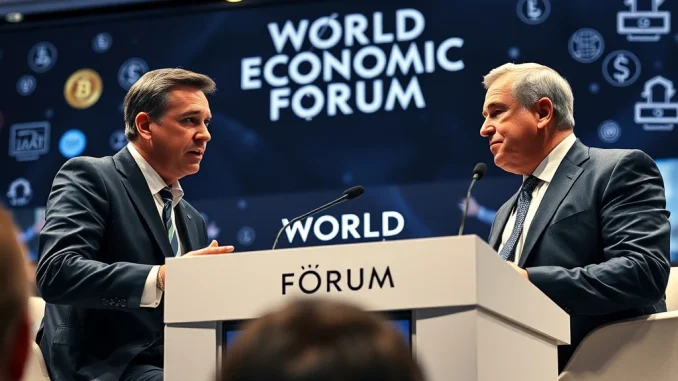
A fundamental clash over the future of money erupted at the World Economic Forum in Davos, Switzerland, this week, as Coinbase CEO Brian Armstrong and Bank of France Governor François Villeroy de Galhau presented starkly opposing visions on whether stablecoins should pay interest to users. This debate, reported by CoinDesk, cuts to the core of a global regulatory dilemma: fostering financial innovation while safeguarding traditional monetary systems. The discussion highlights a growing schism between cryptocurrency advocates and established financial authorities worldwide.
The Core Argument Over Stablecoin Interest Payments
Brian Armstrong, leading one of the world’s largest cryptocurrency exchanges, presented a forceful case for innovation. He argued that users possess a fundamental right to earn a return on their digital assets. Armstrong stressed that permitting interest-bearing stablecoins is crucial for national economic competitiveness. He pointed to China’s digital yuan, a central bank digital currency (CBDC) that already allows for programmable features like interest, as a key example. The Coinbase CEO warned that a U.S. prohibition on such payments would simply cede ground and advantage to global competitors in the fast-evolving digital finance arena.
Conversely, Governor François Villeroy de Galhau articulated a classic central banking perspective focused squarely on systemic risk. He contended that private digital tokens offering interest could destabilize the traditional banking model. Banks rely on deposits to fund lending; a mass migration of funds to high-yield stablecoins could impair this critical function. Villeroy de Galhau stated his belief that the upcoming digital euro should not pay interest, emphasizing that the paramount public policy objective must remain the preservation of financial stability above all else.
Broader Implications for Monetary Sovereignty and Regulation
This disagreement extends far beyond a simple technical feature. The Davos panel revealed a deeper philosophical divide on the nature of money itself. Armstrong framed Bitcoin and certain stablecoins as more independent monetary systems because they lack a single controlling issuer. He suggested this decentralization offers a form of resilience and user autonomy not found in traditional, state-controlled currencies.
Governor Villeroy de Galhau countered with a stark warning about political threat. He expressed concern that widespread adoption of unregulated private currencies, including some stablecoins, could lead to a significant erosion of national monetary sovereignty. This scenario would challenge a central bank’s ability to implement effective monetary policy, manage inflation, and act as a lender of last resort during crises.
Global Regulatory Landscape and the Race for CBDCs
The Davos debate occurs against a backdrop of intense global activity in digital currency. Nations are exploring CBDCs with varying approaches to features like interest.
- China’s Digital Yuan: As Armstrong noted, China’s pilot has tested limited interest-bearing functionality, viewing it as a tool for precise economic stimulus.
- European Digital Euro: The European Central Bank’s investigation phase has explicitly downplayed an interest-bearing model, aligning with Villeroy de Galhau’s stance to avoid competition with bank deposits.
- U.S. Digital Dollar Exploration: The Federal Reserve’s research remains in early stages, with officials repeatedly emphasizing that any U.S. CBDC would require clear support from the executive branch and Congress.
This regulatory patchwork creates uncertainty for global fintech firms and highlights the lack of international consensus. The table below summarizes the key positions from the Davos debate:
| Stakeholder | Position on Stablecoin Interest | Primary Concern | View on Bitcoin/Private Money |
|---|---|---|---|
| Brian Armstrong (Coinbase) | Supportive. A right for users and a competitive necessity. | Losing technological and financial leadership to other nations. | Sees value in decentralized, issuer-independent assets. |
| François Villeroy de Galhau (Bank of France) | Opposed for private stablecoins and the digital euro. | Risk to bank stability and loss of monetary policy control. | Views unregulated private currencies as a political threat to sovereignty. |
Expert Analysis on the Financial Stability Debate
Economists and policy analysts are closely monitoring this tension. Dr. Sarah Bloom, a former financial regulator and current fellow at the Brookings Institution, explains the technical risk. “The concern isn’t merely competition,” she notes. “It’s about the potential for a ‘digital bank run.’ If a large, interest-bearing stablecoin faced a loss of confidence, rapid redemptions could trigger fire sales in the reserve assets backing it, potentially spilling over into traditional markets.” This systemic risk argument forms the bedrock of many central bankers’ caution.
However, innovation advocates like Professor David Lee from the Stanford Digital Currency Initiative counter that well-designed regulation can mitigate these risks. “The goal should be to create a regulatory framework for stablecoins that includes robust reserve requirements, transparency mandates, and clear oversight,” he argues. “A blanket ban on interest payments stifles innovation that could benefit consumers through better yields and more inclusive financial services.” This perspective champions a path of managed integration rather than outright prohibition.
Conclusion
The fiery Davos debate between Coinbase CEO Brian Armstrong and Bank of France Governor François Villeroy de Galhau perfectly encapsulates the central conflict shaping the future of finance. The question of stablecoin interest payments is not merely a technical detail but a proxy for a larger struggle between disruptive technological potential and the imperative of financial stability. As nations race to develop their digital currency strategies, finding a balance between these competing priorities will define the next era of global money. The outcome will determine whether digital assets operate at the fringes or become a integrated, regulated part of the mainstream financial ecosystem.
FAQs
Q1: What are stablecoins?
Stablecoins are a type of cryptocurrency designed to maintain a stable value, typically by being pegged to a reserve asset like the U.S. dollar or a basket of currencies.
Q2: Why do central banks worry about stablecoins paying interest?
Central banks fear that if stablecoins offer high interest, they could attract massive deposits away from traditional banks. This could reduce banks’ ability to lend to businesses and consumers, potentially destabilizing the core of the existing financial system.
Q3: What is a Central Bank Digital Currency (CBDC)?
A CBDC is a digital form of a country’s fiat currency, issued and regulated directly by its central bank. It is a legal tender, unlike cryptocurrencies or stablecoins issued by private companies.
Q4: Does China’s digital yuan pay interest?
In its pilot phases, China’s digital yuan (e-CNY) has experimented with limited, programmable features that can include time-limited interest payments, used as a tool for targeted stimulus by the authorities.
Q5: What was the main point of disagreement about Bitcoin?
Armstrong highlighted Bitcoin’s decentralized nature as a strength, free from control by any single entity. Villeroy de Galhau viewed such decentralized private currencies as a potential threat to the state’s ability to control its own monetary system and ensure financial stability.
Updated insights and analysis added for better clarity.
This article was produced with AI assistance and reviewed by our editorial team for accuracy and quality.