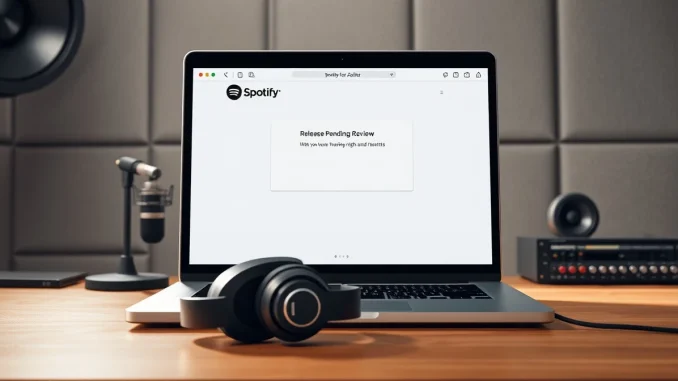
In a significant move to address a growing industry crisis, Spotify has begun beta testing a new ‘Artist Profile Protection’ feature designed to prevent AI-generated music from being incorrectly attributed to legitimate artists on its platform. This initiative, announced on June 9, 2025, responds directly to the escalating problem of ‘AI slop’—low-quality, algorithmically produced tracks—flooding streaming services and cluttering artist profiles. The tool grants artists unprecedented control, allowing them to review and approve any release before it appears under their name, thereby safeguarding their catalog, statistics, and fan recommendations.
Spotify’s Artist Profile Protection Addresses Streaming’s Identity Crisis
The core function of Spotify’s new tool is straightforward yet powerful. Artists enrolled in the beta program receive an email notification whenever a distributor delivers music to Spotify tagged with their artist name. Subsequently, they can log into their ‘Spotify for Artists’ dashboard on desktop or mobile web to review the release. They then hold the authority to approve or decline it. Only approved releases will populate their official artist profile, contribute to their streaming statistics, or influence algorithmic playlists like Release Radar. This process directly tackles a problem Spotify identified as worsening with the rise of accessible AI music generation tools. The company stated that incorrect attributions damage the artist experience, fan discovery, and data integrity.
Historically, metadata errors, name conflicts, and malicious uploads have caused songs to land on the wrong artist pages. However, the volume and ease of generating AI music have exponentially increased these incidents. For instance, just one week before Spotify’s announcement, Sony Music publicly disclosed it had requested the takedown of over 135,000 AI-generated songs that impersonated its roster of artists across various streaming platforms. This figure starkly illustrates the scale of the challenge facing the industry. Spotify’s solution, therefore, shifts the gatekeeping responsibility partially to the artists themselves, creating a more direct line of defense against misattribution.
The Technical and Industry Backdrop
The development of this tool sits at the intersection of two major trends in digital music: the democratization of distribution and the proliferation of generative AI. Open distribution platforms have empowered independent artists to bypass traditional label gatekeepers, but this open system also introduces vulnerabilities. Bad actors can exploit loose metadata verification to attach content to popular artists’ profiles, aiming to siphon streams and revenue. AI generation tools lower the barrier to creating this content en masse. Spotify’s blog post explicitly acknowledged this tension, noting that while open distribution benefits creators, it also “creates opportunities for mistakes and bad actors.” The new feature is opt-in and targeted specifically at artists who have faced repeated incorrect releases, who share a common name, or who simply desire greater control, indicating a tailored rather than blanket approach.
Comparing Platform Responses to AI-Generated Content
Spotify’s proactive measure joins a series of industry actions aimed at regulating AI’s impact on creative fields. Other streaming services and music companies are grappling with similar issues, though their public responses have varied. The following table outlines key recent actions:
| Entity | Action / Policy | Date Announced | Primary Focus |
|---|---|---|---|
| Spotify | Artist Profile Protection Beta | June 2025 | Artist-led review to prevent misattribution |
| Sony Music Group | Mass takedown requests (135k+ songs) | June 2025 | Legal enforcement against impersonation |
| Universal Music Group | Partnerships with AI developers for ethical frameworks | 2024-2025 | Licensing and ethical AI training data |
| Several DSPs | Enhanced metadata verification at upload | Ongoing | Preventative filtering at the point of ingestion |
This comparative view shows a multi-pronged industry response, combining technological tools, legal pressure, and partnership models. Spotify’s artist-centric tool represents a shift towards providing creators with direct platform-level controls, rather than relying solely on post-hoc legal takedowns or pre-upload filters that may not be perfectly accurate.
Implications for Artists, Fans, and Catalog Integrity
The rollout of Artist Profile Protection carries several immediate and long-term implications. For artists, the most direct benefit is the restoration of agency over their digital identity. An artist’s Spotify profile serves as their primary digital storefront and historical archive. Incorrectly attributed AI tracks can:
- Dilute their catalog, confusing fans seeking their authentic work.
- Skew streaming analytics, making it difficult to gauge true fan engagement and plan tours or releases.
- Impact royalty payments, though minimally, by diverting algorithmic playlist placement.
- Damage brand reputation if low-quality content is associated with their name.
For fans, the tool promises a cleaner, more trustworthy discovery experience. Listeners relying on Release Radar or browsing an artist’s page can have higher confidence they are engaging with verified content. This maintains the integrity of the listener-artist relationship, which is fundamental to streaming ecosystems. Furthermore, from a platform perspective, accurate data is crucial for refining recommendation algorithms. Contaminated artist profiles generate noisy data, potentially reducing the effectiveness of personalized music discovery for all users.
Broader Context: The Fight Against “AI Slop”
The term “AI slop” has entered the lexicon to describe the vast quantities of low-effort, often misleading content generated by AI to capitalize on trends or impersonate creators. This phenomenon extends beyond music into articles, images, and videos, polluting digital platforms. Spotify’s tool is a specific countermeasure within this larger battle. It does not ban AI-generated music outright—a complex issue involving legitimate artistic uses of AI—but instead focuses on the critical issue of consent and accurate attribution. This nuanced approach acknowledges that AI is a tool, and the problem lies in its misuse for impersonation and spam, not necessarily in its use for creation.
Conclusion
Spotify’s beta test of Artist Profile Protection marks a pivotal step in the music streaming industry’s adaptation to the age of generative AI. By placing review and approval power directly into artists’ hands, the tool addresses a fundamental flaw exposed by easily producible AI tracks: the vulnerability of digital identity on open platforms. While not a silver bullet for all challenges posed by AI in music, this feature represents a practical, artist-empowering solution to the acute problem of misattribution. Its development signals a maturation in platform responsibility, prioritizing catalog integrity and trust for both creators and listeners as the technological landscape continues to evolve rapidly.
FAQs
Q1: What exactly does Spotify’s Artist Profile Protection tool do?
The tool allows artists in the beta program to review and approve or decline any new release delivered to Spotify with their name attached before it goes live on their official profile. It prevents unauthorized or incorrectly attributed music, including AI-generated tracks, from appearing under an artist’s name.
Q2: Is this tool a response to AI-generated music only?
While the rise of AI music has intensified the problem, the tool addresses all forms of misattribution, including those caused by metadata errors, artists with the same name, and malicious uploads. AI-generated content is a significant and growing part of this issue.
Q3: Can any Spotify artist use this feature now?
No. As of March 2026, the feature is in a limited beta test. Spotify has indicated it is initially designed for artists who have experienced repeated incorrect releases, have a common name, or want more control. A broader rollout timeline has not been announced.
Q4: Does this mean Spotify is banning AI-generated music?
No. The tool does not block AI music creation or upload. It focuses specifically on the attribution of that music. Tracks must be correctly labeled and attributed with the consent of the artist whose name is used. The tool gives that artist a mechanism to enforce that consent.
Q5: How does this differ from Sony Music’s approach of issuing takedown notices?
Sony’s approach is reactive and legal, removing infringing content after it is already live. Spotify’s tool is proactive and technical, aiming to prevent misattributed content from being published in the first place by involving the artist directly in the process.
Updated insights and analysis added for better clarity.
This article was produced with AI assistance and reviewed by our editorial team for accuracy and quality.