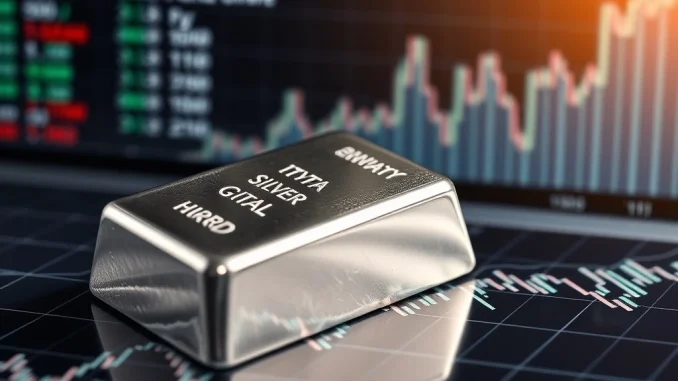
In a landmark moment for commodity markets, spot silver achieved a historic breakthrough on Thursday, April 10, 2025, shattering previous records by briefly trading above the $90 per ounce threshold for the first time in history. The white metal, a cornerstone of both industrial and investment portfolios, surged to an intraday peak of $90.08 before settling at $89.56, marking a powerful 5.16% single-day gain. This unprecedented price level represents the culmination of a complex convergence of macroeconomic forces, supply constraints, and robust investor demand that has redefined the precious metals landscape.
Spot Silver’s Historic Ascent to $90
The journey to $90 for spot silver is not an isolated event but rather the peak of a sustained bullish trend. Analysts point to a multi-faceted catalyst list driving this surge. Primarily, persistent global inflationary pressures continue to erode fiat currency values, enhancing silver’s traditional role as a tangible store of wealth. Concurrently, central bank policies, particularly those signaling potential pauses in aggressive rate hike cycles, have weakened the US dollar, providing a tailwind for dollar-denominated commodities like silver. Furthermore, geopolitical tensions in key resource regions have exacerbated concerns over supply chain stability for industrial metals, of which silver is a critical component.
The price action itself demonstrates remarkable momentum. The move above $90 decisively broke the previous all-time high of $85.50 set in 2024. Market depth data from major exchanges like the COMEX showed unusually high volume during the ascent, indicating strong institutional participation. Key technical indicators, such as the Relative Strength Index (RSI), entered overbought territory, yet buying pressure remained undiminished, a sign many traders interpret as a fundamentally-driven move rather than speculative froth.
Industrial Demand and Market Fundamentals
Beyond its monetary allure, silver’s intrinsic industrial value provides a solid foundation for its price. The metal is indispensable for the global energy transition. Photovoltaic (PV) cells for solar panels consume millions of ounces annually, a demand stream projected to grow by over 8% per year through 2030. Similarly, the proliferation of electric vehicles (EVs), which use silver in every electrical connection, and 5G infrastructure deployment create sustained, structural demand.
Critically, mine supply has struggled to keep pace. Major producing countries like Mexico, Peru, and China have faced operational challenges, from labor disputes to declining ore grades. The following table illustrates the growing supply-demand imbalance over the past three years, a primary factor cited by analysts at institutions like the Silver Institute.
| Year | Global Mine Supply (Moz) | Total Physical Demand (Moz) | Market Deficit (Moz) |
|---|---|---|---|
| 2023 | 843.2 | 1,167.5 | -324.3 |
| 2024 | 832.7 | 1,210.8 | -378.1 |
| 2025 (Est.) | 825.0 | 1,250.0+ | -425.0+ |
This persistent deficit means above-ground inventories, particularly in registered COMEX warehouses, have been drawn down consistently. Consequently, the physical market remains tight, supporting higher spot prices and putting upward pressure on futures contract spreads.
Expert Analysis on the Price Trajectory
Market strategists emphasize the psychological importance of the $90 level. “Breaking this barrier is a monumental shift in market sentiment,” notes a veteran commodity analyst from a leading Swiss bullion bank. “It confirms that silver is decoupling from being merely a follower of gold and is trading on its own robust fundamentals. The investment community is now recognizing it as a dual-purpose asset: an inflation hedge and a critical green energy play.”
Historical context is crucial. Adjusted for inflation, today’s nominal high still sits below the peak of the 1980 Hunt Brothers squeeze in real terms. However, the current rally is broadly based, driven by global ETF inflows, central bank diversification into precious metals, and retail coin and bar demand hitting multi-year highs, as reported by the U.S. Mint and other sovereign mints worldwide. The rally’s breadth across different investor classes suggests durability.
Comparative Performance and Investor Implications
Silver’s performance has notably outpaced its precious metal peer, gold, in recent months, causing the gold-to-silver ratio to contract sharply. This ratio, which measures how many ounces of silver it takes to buy one ounce of gold, fell below 70:1 during the rally, down from a multi-decade average near 80:1. A lower ratio often indicates stronger relative performance for silver and is watched closely by sector investors.
For investors, the new price paradigm presents both opportunities and considerations:
- Volatility Management: Silver historically exhibits higher volatility than gold. Portfolios should account for this risk profile.
- Physical vs. Paper: Demand for physical bars and coins has led to rising premiums over the spot price, a key differentiator for direct buyers.
- Equity Leverage: Shares of primary silver mining companies often provide leveraged exposure to the metal’s price movements.
- Macro Monitoring: Future price direction will be sensitive to shifts in central bank policy, the strength of the US dollar (DXY), and global industrial production data.
Regulatory bodies, including market watchdogs in the UK and US, have stated they are monitoring trading activity for signs of disorderly conduct but have not indicated any current concerns, attributing the move to fundamental factors.
Conclusion
The breach of the $90 level for spot silver marks a definitive new chapter in the commodity’s long history. This all-time high is underpinned by a powerful confluence of enduring inflationary fears, a weaker dollar, and, most significantly, relentless industrial demand set against constrained supply. While short-term corrections are inherent to any volatile market, the fundamental case for silver appears structurally sound. The market has sent a clear signal: silver is no longer just a precious metal but an essential industrial commodity and a modern monetary asset, finally achieving a price that reflects its critical 21st-century role. Investors and industry observers will now watch to see if this new plateau becomes a foundation for the next leg higher.
FAQs
Q1: What exactly is ‘spot silver’?
The spot price of silver refers to the current market price for immediate delivery and payment of the physical metal. It is the benchmark price set by trading on major over-the-counter (OTC) markets and commodity exchanges like the LBMA and COMEX, serving as the reference point for most silver transactions globally.
Q2: Why is industrial demand so important for silver prices?
Unlike gold, over half of annual silver demand comes from industrial applications. This creates a consistent, non-discretionary base of consumption from sectors like renewable energy, electronics, and automotive manufacturing. Strong industrial demand provides fundamental support that can drive prices independently of investment sentiment.
Q3: How does the performance of silver compare to gold during this rally?
Silver has significantly outperformed gold in percentage terms during the recent surge, leading to a decline in the gold-to-silver ratio. This phenomenon, known as ‘silver outperformance,’ often occurs in the later stages of a broad precious metals bull market, as silver’s higher volatility attracts more speculative capital.
Q4: What are the main risks to the current high price of silver?
Key risks include a sharp, sustained strengthening of the US dollar, a more aggressive return to monetary tightening by major central banks to combat inflation, a significant global economic slowdown reducing industrial demand, or a sudden, large increase in mine supply or recycling rates that alleviates the physical market deficit.
Q5: Can individual investors easily buy physical silver?
Yes, individual investors can purchase physical silver in several forms, including government-minted coins (like American Eagles or Canadian Maple Leafs), privately minted bars and rounds, and through allocated accounts with bullion dealers. It is crucial to factor in premiums over the spot price, secure storage, and authenticity verification when making physical purchases.
This article was produced with AI assistance and reviewed by our editorial team for accuracy and quality.